
SACS: Boosting CCN Performance by Exploiting the "Influencer" Effect
Socially-aware caching strategy for content centric networking
This paper introduces SACS (Socially-Aware Caching Strategy), a novel caching mechanism for Content Centric Networking (CCN) that leverages social network metrics. By identifying "Influential users" via PageRank or Eigenvector centrality, SACS pro-actively replicates their content along network paths to significantly enhance delivery performance.
TL;DR
Researchers have developed SACS (Socially-Aware Caching Strategy), a method that transforms Content Centric Networking (CCN) by making it "socially intelligent." By identifying and prioritizing content from influential users (the 20% who generate 80% of the engagement), SACS achieves a 2.5x increase in cache hits on real-world testbeds like PlanetLab, effectively reducing network latency and server load.
Background: Positioning CCN in a Social World
As the Internet shifts from a host-to-host model to a content-centric one, Content Centric Networking (CCN) has emerged as a frontrunner for the future Internet architecture. However, CCN's "default" behavior of caching every packet indiscriminately is a blunt instrument. In the age of Facebook, Twitter (now X), and LastFM, information flows are dictated by social relationships. SACS fills this gap by bridging the divide between the Social Layer and the Network Layer.
The Core Challenge: The Inefficiency of Blind Caching
Traditional caching policies like LRU (Least Recently Used) or FIFO ignore the "who" behind the "what." In a typical CCN scenario, a niche piece of content consumes the same cache resources as a viral update from a major influencer.
- Problem: Lower availability of high-demand content.
- Insight: A small number of users—the Influential users—dominate network activity and produce content with a much higher probability of consumption.
Methodology: Identifying Influence via Graph Theory
SACS isn't just a heuristic; it's grounded in graph mathematics. The authors utilize two primary centrality measures to rank users within the social graph:
- Eigenvector Centrality: Measures a node's influence based on the influence of its neighbors.
- PageRank: A variant of Eigenvector (famous for powering Google Search) that provides a robust score for user importance.
Any user with a score above the network average is flagged as "Influential." When these users publish content, SACS doesn't wait for a request. It pro-actively replicates the data along the shortest paths to that user's social circle.
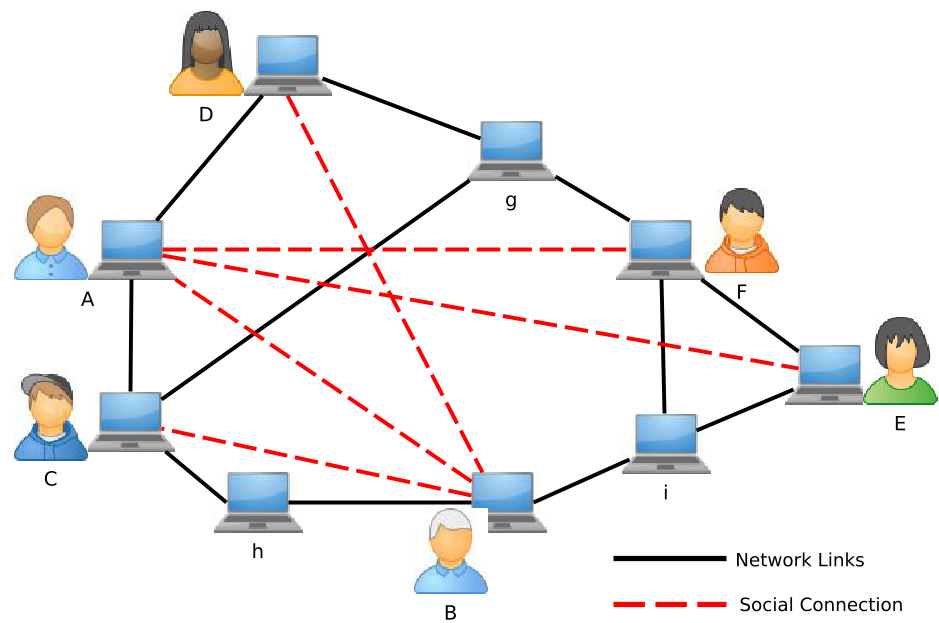 Figure 1: The interaction between the Social Model (Social Graph) and the CCN Physical Topology.
Experimental Results: From Simulations to PlanetLab
The authors didn't just stop at theory. They tested SACS against two massive datasets:
- LastFM: 1,896 users / 12,717 relationships.
- Facebook: 4,039 users / 88,234 relationships.
Performance Metrics
The results across all metrics (Cache Hit, Stretch, and Diversity) were striking.
- Cache Hit Rate: While standard CCN struggled at ~5%, SACS/PageRank soared to 30-40%.
- Stretch (Path Reduction): SACS reduced the distance Interest messages traveled by over 60%, meaning users get their data much faster.
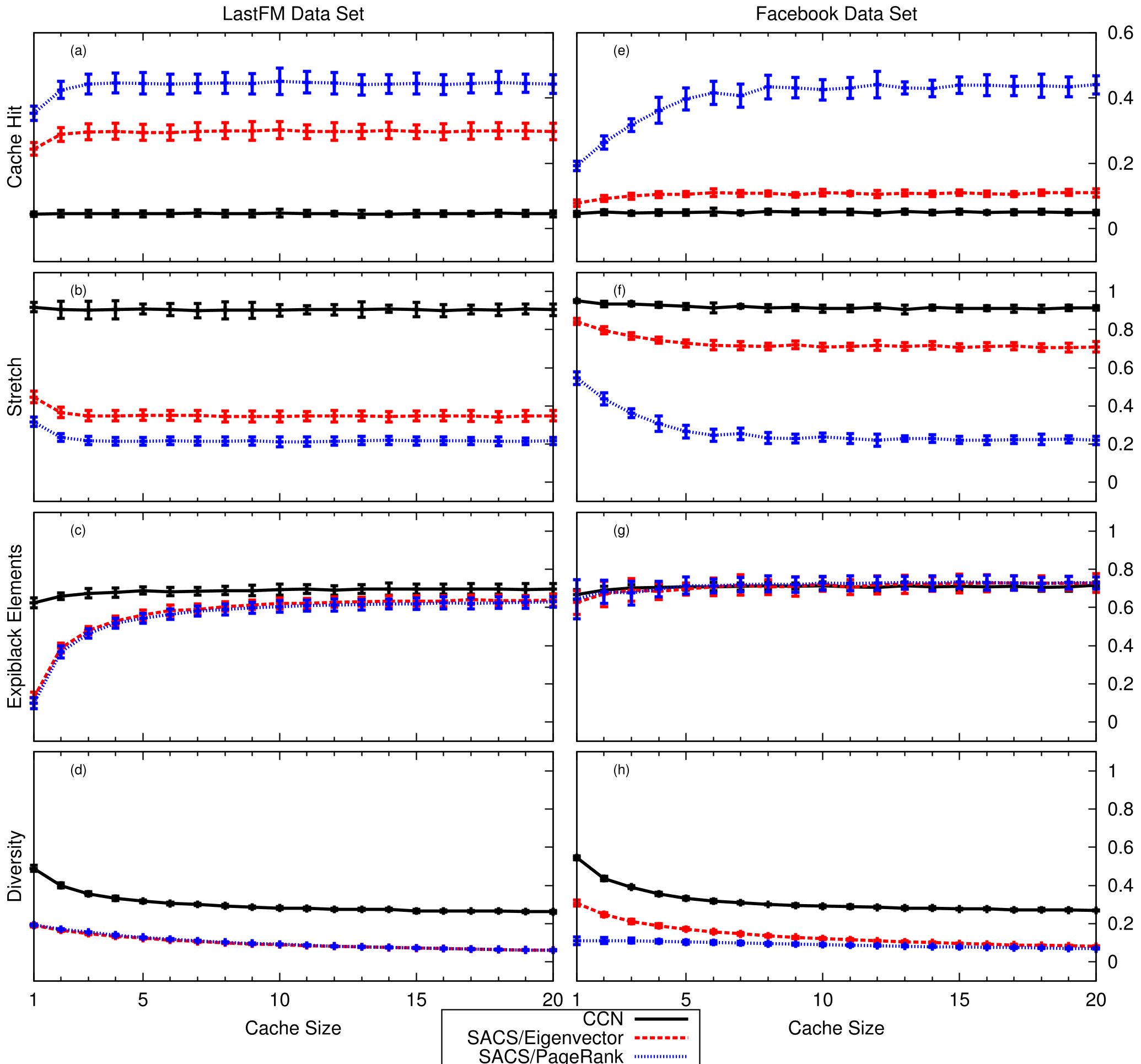 Figure 2: Performance metrics across different cache sizes. Note the massive jump in Cache Hit (top row) when SACS (blue/green lines) is applied.
Real-world Validation
Deploying SACS on PlanetLab (14 nodes globally distributed) confirmed the simulation results. Even in a noisy, real-world environment, the cache hit rate reached 50%, a 2.5x improvement over the default CCNx implementation.
Critical Insight & Future Outlook
While SACS drastically improves efficiency, it does introduce a trade-off: Diversity. Because SACS prioritizes influential content, the variety of unique items in a cache decreases (Diversity drops as cache size increases). However, since the "pruned" content was unlikely to be requested anyway, the "Expired Elements" ratio remains stable, proving that SACS isn't just caching more—it's caching smarter.
Future Work: The authors suggest that social awareness shouldn't stop at caching. Socially-Aware Routing could be the next frontier, where the network decides the best path for a packet based on the social reputation of the producer.
Conclusion
SACS proves that if we want the future Internet to be efficient, it must understand the social fabric of its users. By prioritizing the "Influentials," we can build a network that is faster, leaner, and more responsive to the way humanity actually shares information.