
Hydro-IDP: Mapping Social Media Viral Spirals through the Lens of Hydrodynamics
SPECIAL SECTION ON SOCIALLY ENABLED NETWORKING AND COMPUTING
The paper proposes Hydro-IDP, a novel information diffusion prediction model that applies hydrodynamic equations to describe the spreading of information in Online Social Networks (OSNs). By treating information as a fluid and users as coordinate points in "cyberspace space-time," the model achieves high-precision prediction of information popularity and user influence across both temporal and spatial dimensions.
TL;DR
Information in social networks doesn't just "jump"; it flows. This paper introduces Hydro-IDP, a model that treats information diffusion as a fluid dynamic process. By simulating the "energy density" of influenced users across friendship hops (space) and time, researchers have achieved over 83% accuracy in predicting how a tweet goes viral, specifically accounting for the "superposition effect" of influential followers.
Background: The Fluidity of Information
In the digital age, a single tweet can trigger a global wave. Traditional models view this through the lens of graph theory (nodes and edges) or epidemiology (infected vs. susceptible). However, these often struggle with the spatio-temporal continuity of viral events. The authors of this paper argue that information is effectively a "fluid" in cyberspace, and his movement can be described using the same conservation laws that govern water or air flow.
The Core Intuition: From Physics to Social Metrics
The genius of Hydro-IDP lies in its mapping of hydrodynamic variables to social behaviors. In physical space-time, we track energy density; in social space-time, we track the density of influenced users.
Key mappings include:
- Initial Source Energy (): The inherent popularity or "quality" of the information.
- Flow Velocity (): The intrinsic diffusivity of the social platform (e.g., how "fast" Sina-Weibo is compared to others).
- Initial Source Radius (): The initial influence scale of the publisher.
- Friendship Hops (): The spatial distance, where a direct link is a distance of 1.
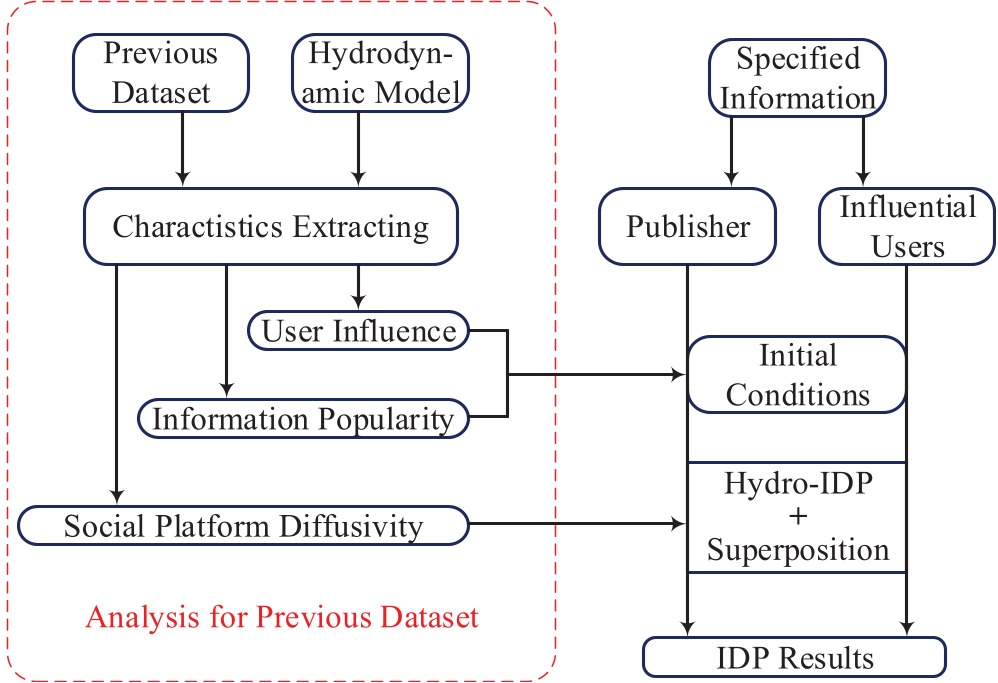
Methodology: Solving the Flow Equations
The model relies on the Energy-Momentum Tensor conservation law:
u} = 0$$ Using the **Godunov method**, the authors solve these partial differential equations (PDEs) to predict how the "fluid" of information expands outward from the source. ### The Superimposed Effect (Type II Diffusion) A critical contribution of this work is the handling of **Influential Users**. In many cases, a message doesn't just fade; it gets a "second wind" when an influencer with millions of followers reposts it. This creates a secondary source. The Hydro-IDP model uses a **superposition principle**—calculating the secondary waves and adding them to the primary flow to account for the sudden spike in engagement at greater "distances" (hops). 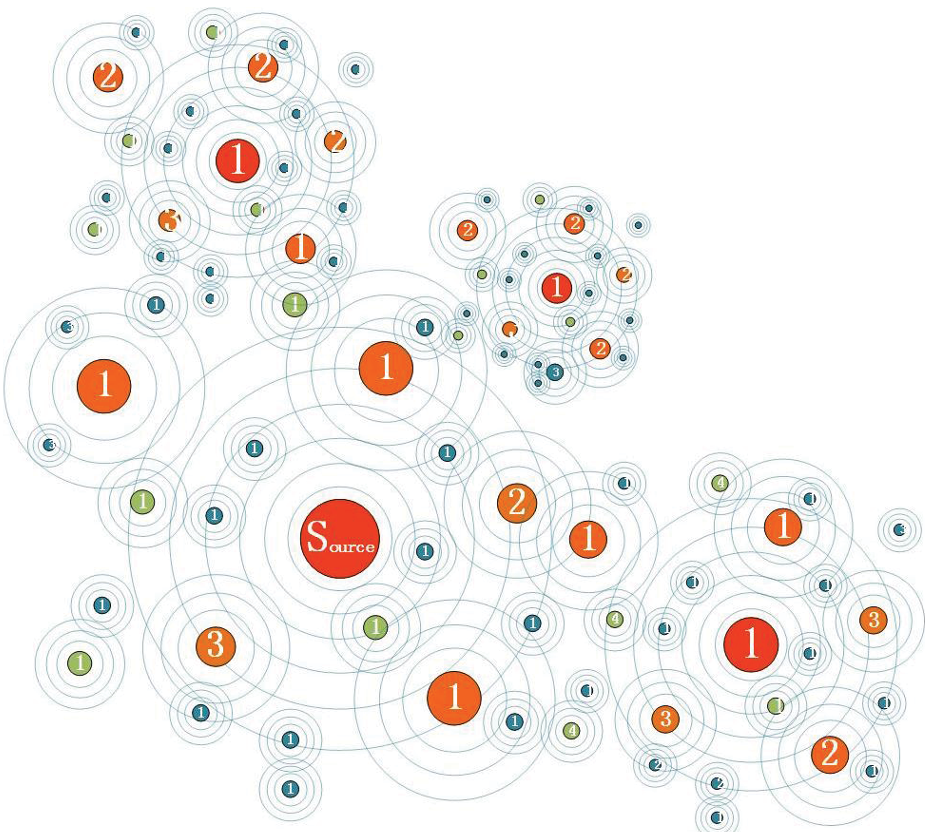 ## Experimental Validation: Real-world Weibo Data The researchers tested Hydro-IDP against a massive dataset: **6,500 video tweets** from Sina-Weibo, involving 200 million action records. ### Key Findings: 1. **Type I (Regular Diffusion):** For 87.3% of tweets, density decreases regularly with distance and time. The model captured this with **76.7% accuracy**. 2. **Type II (Influencer Driven):** For viral tweets, the density at "Hop 2" is often higher than "Hop 1" due to influential followers. By applying the superposition method, the model's accuracy jumped to **83.05%**. 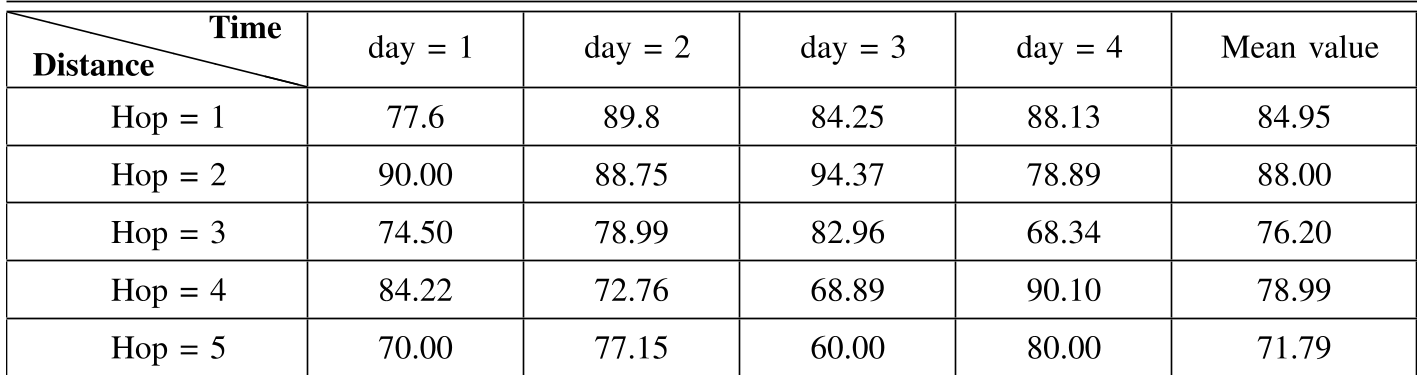 ## Critical Analysis & Conclusion The Hydro-IDP model shifts the paradigm from analyzing *who* sent *what* to *how* a social field evolves. It moves beyond static graphs into a dynamic, continuous framework. **Takeaway**: The "physics" of social networks is increasingly predictable. By quantifying "Platform Diffusivity" and "User Influence" as physical constants, brands and governments can better anticipate the reach of information. **Limitations**: Currently, the model assumes isotropic diffusion (spreading equally in all directions). In reality, social networks are often polarized or fragmented into "echo chambers," which might require a non-isotropic fluid model in future iterations. **Future Work**: The authors aim to explore **cross-platform diffusion**—how a "fluid" leaks from Twitter into Reddit or news outlets—which remains the "holy grail" of information tracking.