
SocialTrust: Hardening the Social Web Against Tampering and Collusion
SocialTrust: Tamper-Resilient Trust Establishment in Online Communities
The paper introduces SocialTrust, a tamper-resilient trust aggregation framework designed for Web 2.0 online communities. It leverages a PID-controller-inspired model and a unique "link quality" metric to counteract large-scale malicious collusion and dishonest feedback in social networks like MySpace.
TL;DR
SocialTrust is a robust trust framework that moves beyond simple "star ratings." By analyzing not just who a user is, but who they associate with (Link Quality) and how they behave over time (Temporal Dynamics), it creates a reputation system that remains effective even when half the community is actively trying to subvert it.
Background: The Vulnerability of the Social Fabric
In the era of Web 2.0, our digital lives are built on the "social web"—user-generated content, tagging, and person-to-person connections. However, this tight social fabric is a double-edged sword. Malicious actors exploit these bonds to spread malware, phishing links, and misinformation.
The authors identify a critical gap: existing reputation systems like eBay's feedback or Google's PageRank weren't built for the "high-churn, high-deception" environment of social networks. PageRank considers links, but doesn't handle malicious cliques well; eBay handles feedback, but is easily "ballot-stuffed."
The Core Insight: Three Pillars of Resilient Trust
The SocialTrust framework stands on a mathematical model inspired by Control Theory (PID controllers). It defines a user's trust value through three components:
- Quality (): A snapshot of the user's current standing.
- History (Integral): The average trust over time, preventing "whitewashing" (leaving and re-entering the network to reset a bad score).
- Adaptation (Derivative): Tracking sudden fluctuations to catch "sleepers"—users who act well to gain trust and then suddenly defect.
1. Distinguishing Relationship Quality from Trust
The most innovative part of the paper is the Core Trust Model. It argues that a recommendation from a "high-trust but low-link-quality" user (someone who is nice but associates with bad people) should count for less.
The formula for the base trust is:

Here, represents Link Quality. If you have friendships with "bad" users, your drops, and consequently, your ability to "vouch" for others (your voting power) is diminished.
2. Scoped Random Walks
To calculate Link Quality, SocialTrust uses a Scoped Random Walk. It simulates a walker starting at your profile and moving hops away. If the walker frequently ends up at "bad" users (determined by low feedback), your Link Quality is penalized. This effectively implements a "guilt by association" metric that is very difficult for malicious cliques to bypass.
Experiments: Stress-Testing with 5 Million MySpace Profiles
The researchers didn't just test this on a toy dataset. They crawled MySpace in 2006, capturing millions of relationships to simulate a real-world environment.
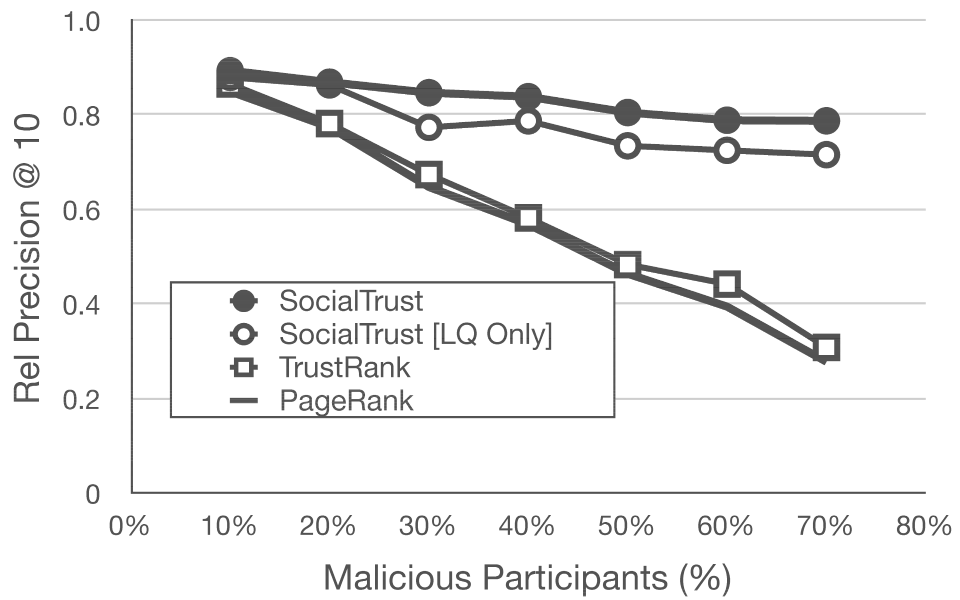
Key Findings:
- Resilience to Malice: Even when 70% of the network provided irrelevant or malicious responses, SocialTrust maintained a precision level significantly higher than PageRank or TrustRank.
- Clique Defeat: Standard algorithms often get "trapped" in malicious cliques where bad actors point to each other to boost scores. SocialTrust’s link-quality metric identifies these tight clusters of bad behavior and isolates them.
- Feedback Robustness: The study compared "Open Voting" (anyone can vote) vs. "Trust-Aware Restricted Voting." The latter, where your vote's weight depends on your own trust score, was the only one that survived large-scale dishonest feedback.
Critical Analysis & Conclusion
SocialTrust provides a blueprint for what modern trust systems should look like: Context-aware, history-dependent, and topologically suspicious.
The Takeaway: Trust is not a static score; it is a trajectory. By incorporating the PID controller logic, SocialTrust successfully models trust as a dynamic property.
Limitations: While powerful, the model assumes a "centralized trust manager" or a very secure distributed alternative. In a purely decentralized (P2P) world, calculating the global for millions of users repeatedly is computationally expensive. Future work needs to focus on making these "scoped walks" more efficient for real-time application in massive-scale networks.
This work remains a cornerstone for anyone building community platforms where user reputation is the primary defense against systemic abuse.