
Societal Computing: Balancing Privacy, Sustainability, and Global Laws in Software Engineering
The tradeoffs of societal computing
This paper introduces "Societal Computing," a cross-disciplinary research framework for Software Engineering and Programming Languages (SE/PL). It identifies and analyzes critical technical tradeoffs between Social Computing benefits and societal costs, specifically focusing on the tensions between Privacy, Cultural/Legal Differences, and Green Computing.
TL;DR
As Social Computing becomes ubiquitous, we are hitting a "complexity wall" where solving one societal problem (like privacy) often exacerbates another (like climate change). This paper proposes Societal Computing—a new research subfield that tasks the Software Engineering (SE) and Programming Languages (PL) communities with managing these fundamental tradeoffs using a holistic, multi-disciplinary lens.
Background: The Price of Specialization
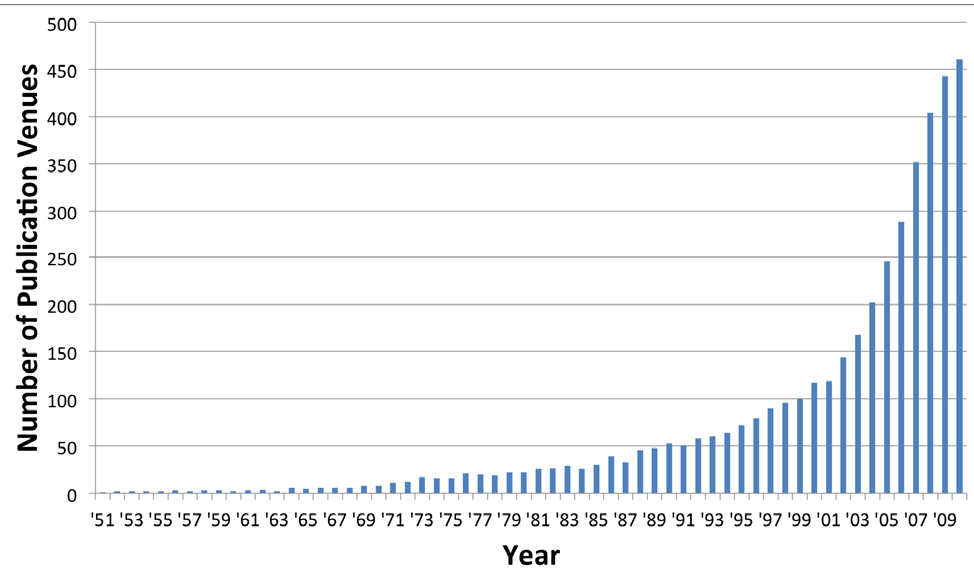
For decades, computer science has trended toward extreme specialization. While this has led to SOTA breakthroughs in niche domains, it has created a "master of one" problem. The authors observe an exponential growth in publication venues (see Figure 1), leading to a fragmented research landscape where the left hand doesn't know what the right hand is doing—or what energy it’s consuming.
Core Concept: The "Pareto Efficiency" of Social Impact
The heart of the paper lies in the application of the economic concept of Pareto Efficiency to software. A system is Pareto efficient if you cannot make it "better" for one societal concern (e.g., making it more private) without making it "worse" for another (e.g., making it more energy-intensive).
The authors argue that we must first identify if our current systems are at this frontier. If they aren't, we can optimize both; if they are, we must make conscious, technically-informed value judgments.
The Three Pillars of Tradeoffs
1. Privacy vs. Green Computing
Protecting user data often involves "Correlation Privacy" testing—simulating attacks by matching datasets (like the famous Netflix/IMDb de-anonymization). However, running these heavy data-mining audits or complex encryption layers consumes massive CPU cycles. In an era where "Green Computing" is vital for sustainability, we face a paradox: Is a perfectly private system ethical if its carbon footprint accelerates environmental collapse?
2. Privacy vs. Cultural Differences (Regulatory Localization)
Privacy is not a universal constant. Germany’s strict post-WWII privacy laws differ vastly from US standards. The authors propose Regulatory Localization: a way to modularize software so that features can be "turned off" or adapted based on local legal frameworks (e.g., Google Street View's challenges in different jurisdictions).
3. The "Gullibility Factor"
To bridge the gap between technical complexity and user understanding, the authors suggest a Gullibility Factor—a 0 to 1 score for privacy settings. This would help "merely puzzled" users understand the trade-offs they are making when they click "Accept All" on a social platform.
Methodology: The SE/PL Role
Why is this an SE/PL problem? Because these communities provide the substrate of all software:
- Architectures: To allow "orthogonalizing" features for local law compliance.
- Compilers/Tools: To quantify energy expenditure per module.
- Testing: Developing "perpetual testing" methods that spread the energy burden across different sources.
Critical Insight & Future Outlook
The paper doesn't just offer problems; it offers a roadmap for "Human Factors" in engineering. A key takeaway is that once we reach a Pareto Efficient state, we might need to favor Human Time (manual code reviews, design thinking) over Machine Time (automated brute-force testing) to save scarce environmental resources.
While the paper was published in 2011, its predictions regarding the friction between global platforms and regional laws (foreshadowing GDPR) and the rise of energy-conscious computing (foreshadowing the AI power-consumption debate) make it a foundational text for modern technical architects.
Conclusion
Societal Computing challenges us to stop looking at software as a series of isolated performance metrics. Instead, we must view it as a balancing act where the code, the law, and the planet are all stakeholders in the same ecosystem.