
Decoding the "Human Middleware": How Guanxi and Culture Power Information Sharing in China
An empirical investigation of socio-cultural factors of information sharing in China
This empirical study explores the socio-cultural drivers of information sharing in China by analyzing 140 high-level managers. Using Partial Least Squares (PLS) modeling, it validates that Guanxi, Collectivism, and Confucian Dynamism significantly enhance in-group information sharing, with Guanxi emerging as the most dominant factor.
TL;DR
Information technology alone doesn't guarantee information flow. In China, the "lifeblood" of data exchange isn't just a high-speed intranet, but a centuries-old social currency called Guanxi. This study proves that while Collectivism and Confucian values drive internal teamwork, Guanxi is the only force capable of bridging the gap between an organization and the outside world.
Context: Why "Global" IT Systems Often Fail locally
Despite the ubiquity of the Internet, information sharing remains a deeply human act governed by cultural "operating systems." For Western firms entering China, the struggle isn't a lack of bandwidth, but a lack of cultural alignment. This research asks: Why do Chinese managers share information, and what social structures control it?
The Pillars of Chinese Information Culture
The authors identify three specific socio-cultural variables that replace the "rational self-interest" models often found in Western management theory:
- Guanxi: Direct, particularistic ties involving mutual obligation and trust. It is more than friendship; it is a "social investment."
- Collectivism: The subordination of personal goals to the group, emphasizing harmony and "in-group" loyalty.
- Confucian Dynamism: A value set focusing on persistence, status-ordered relationships, and "saving face."
Methodology: The Theory of Communicative Action
The study moves beyond simple observations by applying Social Network Theory and Interdependence Theory. The researchers surveyed 140 senior managers across various Chinese industries, using Partial Least Squares (PLS) to map the causal relationships between these cultural factors and the act of sharing proprietary data.
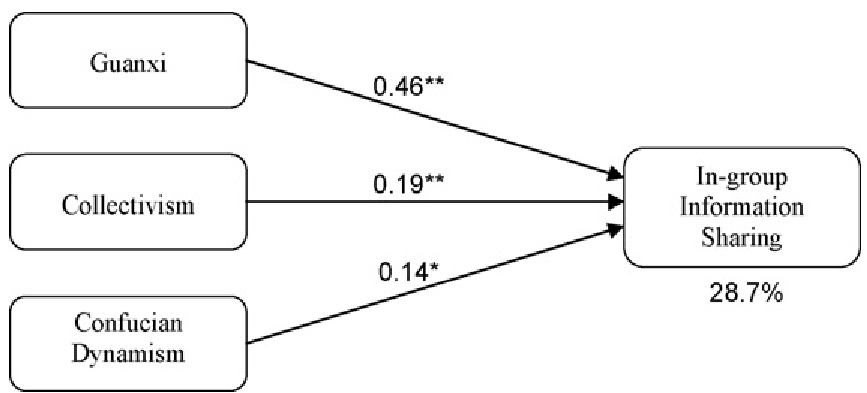 Figure 1: The Research Model showing path coefficients. Note the overwhelming strength of Guanxi (0.46) compared to other factors.
Key Insights: In-Group vs. External Boundaries
The results revealed a fascinating dichotomy in how Chinese professionals share information:
1. The Monopoly of Guanxi
Guanxi was the "MVP" of the study. It significantly influenced information sharing within workgroups and was the only cultural factor that successfully predicted sharing with external partners (suppliers, retailers, government).
2. The Limits of Collectivism
While Collectivism strongly promoted sharing within the "safe" confines of the organizational family, it completely failed to predict sharing with outsiders. In fact, the data supports the idea that collectivists are often apathetic—or even hostile—to the needs of those outside their immediate circle.
3. The Fading Influence of Confucianism
Interestingly, Confucian Dynamism had the weakest impact . The researchers suggest this might be due to a "generational shift"—younger Chinese managers may be moving toward more pragmatic or globalized value sets, though social harmony still plays a background role.
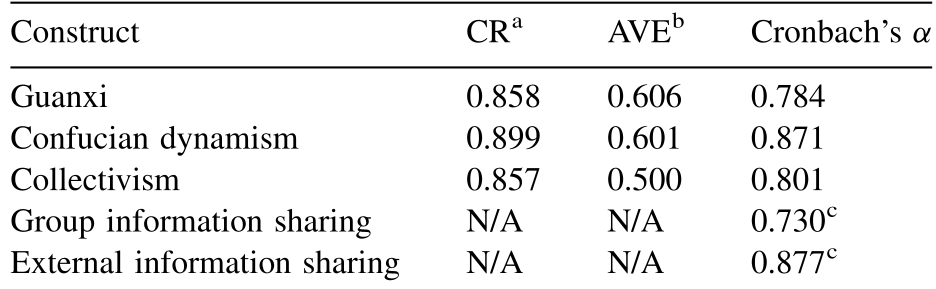 Table 1: Reliability assessments proving the statistical validity of the cultural constructs.
Critical Insight & Practical Application
The "Takeaway" for the modern CTO is clear: You cannot code your way out of a cultural barrier.
- Trust-Based Design: IT systems in China should be designed to foster peer-to-peer communication and facilitate the building of trust (Guanxi), rather than just acting as top-down repositories.
- External Strategy: If navigating a supply chain in China, "rational" contracts are insufficient. Information will only flow if there is an investment in horizontal "Guanxi" with suppliers and regulators.
Conclusion
This paper serves as a vital reminder that in the globalized era, "National Culture" is not a soft metric—it is a hard variable that determines the efficiency of business intelligence. Guanxi remains the essential prerequisite for any successful information-sharing strategy in the Chinese market.