
Decoding Workplace Dynamics: The SocioMetric Badges Corpus and the Rise of Computational Social Science
The SocioMetric Badges Corpus: A Multilevel Behavioral Dataset for Social Behavior in Complex Organizations
The paper introduces the SocioMetric Badges Corpus, a multi-level behavioral dataset tracking 53 individuals over six weeks in a research institution. It combines high-granularity digital traces from wearable SocioMetric Badges with longitudinal psychological assessments to map social interactions against personality and affective states.
TL;DR
Understanding how people actually behave in organizations has historically been a black box of subjective surveys. The SocioMetric Badges Corpus changes this by providing a 6-week, high-resolution dataset of 53 employees. By fusing wearable sensor data (face-to-face hits, physical activity, speech prosody) with real-time psychological "experience sampling," this research offers a multi-layer look at how personality, mood, and social networks co-evolve in a modern office.
The "Subjectivity" Trap in Organizational Research
For decades, social scientists have struggled with the observer effect and recall bias. If you ask an employee how many times they spoke to a colleague last week, their answer is often an approximation filtered through their internal biases.
While modern "Digital Humanities" have turned to email and Slack logs, these ignore the water-cooler talks and face-to-face brainstorms that constitute the "social glue" of an organization. The authors argue that we cannot understand organizational performance without capturing these organic, physical micro-interactions.
Methodology: The Multi-Layer View
The researchers didn't just hand out sensors; they designed a longitudinal study in three distinct stages:
- Stage 1 (Calibration): Establishing baseline personality traits (Big Five) and social network ties.
- Stage 2 (The Deep Dive): Six weeks of wearing SocioMetric Badges. These devices are packed with:
- Infrared (IR): Captures "Line of Sight" to detect face-to-face interaction.
- Bluetooth: Maps proximity (who is nearby, even if not facing each other).
- Accelerometers: Measures "Body Activity" and energy levels.
- Microphones: Analyzes prosodic features (not content) to gauge social engagement.
- Experience Sampling (ESM): Three times a day, participants filled out "mini-surveys" on their smartphones to report their current creativity, productivity, and mood.
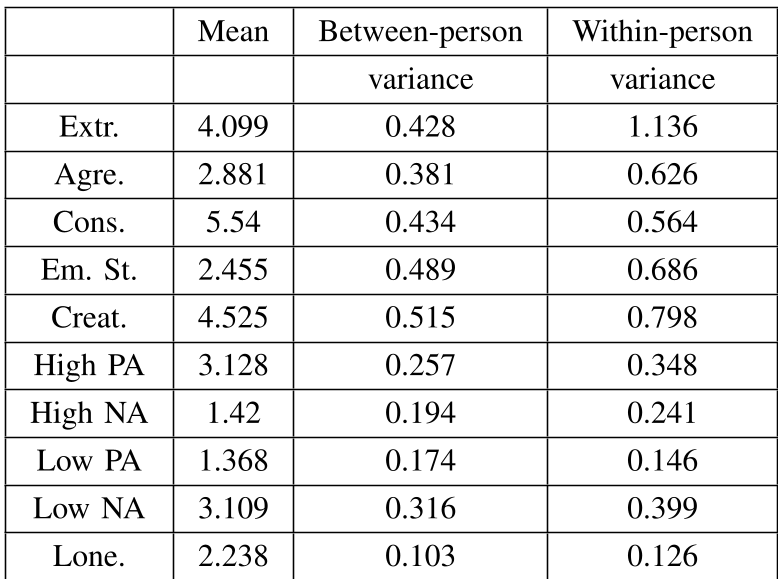 The table above highlights the critical distinction between 'Between-person' and 'Within-person' variance, showing that our personality 'states' fluctuate significantly throughout the day.
Key Insight: The Fluidity of Personality
One of the most striking findings from the descriptive statistics is the high within-person variance. Traditional psychology often views personality as a static trait (e.g., "I am an introvert"). However, the corpus data shows that an individual's "extraversion state" fluctuates wildly based on their current situation and recent social hits.
For researchers, this means that digital traces are better at predicting who you are acting like right now than who you say you are on a static survey.
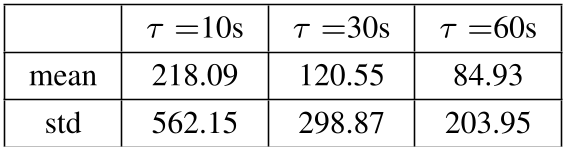 Measuring face-to-face interactions via IR sensors provides a concrete proxy for actual social engagement.
Critical Analysis & Conclusion
Why it Matters
This corpus is more than just a data dump; it’s a blueprint for Computational Social Science. By aligning raw sensor signals with ground-truth psychological states, it allows for the development of algorithms that can automatically detect burnout, identify "toxic" social silos, or predict a team's creative output before a single project is finished.
Limitations
- Hardware Fragility: The authors noted a ~10% data loss due to sensor malfunctions and clock de-synchronization—a common headache in "In-the-Wild" wearable research.
- Privacy vs. Utility: To protect participants, the audio content was not recorded. While necessary, this limits our understanding of the nature of the social interactions (e.g., was it a conflict or a joke?).
Future Outlook
The SocioMetric Badges Corpus paves the way for "Sensible Organizations." In the future, the integration of these sensing methods into everyday enterprise tools could create "organizational weather maps," helping leaders foster better collaboration and employee well-being based on objective behavioral evidence rather than gut feeling.