
Beyond the Digital Divide: A Sociocultural Map of Rural Internet Work
10808_A Sociocultural Explanation of Internet-Enabled Work in Rural Regions.
This research provides a sociocultural ethnographic analysis of Internet-enabled work in the rural Western United States. It categorizes rural digital labor into "telework" (primarily white-collar) and "online marketing and sales" (rooted in local industries), identifying how gender and origin shape technology adoption.
TL;DR
In the Western US, the rural "digital divide" isn’t just about signal bars—it’s about sociocultural identity. This ethnographic study by Kahn and Burrell reveals that while urban transplants use the Internet for "telework," rural natives—particularly women—are the ones leveraging digital marketplaces to bypass traditional patriarchal barriers. Meanwhile, established rural men often ignore the Internet to preserve their autonomy and status.
Introduction: Why Infrastructure isn't the Whole Story
For decades, policymakers have treated the rural digital divide as a simple math problem: Infrastructure + Skills = Adoption. If we build the fiber and teach the classes, the rural economy will flourish, right?
Zoe Kahn and Jenna Burrell’s research suggests this is a profound oversimplification. By living in and interviewing residents of Mendocino County (CA), Central Oregon, and the Methow Valley (WA), they found that the Internet isn't just a tool; it's a site of cultural negotiation.
The Two Faces of Rural Internet Work
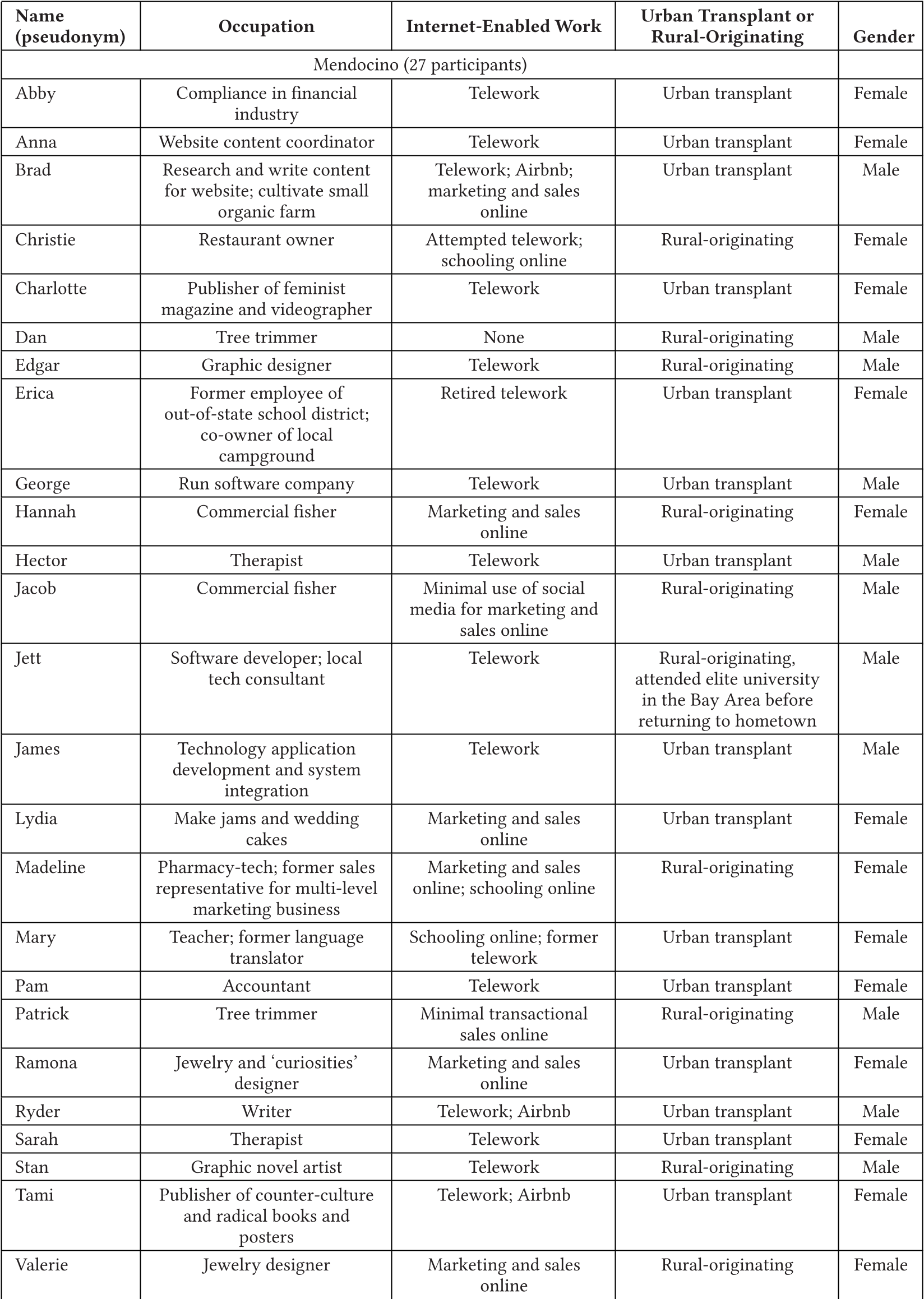
The researchers identified two divergent pathways for digital labor:
- Telework: White-collar "mindwork" (software dev, grant writing) performed almost exclusively by urban transplants. These workers are physically in the rural space but digitally tethered to urban hubs.
- Online Marketing & Sales: Leveraging platforms like Etsy, Airbnb, and Facebook to sell rural-rooted goods (wool, fish, ranch stays). This is where rural-originating women are making significant inroads.
The "Hyper-Masculine" Barrier to Adoption
One of the most striking findings is the active "non-use" of technology by rural-originating men—specifically those in traditional industries like ranching. Whereas teleworkers see the Internet as essential, these men often view it as:
- "Below their pay grade": A feminized administrative task (like typing used to be).
- A threat to autonomy: Managing an Airbnb involve "people problems" and catering to "outsiders," which clashes with the cowboy ethos of independence.
- Unnecessary for status: Multi-generational ranchers often have enough social capital and face-to-face networks that they don't need the Internet to survive economically.
The "Gender Lens" as an Economic Edge
While men avoid the "relational work" of the Internet, rural women are using it as a back door into male-dominated industries.
- Case in point: Hannah, a fishing boat captain, uses social media to build a "locavore" brand. By dealing with the "people problems" her male counterparts despise, she has built a market the traditional fleet can't touch.
- Strategic Leverage: "Ranch wives" are increasingly using Airbnb to supplement declining agricultural income, framing it as "secondary" to avoid disrupting the patriarchal household, even when the income becomes vital.
Critical Analysis & Conclusion
Kahn and Burrell successfully pivot the conversation from Deficit (what rural people lack) to Socio-cultural Repertoire (how they choose to use what they have).
Key Takeaways:
- Telework is an "import": It doesn't necessarily "spill over" to local populations because it requires urban social capital.
- Non-use is a luxury: Only those with established local power (ranch owners) can afford to ignore the digital shift.
- HCI Implications: Designers of rural tech need to move beyond "user-friendly" and start thinking about "culture-compatible." If a tool feels "feminized" or "outsider-facing," a significant portion of the rural workforce will reject it regardless of its utility.
Limitations
The study focuses on the Western US, a region with a specific "frontier" brand of masculinity. Results might differ in rural contexts where agriculture is less about autonomous ranching and more about corporate industrial farming.
Future Outlook: As urban transplants continue to drive up housing prices in "amenity-rich" rural areas, the tension between telework and local work cultures will likely become the next major frontier in rural sociology.