
The Bridge Builders: A Sociolinguistic Deep Dive into Multilingual Twitter
Sociolinguistic analysis of Twier in multilingual societies
This paper presents a large-scale computational sociolinguistic study of Twitter across three multilingual regions (Qatar, Switzerland, and Quebec). It introduces a methodology to identify bilingual users and utilizes network analysis alongside LDA topic modeling to reveal how language choice correlates with social structure and influence.
TL;DR
In a world where English is often seen as the dominant digital lingua franca, this study reveals a more nuanced reality. By analyzing millions of tweets from Qatar, Switzerland, and Quebec, researchers found that bilingual users act as the critical "glue" between segregated monolingual clusters. Interestingly, while English acts as a hub, the "true" influencers in regional networks are those who tweet in local languages.
Motivation: Is the Internet Killing Local Languages?
In multilingual societies, language is more than just a tool for communication—it's a marker of identity and social status. Linguists have long debated whether the rise of English on social media would eventually lead to "language death" for local dialects. Alternatively, do digital networks encourage segregation, where speakers of different languages never interact? This study seeks the "bridge-builders"—the bilinguals—and quantifies their impact on social capital and integration.
Methodology: Measuring Lingual Diversity
The researchers didn't just look at what people said, but whom they followed.
1. Language Profiling
Instead of classifying individual tweets (which are often too short), they aggregated all tweets by a user into a "document." Using CLD2 (Compact Language Detector 2), they defined a user as "speaking" a language if it occupied at least 15% of their total byte-count.
2. Network Diversity Metrics
To measure how effectively users were connecting across language barriers, they used three key metrics:
- Shannon Entropy (): Measures the concentration of outgoing links.
- Simpson Index (): Quantifies how "well-distributed" a node's connections are across different groups.
- Self-follow Index: A measure of homophily—how likely a user is to follow someone from their own language group.
 Figure 1: Visualization of Qatar's network. Notice how AR-EN bilinguals (middle) bridge the gap between Arabic and English monolingual clusters.
Key Insights: Why Bilinguals Matter
The Bridge and the Hub
The study confirms that English acts as a "hub language." Connections between different local language groups (e.g., French and German speakers in Switzerland) almost always pass through either English monolinguals or bilinguals who speak English. Monolingual users of different languages rarely follow each other directly.
The Mirror Effect
One of the most striking findings is the "Language Convergence" pattern. Bilingual users do not just switch to English to maximize their audience. Instead, they mimic their followers. If 30% of a bilingual's followers tweet in English, the user will likely tweet in English 30% of the time. This suggests a social "equilibrium" rather than a total takeover by a single dominant language.
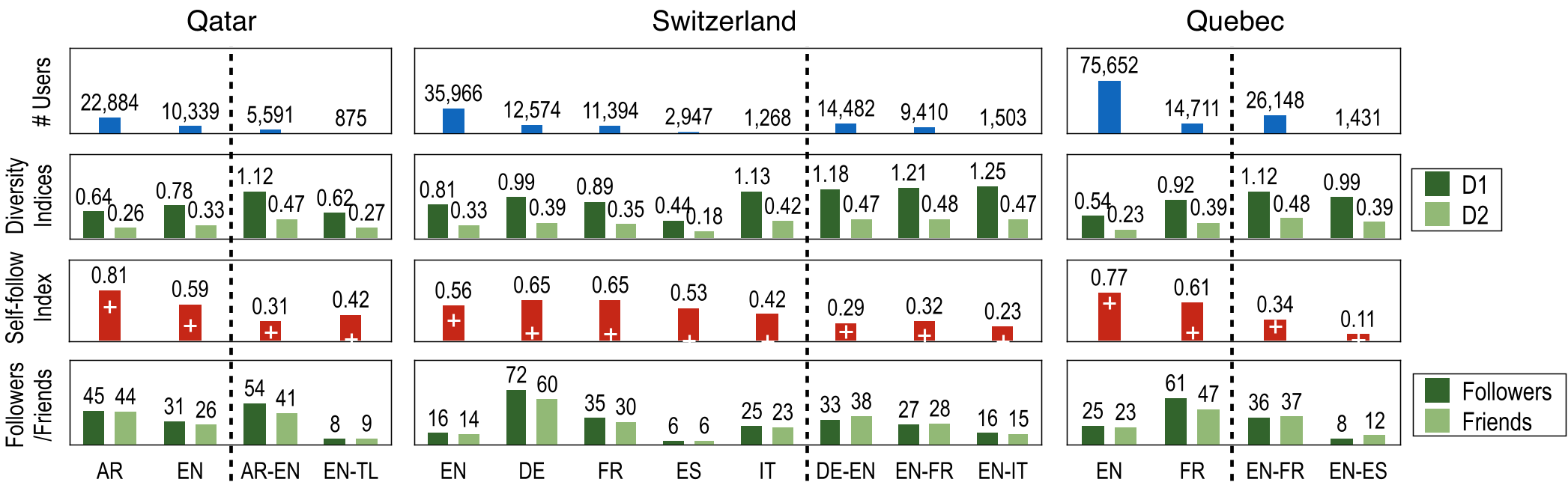 Figure 2: Diversity measures showing that bilinguals (peaks in D1/D2) have significantly more diverse networks than monolinguals.
Different Languages, Different Stories
By using LDA (Latent Dirichlet Allocation) on parallel hashtags, the researchers found a strategic split in content:
- Local Languages: Used for "serious" matters—politics, government news, and community debates.
- English: Used for "outward-facing" content—tourism, photography, events, and leisure.
Social Influence: The Local Advantage
Contrary to the "Elite English" myth, users tweeting in the local language (Arabic in Qatar, French/German in Switzerland) actually had more followers and higher regional influence than those tweeting only in English. Even when English speakers were more numerous in the dataset, the local language remained the currency of social capital.
Critical Analysis & Conclusion
This paper provides a robust framework for understanding digital sociolinguistics at scale. It proves that bilingualism is not just a personal trait, but a structural necessity for a cohesive society.
Limitations: The study relies on follower/following counts as a proxy for social status, which might miss deeper engagement metrics like retweets or mentions (though the authors note a strong correlation). Additionally, the use of 2014-era LDA might be replaced today by LLM-based semantic analysis for even richer insights into how topics differ across languages.
The Takeaway: For platforms and brands, the message is clear: To gain influence, you must speak the local tongue. To expand the network, you must empower the bilingual bridges.