
SocioNet: Engineering Social Intelligence into P2P Multimedia Networks
SocioNet: A Social-Based Multimedia Access System for Unstructured P2P Networks
SocioNet is a social-based unstructured Peer-to-Peer (P2P) multimedia access system that clusters peers into a small-world network based on semantic preference relationships. It integrates interest-based clustering with short path lengths to facilitate efficient partial-match keyword searches, consistently outperforming standard unstructured overlays in search success and precision.
TL;DR
SocioNet bridges the gap between unstructured P2P flexibility and structured search efficiency. By modeling the overlay as a small-world social network, it clusters users with similar multimedia tastes while maintaining "shortcuts" to the broader network. The result is a system that handles partial-match keyword queries with higher success and lower overhead than standard Gnutella-like protocols.
Context: Beyond the Hash
In the era of massive multimedia distribution, users rarely search by unique file identifiers (hashes). Instead, they use keywords like "The Beatles" or "Jazz." Structured P2P systems (DHTs) are excellent at finding a specific needle in a haystack but fail when the user only knows the "color" of the needle.
Unstructured networks are the natural habitat for keyword searches, but they suffer from the "dark matter" problem: relevant content might exist, but if it is 10 hops away in a random graph, your TTL-limited query will never find it. SocioNet's core insight is that P2P users are social creatures with niche interests. If you share 90% of your music library with another peer, your next query is highly likely to be satisfied by them.
Methodology: The Small-World Blueprint
SocioNet constructs its topology using three pillars:
1. Multi-Dimensional Profile Similarity
The system quantifies the "closeness" between peers by analyzing the objects they hold. Using a Weighted Similarity Distance, it calculates the cosine similarity of keyword vectors across multiple content types (e.g., Audio and Video), ensuring that peers who appreciate the same genres are prioritized as neighbors.
2. Distributed Small-World Adaptation
Following the Watts-Strogatz -model, each node maintains:
- Friend Links: Connections to peers with the highest similarity scores.
- Acquaintance Links: Random shortcuts that prevent the network from becoming local "islands" of nodes.
To maintain this under high node churn, the authors utilize a Random Walk sampling technique rather than global flooding, ensuring that buddy selection remains computationally cheap and decentralized.
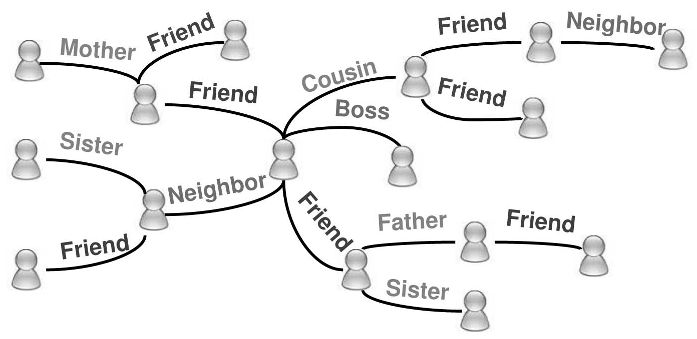 Fig 1: Similarity-based sociogram demonstrating interest-based clustering with random shortcuts.
3. The TTL Mathematical Model
One of the major technical contributions is a formula for determining the Time-to-Live (TTL). By considering the Clustering Coefficient () and the popularity distribution of objects (Zipf-like), the system can mathematically predict the minimum TTL needed to hit a target success ratio (e.g., 90%).
Experimental Performance
Using the AudioScrobbler dataset (tracking 1,355 real users), the authors validated that SocioNet behaves as a true small-world network.
- Search Efficiency: SocioNet achieved significantly higher Precision and Recall rates compared to Semantic Overlay Networks (SON) and random graphs.
- Dynamic Robustness: In scenarios with high "churn" (nodes constantly joining and leaving), SocioNet maintained a cumulative success rate nearly 40% higher than non-social overlays, thanks to its proactive buddy adaptation.
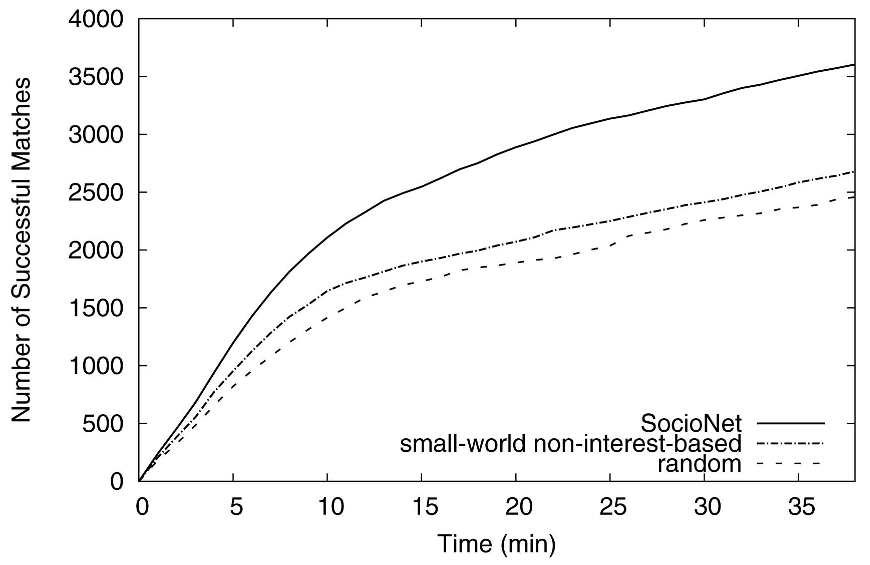 Fig 2: Success matches over time in churn and shrink scenarios, showing SocioNet's superior resilience.
Critical Insight & Practical Value
The genius of SocioNet lies in its Inductive Bias. It assumes that decentralized systems should mirror human social structures because the data stored in these systems is a byproduct of human interest.
However, the system does have a "cold start" problem. New users without a library cannot effectively calculate a profile. While the authors suggest using a buffer to create a temporary profile, the system's efficiency inherently grows as the user contributes more—effectively creating a built-in incentive to share.
Conclusion
SocioNet proves that in unstructured environments, topology is destiny. By moving away from random interconnections toward an interest-aware, small-world architecture, decentralized networks can finally offer keyword searching that is both scalable and accurate. For future P2P architectures, the lesson is clear: to find data effectively, first find the friends who share your soul.