
SOFTec 2013: Reclaiming the "Human" in Ubiquitous Computing
SOFTec 2013: second workshop on computer mediated social offline interactions
SOFTec 2013 is a specialized workshop proposal for UbiComp '13 that focuses on "Computer Mediated Social Offline Interactions." It aims to shift the focus of ubiquitous computing from remote virtual communication to technology that actively nurtures and stimulates face-to-face, "in the flesh" social encounters.
TL;DR
In an era where we are "always on" but increasingly alone, SOFTec 2013 (held at UbiComp '13) challenges the HCI community to stop designing for virtual isolation. Instead of building tools that keep eyes glued to screens, the authors advocate for technology that acts as a catalyst for face-to-face, offline social interactions.
Background: The Paradox of Connection
We are living in an age of Perpetual Contact. With billions of users on social networks, the digital "water cooler" is never empty. However, the authors point out a grim reality: this pervasive connectedness often comes at the expense of direct social interaction.
The motivation for the SOFTec workshop is rooted in a biological and sociological crisis. Research highlights that virtual interactions are poor substitutes for physical ones, with high online usage linked to increased loneliness and even higher mortality rates. The central question is: Can we design technology that weaves itself into the fabric of everyday life without tearing the fabric of social interaction?
The "Absent Presence" Problem
The paper identifies a phenomenon known as Absent Presence—where individuals are physically present but mentally and socially absorbed in their remote digital worlds.
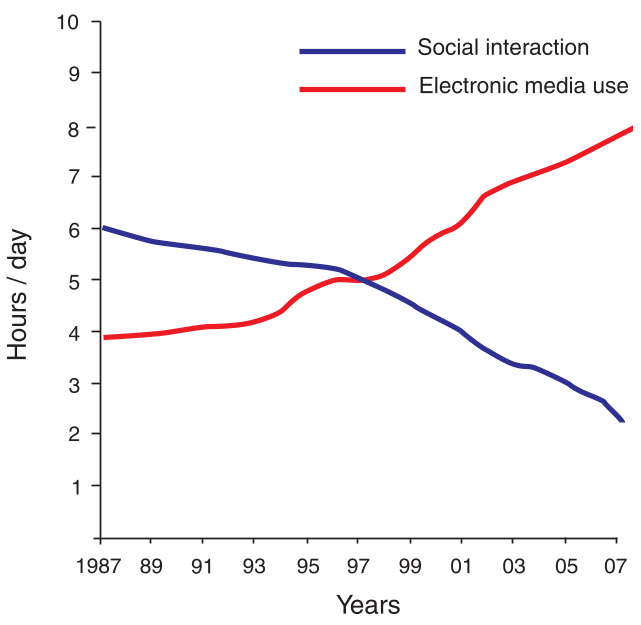 Figure 1: The inverse relationship between increased online interaction and the decline of social offline interaction.
The "Why" behind this shift is the lack of Non-Verbal Cues. As cited in the text, body language, facial expressions, and true eye contact—vital components of human empathy and connection—are fundamentally missing or distorted in digital mediated communication.
Methodology: Designing for SOFTec
The workshop identifies several "Communicative Ecologies" that can be leveraged to fix this:
- Public & Semi-Public Displays: Using large screens in "third spaces" (cafes, libraries) to stimulate spontaneous interaction between strangers or colleagues.
- Serendipity Engines: Utilizing mobile proximity sensors and user profiles to inform nearby people of shared interests, facilitating real-world introductions.
- Theories of Interaction: Applying Goffman’s theory of social interactions to technical design, ensuring that gadgets respect and enhance the social norms of public spaces.
A New Research Agenda
The goal of SOFTec 2013 was not just to present papers but to perform a Group Analysis of real-world interactions. By studying videos and images of technology either "getting in the way" or "supporting" offline interaction, the organizers aimed to create an affinity diagram of opportunities for the UbiComp community.
Key Themes for Future Work:
- Mesh Technologies: Combining mobile, sensors, and public displays into a single interactive ecosystem.
- Serious Games: Using gamification to break the "ice" between strangers in physical crowds.
- Measurement Tools: Developing new metrics to quantify the "social health" of an environment, moving beyond simple engagement clicks to real-world face-to-face duration.
Critical Insight: Beyond the Digital/Physical Binary
The most profound takeaway from the SOFTec proposal is the rejection of the idea that "online" and "offline" are separate worlds. Instead, they are part of a single Communicative Ecology. The most successful future products won't be those that create the most immersive virtual worlds, but those that use digital intelligence to make the physical world more socially vibrant.
Conclusion
As we look back on the goals of SOFTec 2013, the challenges have only intensified with the arrival of the Metaverse and generative social AI. The workshop’s legacy serves as a vital reminder: technology is at its best when it serves as a bridge to other humans, not a destination in itself.