
EnergyCity: Empowering the "Powerless" through Consumer Social Networks
A Software Agent Framework for Exploiting Demand-Side Consumer Social Networks in Power Systems
This paper introduces EnergyCity, a JADE-based multi-agent framework designed to simulate power systems and explore Consumer Social Networks (CSNs). It empowers small-scale electricity consumers to aggregate their demand-side response through collective action, effectively increasing their market power in a decentralized energy landscape.
TL;DR
EnergyCity is a sophisticated multi-agent framework that transforms passive electricity consumers into active market players. By forming Consumer Social Networks (CSNs) based on social, economic, and geographic proximity, small users can aggregate their demand-side response, gaining the market power necessary to influence grid stability and reap economic rewards.
Background: The Fragmented Smart Grid
The transition toward decentralized energy—think solar panels and micro-turbines—demands a new management paradigm. While Smart Grids provide the ICT infrastructure, the human element remains a "latent asset." Individual households have negligible impact on the market; however, as a collective group, their peak demand shift can prevent grid failure. The challenge is: How do we model and motivate this collective behavior?
The Core Innovation: Consumer Social Networks (CSNs)
EnergyCity moves beyond traditional physics-based simulations to a socio-technical model. The framework treats consumers as autonomous agents with a "genetic code"—a bit-string representing their consumption habits, financial status, and environmental awareness.
1. Agent Architecture
The system utilizes specialized agents to simulate a complete ecosystem:
- ConsumerAgents: The core actors looking for "the perfect match" to form coalitions.
- MediaAgents: Simulating the "nudge" of social awareness and economic news.
- MatchAgents: Facilitating the grouping process using the Gale-Shapley stability algorithm.
2. The Logic of Grouping (Methodology)
Why would a consumer join a CSN? In EnergyCity, this decision is governed by a multi-objective preference function. It calculates Consumption Proximity (similarity in usage patterns) and Physical Proximity (grid topology) to ensure that the resulting groups are both socially compatible and technically relevant to the local Distribution System Operator (DSO).
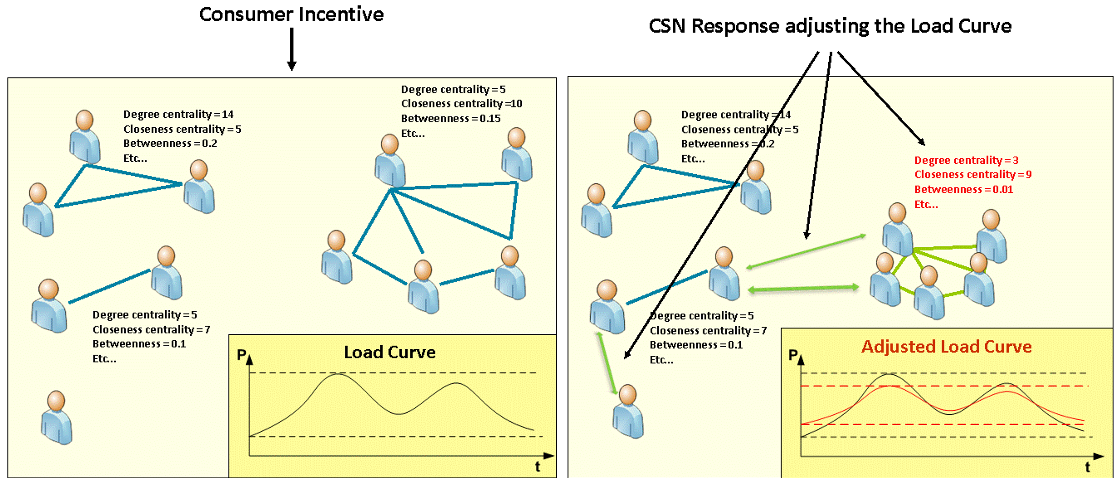
Figure 1: Electricity Suppliers (ES) send incentives to formatted CSNs, which then adjust their collective load curve—a feat impossible for isolated consumers.
Detailed Consumer Modeling
The "Genetic Code" of an agent is what sets this research apart. Instead of just a load profile, each agent possesses a 24-gene chromosome:
- Energy Traits: Consumption volume, utility satisfaction.
- Social Traits: Trustworthiness, prosperity, and "influence degree."
- Cognitive Traits: Environmental awareness and "Sight" (how far they can look for partners).
Formulating the "Perfect Match"
The framework uses a tanh-based physical proximity calculation combined with a weighting of social metrics. This ensures that the simulated society doesn't just form random clusters, but "Trust-based energy communities."
Experiments and Insights
EnergyCity was implemented using the JADE (Java Agent Development Framework). The simulations demonstrate that when users are provided with social "information degrees" (via MediaAgents) and economic incentives, the formation of CSNs leads to a more predictable and "smoother" aggregate load curve.
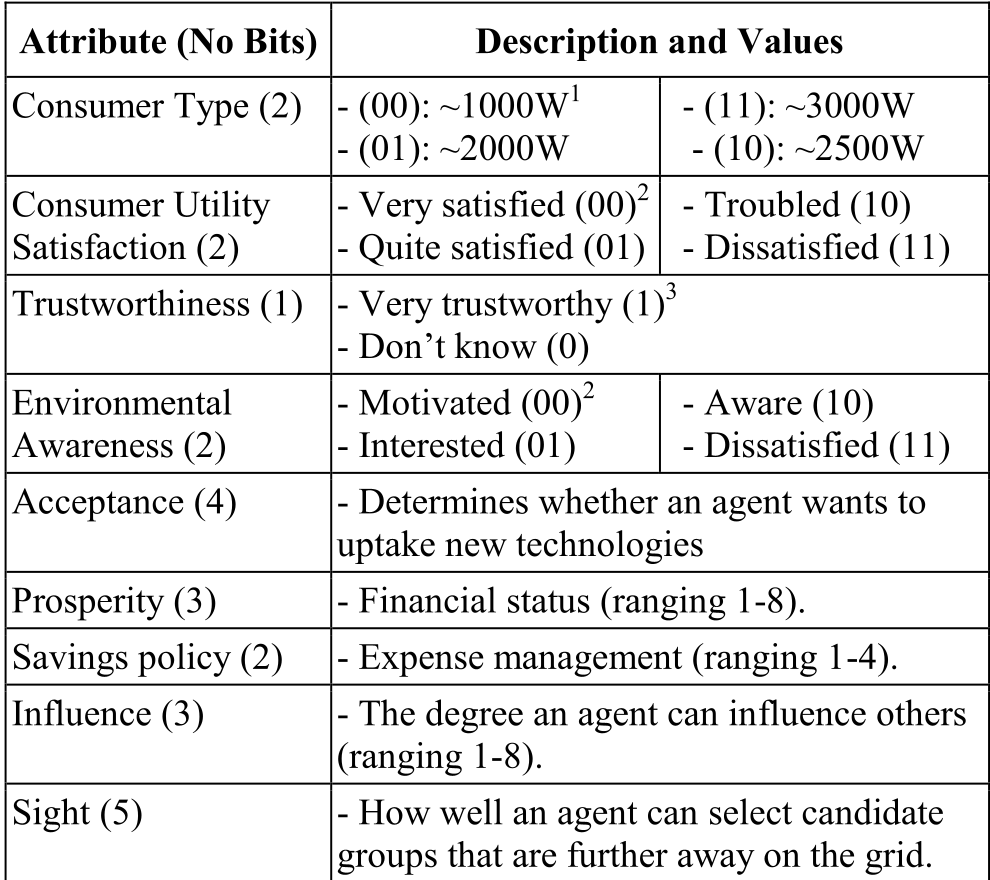
Table 1: The multidimensional attributes that define a ConsumerAgent's behavior and grouping preference.
Critical Analysis & Future Outlook
While EnergyCity provides a robust framework for simulation, its reliance on a 2D grid may oversimplify real-world urban power distribution networks. However, its core insight—that social awareness is as important as price signals—is a vital takeaway for policy makers.
Future Directions:
- Integrating real-time sensor data from IoT devices to update agent chromosomes dynamically.
- Exploring "cheating" and "manipulation" within CSNs (alluded to in the paper's footnotes).
- Expanding the framework to handle Peer-to-Peer (P2P) energy trading between groups.
In conclusion, EnergyCity provides the "semantic infrastructure" needed to bridge the gap between individual energy consumption and systemic grid reliability.