
SDN-Assisted MSNs: Bridging Social Intelligence and Centralized Control at the Edge
Software-Defined Networking-Assisted Content Delivery at Edge of Mobile Social Networks
This paper introduces an SDN-assisted architecture (SDMSN) for content delivery in Mobile Social Networks (MSNs). It proposes density-aware routing mechanisms—sparse-mode and dense-mode—leveraging centralized control to improve delivery ratios and reduce device overhead.
TL;DR
Mobile Social Networks (MSNs) are plagued by the unpredictability of human mobility and the limited resources of edge devices. This paper presents SDMSN, a framework that brings the centralized logic of Software-Defined Networking (SDN) to the social edge. By introducing density-aware routing mechanisms—specifically designed for sparse and dense environments—the authors achieve a delivery ratio of up to 93% while significantly slashing the overhead of traditional algorithms like BubbleRap.
Problem & Motivation: The distributed intelligence bottleneck
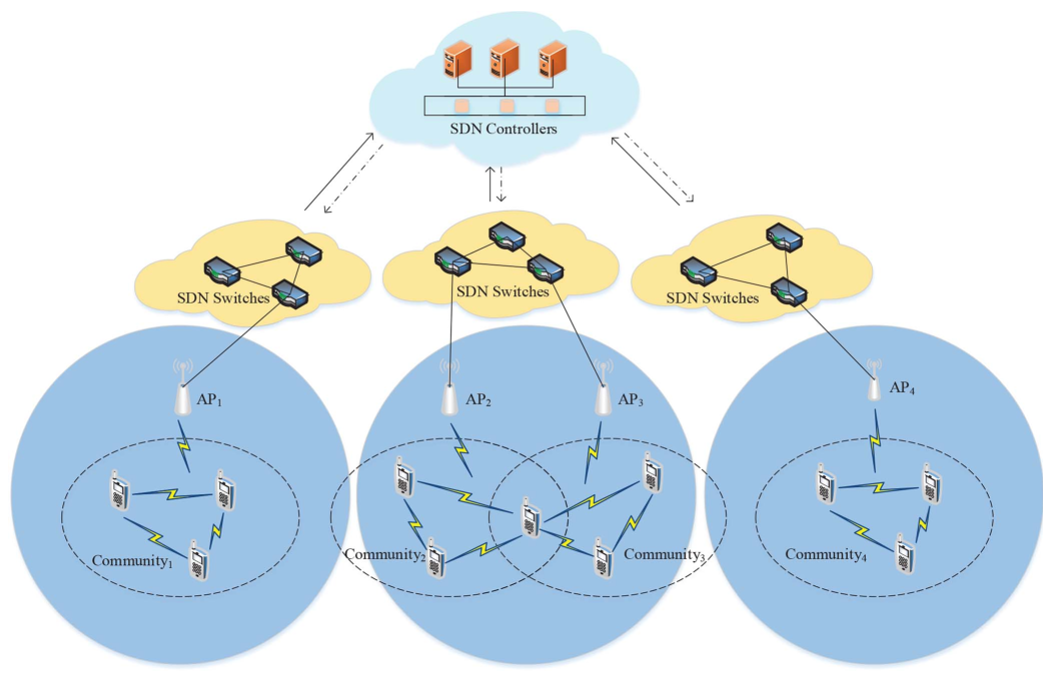
In traditional MSNs, nodes act as both carriers and routers. Algorithms like BubbleRap rely on "centrality"—the idea that you should hand a message to someone more "popular" or "connected" than you. However, this creates two major pain points:
- Resource Exhaustion: Popular nodes become bottlenecks, overwhelmed by traffic that drains their battery and memory.
- Lack of Global Vision: Nodes only see their immediate neighbors, making it difficult to find optimal multi-hop paths in highly dynamic or extremely sparse environments.
The authors' insight is to decouple the Data Plane (physical content delivery by mobile devices) from the Control Plane (social relationship calculation by a powerful SDN controller).
Methodology: Adaptive Density-Aware Routing
The core innovation lies in the Discriminating Scheme, which uses graph theory concepts ( representations) to identify whether a network is sparse or dense based on the ratio of Access Points (APs) to mobile nodes.
1. Sparse-Mode: Quality over Quantity
In sparse networks, encounters are rare. The system uses Cluster-based community discovery (based on AP residency) and introduces Circle Similarity (CS).
- The Intuition: If a node doesn't have high centrality but shares a significant number of "friends" with the destination node, it is a highly effective relay.
2. Dense-Mode: Scalability via Sheep Optimization
Dense networks involve massive data points, making traditional clustering computationally expensive. The authors treat community discovery as an optimization problem, solved via Sheep Optimization (SO) to maximize modularity.
- Architecture: It introduces Community Closeness (CC), treating entire communities as delivery units rather than relying on a few stressed "super-nodes."
Experiments & Results
The researchers used the Opportunistic Network Environment (ONE) simulator to benchmark their approach against baselines like Epidemic, Spray-and-Wait, and BubbleRap.
Key Findings:
- Delivery Ratio: The Dense-mode mechanism reached a 93% delivery ratio, outperforming BubbleRap consistently as time progressed.
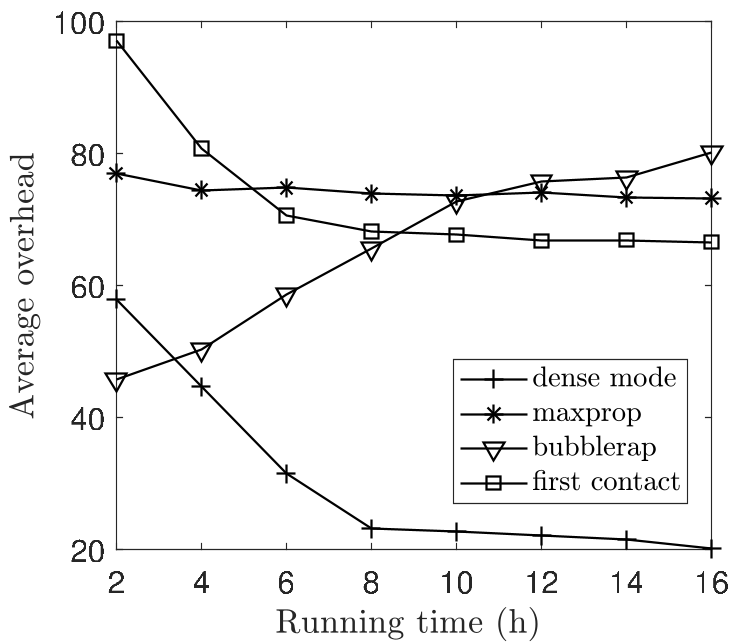
- Overhead Reduction: In dense scenarios, the overhead was 54% lower than BubbleRap. This is primarily because the SDMSN controller prevents "blind flooding" by selecting only socially-relevant relays.
- Buffer Management: By controlling message copies, the Average Buffertime was significantly increased (up to 1160.2s in dense mode), indicating fewer packet drops due to cache overflow.
Critical Analysis & Conclusion
Takeaway: This work successfully demonstrates that the "Software-Defined" paradigm isn't just for data centers—it is a powerful tool for managing the "chaos" of mobile social movements. By offloading the "thinking" (social metric calculation) to a controller, the "doing" (data forwarding) becomes far more efficient.
Limitations:
- Connectivity Assumption: The model assumes nodes can maintain a connection to the SDN controller (perhaps via LTE/5G) to receive routing updates. In total "off-grid" scenarios, this architecture might struggle.
- Selfishness: The current model assumes nodes are altruistic. In real-world MSNs, users might refuse to forward data to save battery.
Future Work: The authors plan to integrate incentive mechanisms to tackle node selfishness, a move that would bring this high-performance routing framework one step closer to real-world commercial deployment.