
NN-MFPA: Revolutionizing Soil Moisture Prediction for Sustainable Agriculture
Soil moisture quantity prediction using optimized neural supported model for sustainable agricultural applications
This paper presents a hybrid Soil Moisture Prediction model, NN-MFPA, which integrates an Artificial Neural Network (ANN) with a Modified Flower Pollination Algorithm (MFPA). Utilizing soil temperature, air temperature, and relative humidity as inputs, the model achieves a state-of-the-art average RMSE of 0.0019, significantly outperforming traditional ANN and optimization techniques like PSO and Cuckoo Search.
TL;DR
Soil moisture prediction is the backbone of precision agriculture. This paper introduces NN-MFPA, a hybrid model that fuses Artificial Neural Networks (ANN) with a Modified Flower Pollination Algorithm. By optimizing the network's weights through global metaheuristic search rather than standard gradient descent, the model achieves an unprecedented RMSE of 0.0019, exhibiting high stability even when weather data is noisy.
Problem & Motivation: The Local Optima Trap
Effective irrigation and crop management rely on knowing exactly how much water is in the soil. However, the relationship between soil temperature, air temperature, and humidity is profoundly non-linear.
Previous approaches utilized standard Multi-Layer Perceptrons (MLP). The core problem? Gradient Descent. Traditional training is a "local search" technique; it's like a hiker trying to find the lowest valley in a mountain range by only looking at their feet—they often get stuck in a small pit (local optima) and never find the ocean (global optima). To solve this, the authors turned to nature-inspired metaheuristics.
Methodology: Flower Pollination & Lévy Flights
The authors propose the Modified Flower Pollination Algorithm (MFPA) to train the ANN. The FPA mimics the reproduction process of plants:
- Global Pollination: Pollinators (like bees) carry pollen over long distances via Lévy flights, allowing the algorithm to "jump" out of local optima.
- Local Pollination: Abiotic agents (wind/water) handle nearby pollination, refining the local solution.
- The Modification: The authors integrated McCulloch’s method to generate more stable random numbers for the Lévy flights, ensuring faster and more reliable convergence in time-constrained agricultural settings.
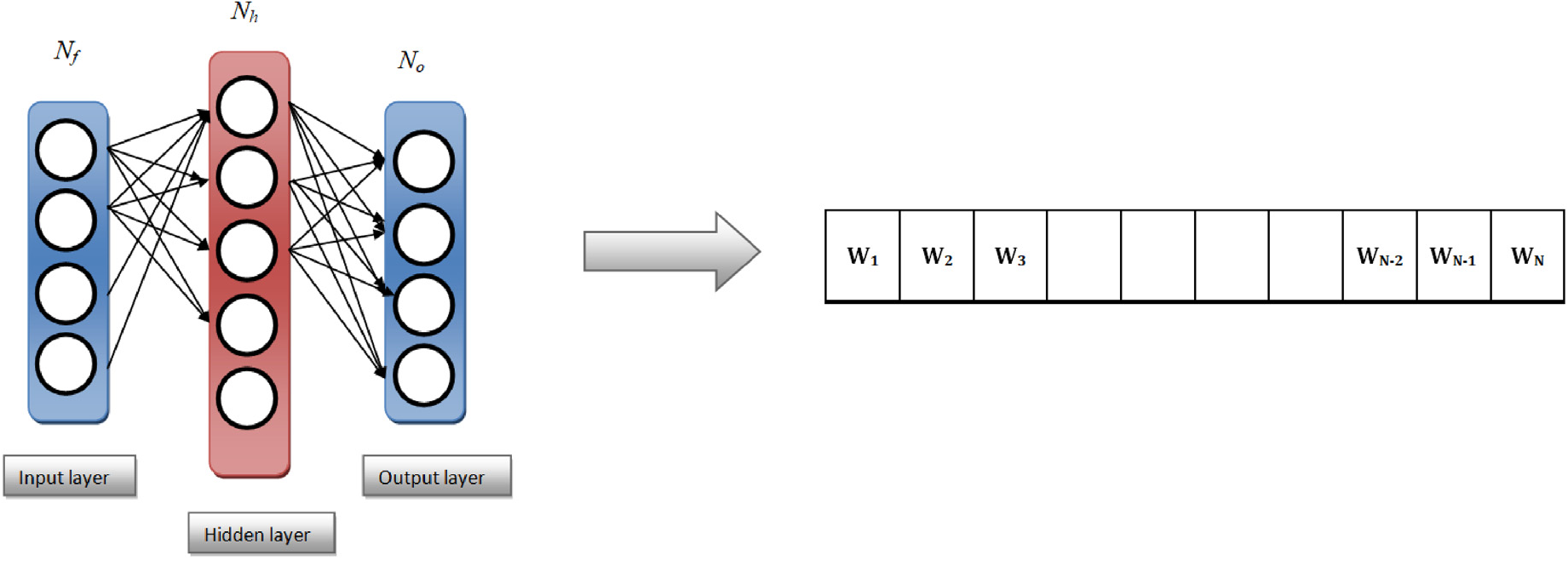 Fig 1: Mathematical formulation of the ANN weight optimization problem.
Experiments: Superior Precision and Robustness
The model was tested against several heavyweights: standard MLP, Particle Swarm Optimization (PSO-ANN), and Cuckoo Search (CS-ANN).
1. Accuracy Comparison
NN-MFPA didn't just win; it dominated the field:
- MLP-FFN: RMSE 0.2125
- NN-PSO: RMSE 0.1575
- NN-MFPA: RMSE 0.0019
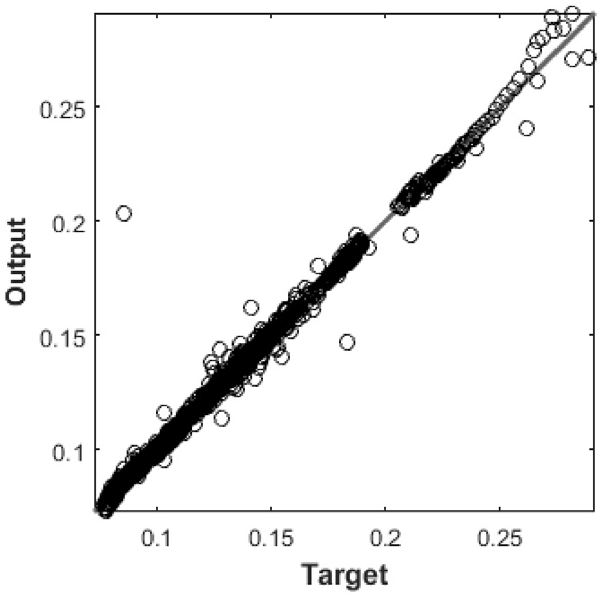 Fig 2: Regression plot showing the near-perfect fit of NN-MFPA predictions.
2. Stability Analysis
Agricultural sensors aren't perfect—weather varies and hardware fails. The authors performed a Stability Analysis by adding a perturbation value (β) to the test data. While other models degraded rapidly, NN-MFPA maintained an RMSE below 0.081 even under stress, proving its readiness for the "messy" real world.
Critical Insight & Future Outlook
The brilliance of this work lies in recognizing that soil moisture is not just a data problem, but an optimization problem. By refining the Lévy flight mechanism with McCulloch’s method, the authors balanced exploration (searching new areas) and exploitation (refining the best guess).
Future Directions:
- Multi-Objective Optimization: Training the ANN not just for accuracy, but also for computational efficiency on edge devices (like IoT sensors).
- Cross-Domain Application: Applying MFPA-ANN to other volatile fields like solar radiation estimation or forest type classification.
Conclusion
The NN-MFPA model provides a robust, statistically significant path toward sustainable agriculture. It proves that by tweaking nature-inspired algorithms, we can achieve the precision required to feed a growing global population while conserving our most precious resource: water.