
SoLearn: Transforming E-Learning into a Social Network Experience
Solearn: A Social Learning Network
This paper introduces SoLearn, a social learning network based on the Computer Supported Social Learning (CSSL) paradigm. It integrates Social Web concepts and Social Awareness features into e-learning to overcome the isolation and rigidity of traditional systems, achieving a 90% user familiarity rate by mimicking the Facebook interface.
TL;DR
The paper introduces SoLearn, a platform that shifts the e-learning paradigm toward Computer Supported Social Learning (CSSL). By adopting a "Facebook-like" interface and deep social awareness features, SoLearn addresses the isolation of traditional online education, allowing students to form organic networks and receive personalized recommendations while remaining fully aware of their community's activities.
Beyond the "Lonely Screen": The Motivation
The fundamental flaw in traditional e-learning systems is their mechanical nature. Most systems treat learning as a transaction between a human and a static database of resources. This leads to several pain points:
- Isolation: Learners lack "Social Awareness"—they cannot see what their peers are doing or feeling.
- Technification: Users spend more time learning the software than the actual subject matter.
- Rigidity: Pre-defined groups often fail to match the social capital or personal preferences of the learners.
The authors argue that by leveraging the Social Web (Web 2.0), we can create environments where collective intelligence and social capital drive the educational process.
Methodology: The Architecture of SoLearn
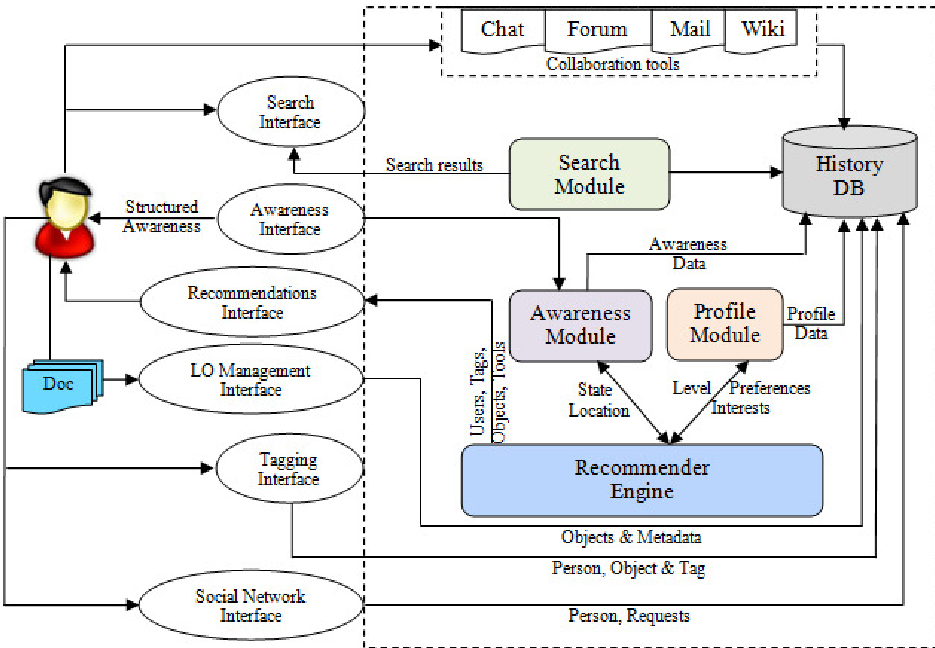
SoLearn is built on the principle that learning is inherently social. The architecture (as seen in Figure 1) hinges on a synergy between social networking and intelligent recommendation.
1. The Recommendation Engine (RE) & The Cold Start
One of the core technical insights is how SoLearn handles new users. Initially, a student doesn't know who the experts are. The RE tracks interactions to build Cognitive, Behavioral, and Social Profiles, gradually refining suggestions for collaborators, tutors, and learning objects as the user participates.
2. Social Awareness Module
This is the "soul" of the system. It manages indicators of activity/inactivity and participation rates. Features like the SoLearn Wall and Activity Traces ensure that users feel the presence of others, mirroring the social cues of a physical classroom.
3. Diverse Networking
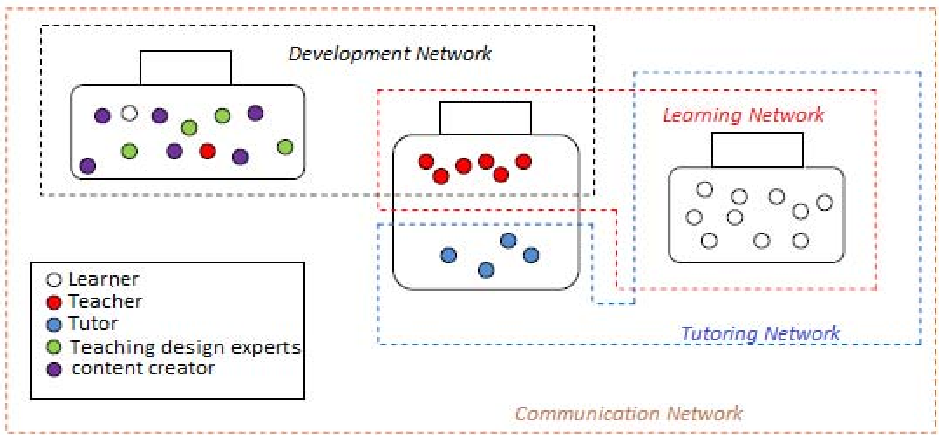
Unlike fixed classroom rosters, SoLearn allows for four specific network types:
- Learning: For peer study.
- Assistance: For seeking help.
- Development: For project building.
- Communication: For general interaction.
User Experience: The Facebook Metaphor
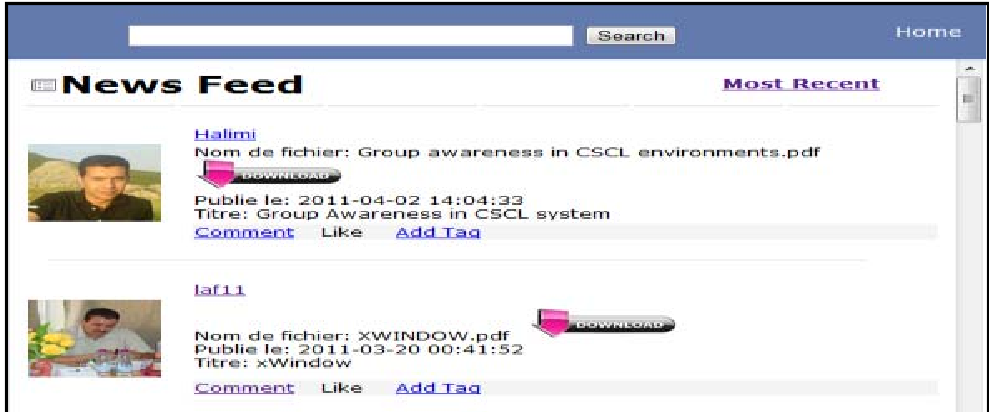
To combat the "technification" problem, the researchers designed SoLearn to look and feel like Facebook. The SoLearn Wall (Figure 3) acts as a virtual classroom where teachers post lessons and students comment, debate, and tag resources.
Experimental Results & Insights
The system was tested at the University of Guelma with very positive feedback:
- Familiarity: 90% of students found the system easy to use because of its similarity to social media.
- Engagement: 95% of students appreciated the ability to choose their own network and be aware of "who is doing what."
- Privacy: Interestingly, despite the constant activity tracking, only 15% viewed it as a privacy violation—most saw it as a necessary component of a "real" classroom feeling.
| Survey Question | Positive Response |
|---|---|
| Like learning in a social site? | 95% |
| Prefer only seeing network updates? | 80% |
| Interesting to find resources via tags? | 30% (Low awareness of Folksonomy) |
Critical Analysis & Future Outlook
Strengths: The "Social Awareness" focus is a powerful solution to the drop-out rates in remote education. Using familiar UI (Facebook) is a brilliant way to bypass the learning curve of new software.
Limitations: The "Folksonomy" (tagging) feature was least appreciated (30-40%), suggesting that while social interaction is intuitive, collaborative metadata management requires more structured guidance or better UI integration.
Future Work: The authors plan to integrate Semantic Web technologies to refine the tagging process and utilize Social Network Analysis (SNA) to quantify knowledge flows between users more accurately.
Conclusion
SoLearn proves that e-learning doesn't have to be a lonely experience. By blurring the lines between social networking and education, we can create more flexible, engaging, and human-centric digital classrooms.