
SonetRank: Why Your Social Circles Hold the Key to Better Search
SonetRank: Leveraging Social Networks to Personalize Search
SonetRank is a personalized search framework that leverages Socially-Aware Search (SAS) graphs to re-rank Web results. It integrates individual click history, aggregate preferences from social groups, and global query patterns using an authority-flow algorithm, achieving SOTA ranking performance in social contexts.
TL;DR
Search engines often struggle with ambiguous queries like "City of Hope" (is it a movie, a city, or a hospital?). SonetRank solves this by building a Social-Aware Search (SAS) Graph. By blending your personal history with the collective wisdom of your social groups (e.g., Facebook groups), it delivers a 36%-62% improvement in ranking quality over traditional methods.
The "Group-Think" Problem in Search
Personalization usually works in two extremes:
- Too Individual: It only looks at your past clicks. If you're searching for something new, the engine is blind.
- Too Generic: It clusters you into a "segment." Everyone in that segment gets the same results, ignoring your unique tastes.
SonetRank identifies a middle ground: Social Groups. If you belong to a "Leukemia Awareness" group, your search for "cancer research" should look different from someone in a "Breaking Bad Fans" group, even if you both click on similar things occasionally.
Methodology: The Social-Aware Search (SAS) Graph
The core innovation is a heterogeneous graph that maps the relationships between four distinct entities: Users, Groups, Queries, and Documents.
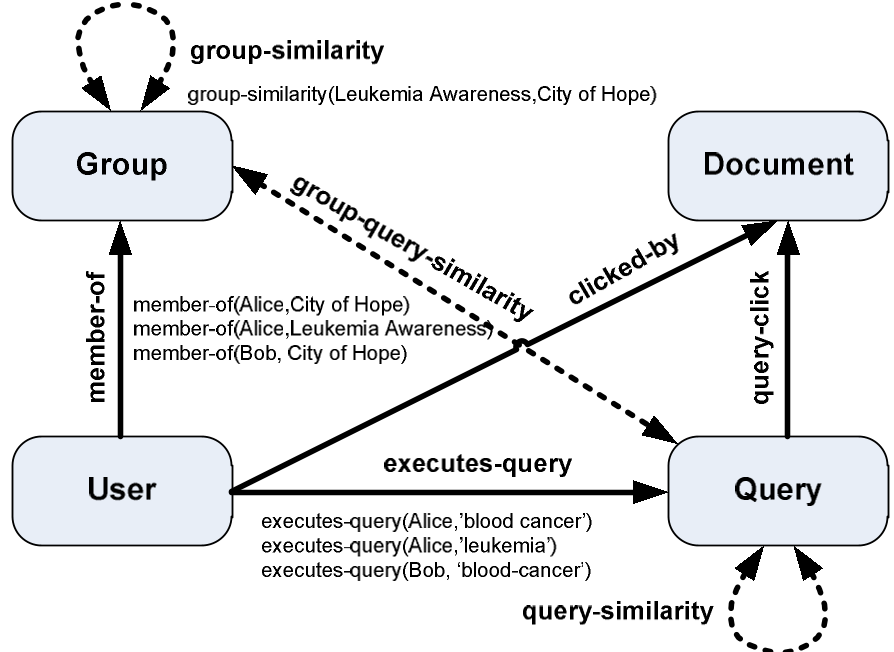
The Secret Sauce: Balanced Authority Flow
Using a standard PageRank on this graph would fail because queries might have hundreds of similarity edges while users have only a few. This causes the "authority" to drown in certain nodes. SonetRank introduces an Authority Transfer Factor to ensure that information flows fairly between different types of nodes (e.g., from a Group to a Query).
Adaptive Merging
SonetRank doesn't blindly trust the social graph. It calculates a Confidence Factor () using SimRank. If the graph is "rich" (i.e., you and your query are closely connected through many common paths), it relies heavily on social re-ranking. If the query is niche or new, it falls back to the standard search engine ranking.
Experiments: Proving the Hype
The researchers tested SonetRank using Amazon Mechanical Turk workers across "Movie Fan" groups (Comedy vs. Mafia genres).
Key Findings:
- Significant Gains: SonetRank achieved an NDCG@5 of 0.275, compared to 0.125 for a standard search engine.
- Growth Potential: As more people joined and the graph became "denser," the confidence factor grew, leading to even better precision over time.

Table 2: SonetRank vs. Baselines (Baseline 1: Google, Baseline 2: Click-graph, Baseline 3: No-Groups).
Critical Insight & Conclusion
The genius of SonetRank lies in its principled hierarchy of signals:
- Personal Preference (Highest weight)
- Related Group Preference (Medium weight)
- Global Network Preference (Lowest weight)
By organizing these into a graph, the system can "backfill" relevance information. If Alice clicks a link and Bob is in a similar group, Bob benefits from Alice's discovery.
Limitations: The reliance on explicit group subscription may be a bottleneck in an era where social media privacy is tightening. Future iterations might need to infer "latent groups" through behavior rather than just explicit memberships.
Takeaway: Personalized search is moving away from "what you did" toward "who you are connected to." SonetRank provides the mathematical framework to make that transition possible.