
sonSQL: Bridging the Gap Between Social Complexity and Relational Rigor
sonSQL: An Extensible Relational DBMS for Social Network Start-Ups
sonSQL is an extensible relational DBMS variant of MySQL specifically designed for social network start-ups. It utilizes a core conceptual schema called sonSchema to map complex social interactions—users, products, and relationships—into a robust, relational framework.
Executive Summary
TL;DR: sonSQL is a specialized variant of MySQL designed to be the "out-of-the-box" database solution for social network start-ups. It abstracts the chaotic nature of social data into a structured relational schema called sonSchema, allowing founders to build scalable social platforms without deep database expertise.
Market Positioning: Unlike modern NoSQL or Graph-only solutions, sonSQL doubles down on the reliability of Relational DBMS (RDBMS). It is a "structural middleware" that provides the mature optimization of SQL while handling the heterogeneous "products" and "interactions" typical of social networks.
Problem & Motivation: The Start-up Dilemma
Most social network start-ups face a "technical debt trap." They either:
- Build ad-hoc relational tables that become unmanageable as features (like blogs, games, or tagging) are added.
- Adopt graph databases that, while intuitive for "friends," often lack the robust query optimization, concurrency control, and crash recovery that the RDBMS world has perfected over decades.
The authors argue that a social network database must possess an expressive query language and integrity constraints. Their insight? Social networks are not just graphs; they are ecosystems of users, products, and cumulative interactions.
Methodology: The Architecture of sonSchema
The core innovation is sonSchema, a conceptual blueprint that categorizes all social data into four pillars:
- Users & Relationships: Friendships, followers, and groups.
- Social Products: Photos, blogs, coupons, or courses.
- Product Activity: Linking users to products (e.g., voting, buying).
- Product Relationships: Links between items (e.g., a poll attached to a meeting).
System Architecture
sonSQL stands as a layer between the user (SNcreator) and the MySQL engine. It features an Inference Engine (Entity Mapper) that translates simple forms into complex SQL DDL scripts.
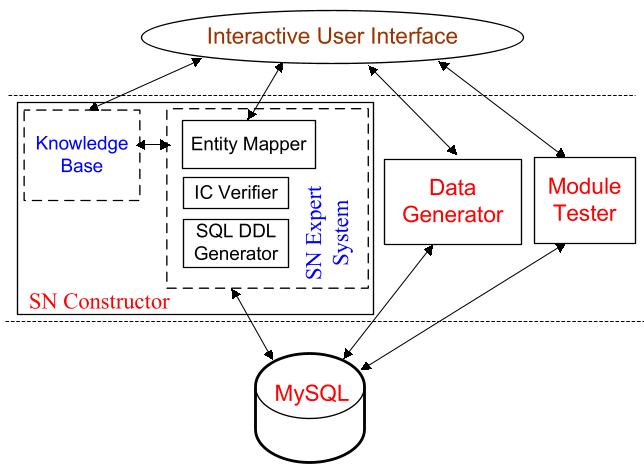 Fig 1. The sonSQL system architecture showing the interplay between the SN Constructor and MySQL.
Designing for Scalability (O4)
A critical technical highlight is the schema's mathematical purity. sonSQL enforces Boyce-Codd Normal Form (BCNF). This isn't just academic—BCNF allows the system to perform updates without expensive integrity checks, which is vital for heavy-workload distributed systems.
Furthermore, the schema is hypergraph-acyclic. This property allows for a "full reducer," enabling sonSQL to identify "bushy" strategies for multi-way joins that execute significantly faster than standard optimizers in PostgreSQL or MySQL.
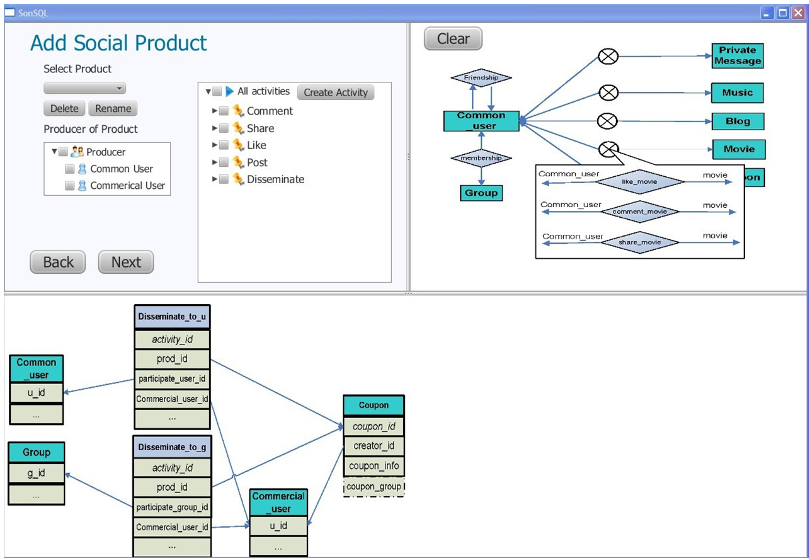 Fig 2. The 3-level view: From high-level social concepts to low-level relational tables.
Experiments & Results
The demonstration proves that a novice "SNcreator" can instantiate a complex site (like a sports news social hub) by simply identifying the domain and following a rule-based expert system.
Key achievements include:
- Expert System Integration: Automatic generation of DDL/DML scripts based on user intents.
- Constraint Verification: The "IC Verifier" ensures that even as the schema is modified/updated, it remains technically sound and BCNF-compliant.
- Performance Potential: By exploiting acyclicity, the system sets the stage for social-aware query optimization that outperforms general-purpose RDBMS engines.
Critical Analysis & Conclusion
Takeaway
sonSQL successfully argues that "Social" is a first-class data type that deserves its own optimized relational schema. It proves that you don't need to abandon SQL to build a flexible social graph.
Limitations
While sonSQL excels at structure and consistency, the demonstration focuses on the "creation" phase. It remains to be seen how sonSchema handles extremely sparse data or unstructured "likes" compared to modern NoSQL document stores or specialized vector databases used in contemporary social recommendation engines.
Looking Forward
The research into "bushy join trees" for sonSchema is the most exciting frontier. If the team can prove that social-specific schemas consistently lead to faster multi-way join execution, it could redefine how we architect the backends of the next generation of social platforms.