
SoRecGAT: Decoding Influence through Multi-Head Graph Attention for Social Recommendation
SoRecGAT: Leveraging Graph Attention Mechanism for Top-N Social Recommendation
The paper proposes SoRecGAT, a novel Graph ATtention framework for Top-N social recommendation. It integrates user-item interaction networks and social networks into a unified heterogeneous graph, utilizing multi-head and multi-layer attention to learn specific influence weights between entities.
TL;DR
SoRecGAT is a cutting-edge recommendation framework that treats social connections and user-item interactions as a unified heterogeneous graph. By replacing static similarity assumptions with a Multi-head Graph Attention Mechanism (GAT), it learns the specific "weight" of influence each friend or item has on a user, significantly boosting Top-N recommendation performance even in extremely sparse data environments.
Problem & Motivation: The Fallacy of Equal Influence
In traditional social recommendation, the underlying assumption has often been that "all friends are created equal." Most models (like DeepSoR or SBPR) treat social links as binary or static constraints. However, in reality, your "friend" who shares your niche taste in jazz has a much higher influence on your next purchase than a high school acquaintance with different hobbies.
Moreover, when dealing with implicit feedback (where we only know if a user interacted with an item, not why), the challenge is twofold:
- We must estimate the "quantum of influence" between entities.
- We must bridge the gap between two different networks (User-Item vs. User-User).
Methodology: The Core of SoRecGAT
1. Unified Heterogeneous Graph
The authors solve the data silo problem by mapping users, items, and social connections into a single graph . To handle the different nature of relations, they introduce "Social Entities" as bridge nodes. This allows the model to treat social influence and item preference within the same mathematical space.
2. Multi-Head Attention Mechanism
The heart of the model is the attention layer. Instead of a simple dot-product, it uses a parameterized feedforward network to calculate the importance of neighbor to node :
By using Multi-head Attention, the model can attend to different "features" of influence simultaneously—one head might capture professional influence, while another captures leisure interests.
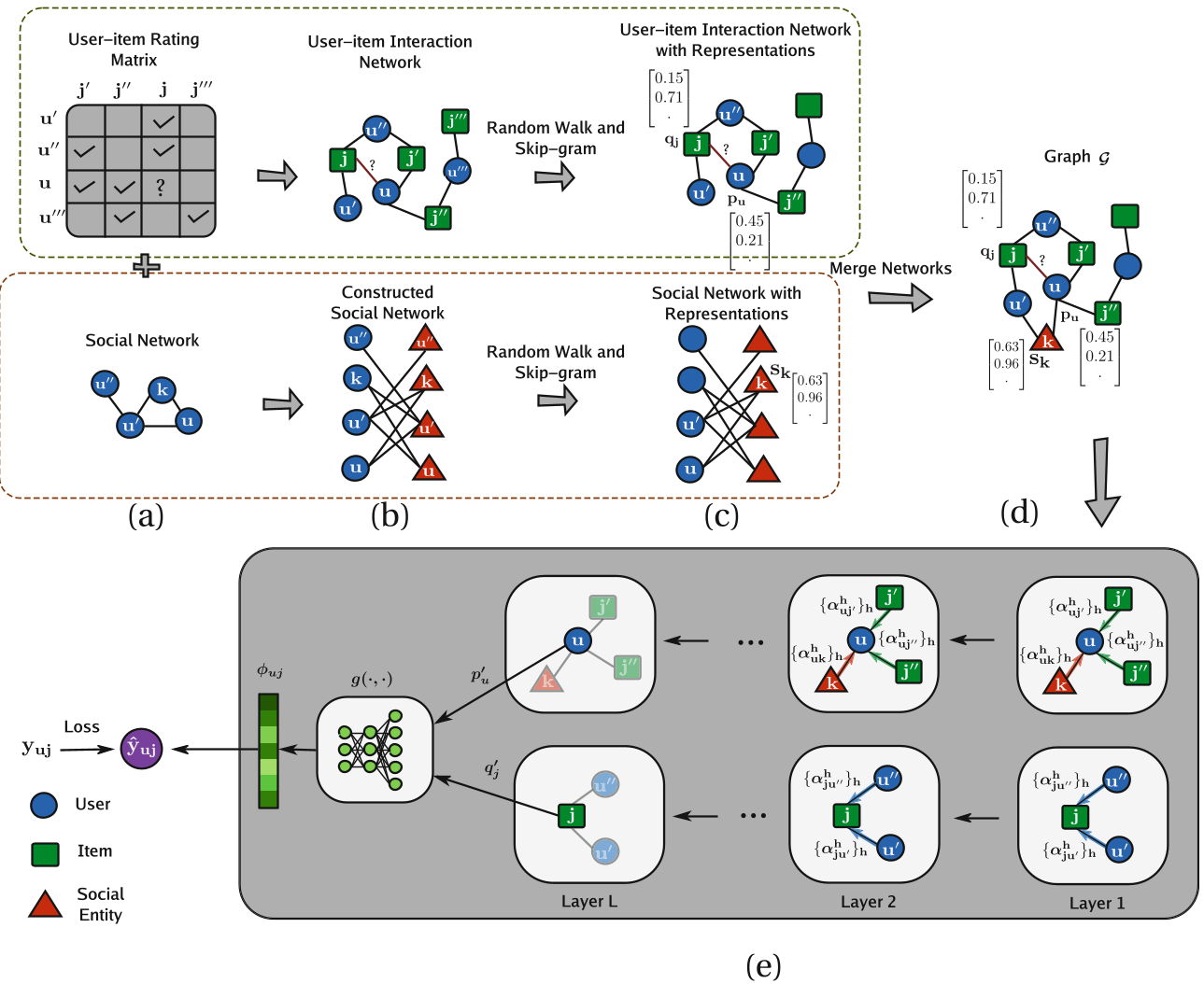 Figure 1: The SoRecGAT framework, illustrating the transformation from raw matrices to a unified graph and the subsequent multi-layer attention stack.
3. Node Initialization (Skip-Gram)
Unlike standard GNNs that might start with random vectors, SoRecGAT uses metapath-based random walks and Skip-gram (similar to DeepWalk) to generate initial embeddings. This ensures that the global structure of the network is baked into the nodes before the attention mechanism begins fine-tuning the local influences.
Experiments & Results
Authors compared SoRecGAT against a heavy-hitting field, including:
- Matrix Factorization Baselines: BPR, TrustSVD, SBPR.
- Deep Learning Baselines: NeuMF, DeepSoR, SAMN.
Key Performance Findings:
- Consistent SOTA: On datasets like Amazon CD and Yelp Food, SoRecGAT outperformed the previous best (NeuMF/SAMN) across both Hit Ratio (HR@5) and NDCG@5.
- Sparsity Resilience: As training data was reduced to 20%, the performance gap between SoRecGAT and traditional models widened. This proves that graph-based influence learning is a powerful cure for the "cold start" or sparse data problem.
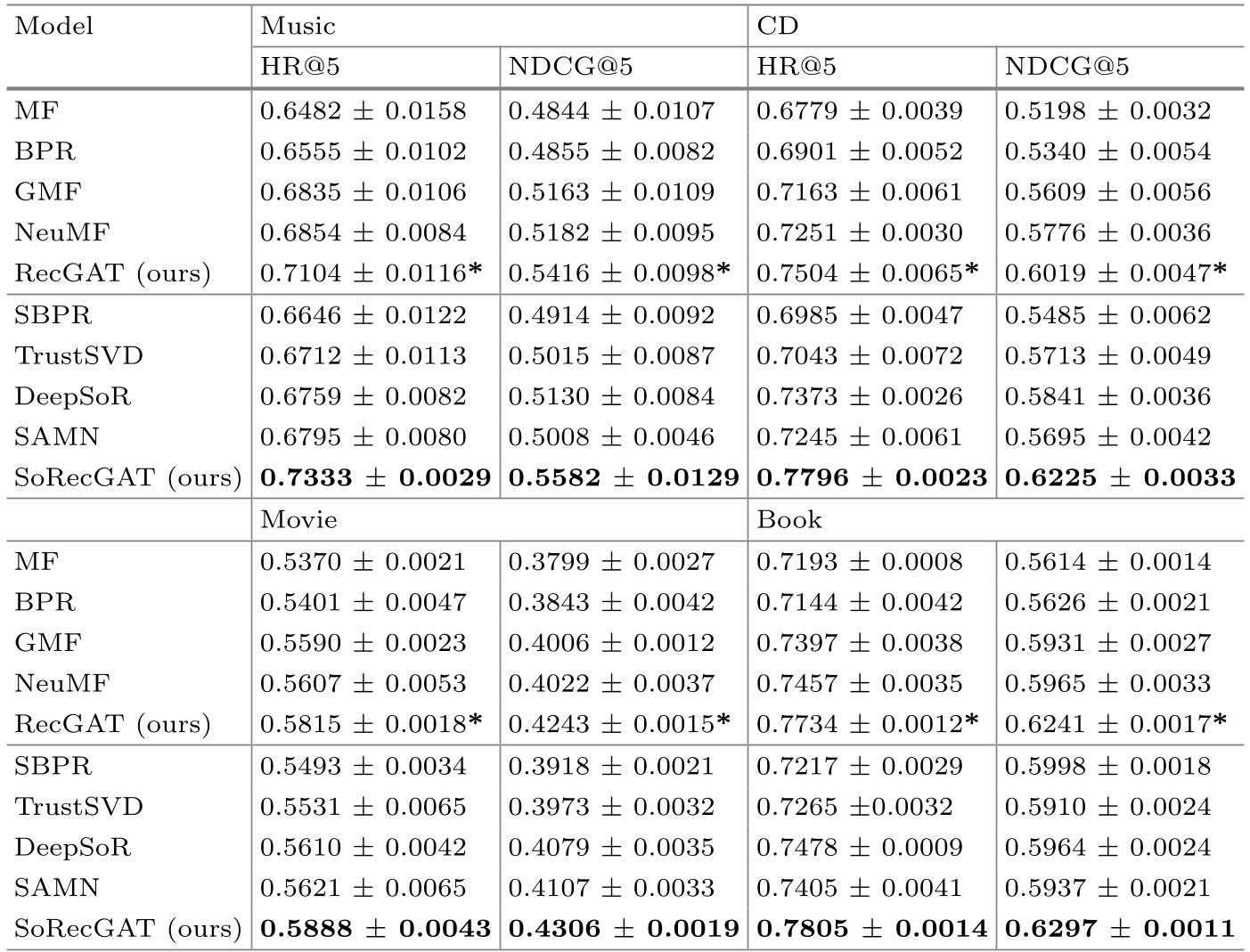 Table 2: Performance comparison on Amazon datasets. Note the significant lead of SoRecGAT over state-of-the-art Neural Collaborative Filtering (NeuMF).
The "Aha!" Moment: Ablation Study
The authors conducted an experiment varying the number of attention heads (from 2 up to 20). The results showed a clear "U-shape" curve: performance peaks at around 8-12 heads. This confirms that influence is multi-faceted; you need enough "heads" to capture the complexity, but too many lead to overfitting on noise.
Critical Analysis & Conclusion
Takeaway
SoRecGAT successfully proves that influence is a learned dynamic, not a static graph property. By unifying heterogeneous networks into a single attention-driven space, it provides a flexible blueprint for modern recommendation engines that need to ingest diverse data sources like trust scores, co-purchase graphs, and friendship networks.
Limitations
- Computational Overhead: While attention is powerful, calculating multi-layer, multi-head weights for every edge in a massive graph (like Restaurant with 1M+ connections) is computationally expensive compared to simple MF.
- Static Nature: The current model doesn't explicitly account for the temporal decay of influence—a friend's influence from five years ago might be less relevant today.
Future Work
The authors plan to extend this into multimedia recommendation, where the graph nodes could represent different modalities like audio clips or video frames, further leaning into the "heterogeneous" capability of the GAT architecture.