
Precise Soybean Phenotyping: Bridging the Gap Between Field and Lab with DNN Unions
Soybean pod and seed counting in both outdoor fields and indoor laboratories using unions of deep neural networks
The paper introduces a dual-strategy deep learning framework for soybean yield estimation, utilizing YOLOv8 variations (YOLO-SAM and YOLO-DA) for robust outdoor field counting and a Mask-RCNN-Swin Transformer pipeline for high-precision indoor laboratory analysis. The system achieves SOTA performance in both environments, significantly automating the phenotypic process.
Executive Summary
TL;DR: This study presents a comprehensive solution for counting soybean pods and seeds in both uncontrolled outdoor environments and precision-focused laboratories. By leveraging YOLOv8 with Domain Adaptation (YOLO-DA) for the field and a Mask-RCNN + Swin Transformer pipeline for the lab, the researchers achieved significant reductions in Mean Absolute Error (MAE), effectively handling severe occlusion and complex backgrounds.
Positioning: This work moves beyond simple object detection by treating agricultural counting as a multi-domain challenge, combining foundation models (SAM) and synthetic data strategies to reach "near-perfect" accuracy in controlled settings while maintaining robustness in the wild.
Problem & Motivation
Manual counting of soybean pods—a critical metric for yield prediction—is a notorious bottleneck in breeding. Existing automated solutions face a "two-world" problem:
- The Field Chaos: In outdoor images, pods overlap, and backgrounds are cluttered. Previous point-based models like P2PNet-Soy only count what they "see," failing to estimate occluded seeds.
- The Lab Precision Trap: While indoor setups have clean backgrounds, current models still struggle with high-error margins in seed-per-pod estimation, often due to small, non-representative datasets.
The authors' insight was to stop looking for a "silver bullet" and instead design specific unions of neural networks tailored to the unique noise profiles of each environment.
Methodology: The Core Architecture
1. Outdoor: YOLOv8-DA (Domain Adaptation)
To handle the diversity of soybean varieties and lighting, the authors integrated a Gradient Reversal Layer (GRL) and a discriminator into the YOLOv8 backbone.
- The Intuition: By forcing the feature extractor to "confuse" the discriminator about whether an image is from a controlled lab set or a messy field set, the model learns domain-invariant features.
- Occlusion Handling: Unlike previous works, the authors annotated pods as whole units even when partially hidden, training the model to "infer" the existence of occluded seeds.
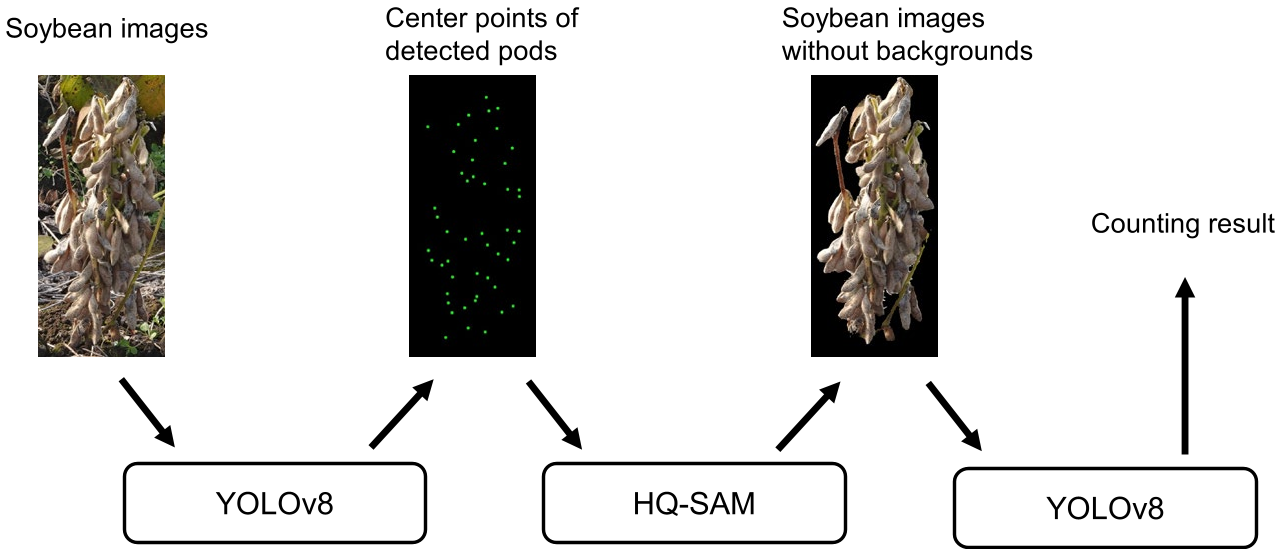 Fig 1. The YOLOv8-SAM pipeline: Using HQ-SAM to extract point-prompted masks and eliminate background noise.
2. Indoor: Mask-RCNN-Swin
For the lab, the authors moved away from regression.
- Step A: Mask-RCNN segments individual pods.
- Step B: A Swin Transformer treats the number of seeds (1, 2, 3, or 4) as a classification task. Since seed counts are discrete, classification is inherently more stable than regression.
- Data Synthesis: To overcome data scarcity, they created 2,800 synthetic images by randomly rotating and placing real pod masks on black backgrounds, achieving massive scale from just 80 real images.
Experiments & Results
The results demonstrate a clear hierarchy of performance. In outdoor trials, YOLO-DA emerged as the winner, balancing inference speed with accuracy.
| Task | Method | MAE (Lower is better) |
|---|---|---|
| Pod Counting (Field) | YOLOv8m-DA | 6.13 |
| Seed Counting (Field) | YOLOv8m-DA | 10.05 |
| Seed Counting (Lab) | Mask-RCNN-Swin | 1.33 |
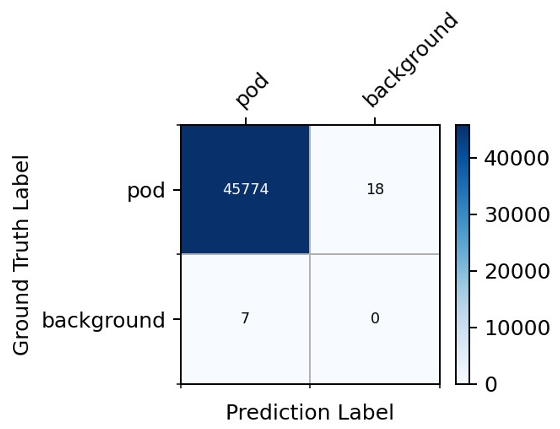 Fig 2. Visual evidence of the model's ability to detect and categorize pods even under significant mutual occlusion.
Key Insights from Ablation:
- Component Value: Using HQ-SAM (YOLO-SAM) significantly improved results over vanilla YOLO by cleaning the input, but it added inference latency.
- Swin Advantage: The Swin Transformer module reduced the indoor seed counting error from 3.57 (Standard Mask-RCNN) to 1.33, proving that hierarchical attention is superior for fine-grained agricultural classification.
Critical Analysis & Conclusion
Takeaway: This paper proves that Domain Adaptation is a powerful tool for agricultural AI, where "perfect" field data is expensive to label. Furthermore, the success of the lab-based synthetic training suggests that we can achieve high-precision phenotyping with very little manual effort.
Limitations: While YOLO-DA is efficient, the YOLO-SAM variant is computationally heavy for real-time mobile deployment due to the SAM backbone. Future work should focus on distilling SAM into lighter architectures for edge devices.
Future Outlook: The integration of these models into an open-source platform (GitHub Link) paves the way for a unified "Field-to-Lab" digital pipeline in soybean breeding.