
Space-Optimal Proportion Consensus: Moving Beyond Simple Majority in Population Protocols
Space-Optimal Proportion Consensus with Population Protocols
This paper introduces the Proportion Consensus Problem for population protocols, where anonymous agents must reach a unanimous agreement on the range containing the fraction of initial views. The authors propose the Proportion Consensus Protocol (PCP), which achieves SOTA space efficiency by requiring only states to reach consensus within a precision of .
TL;DR
In the world of distributed computing with "tiny" agents (like sensors or DNA molecules), reaching a consensus is hard. While most protocols just tell you who won (Majority), this paper presents a protocol that tells you by how much they won (Proportion). It introduces a space-optimal method for all agents to agree on a specific range containing the true proportion of initial opinions, using a near-minimal number of memory states.
Background: The Limits of Modern Consensus
Population protocols (PP) model systems of identical, finite-state agents that interact randomly. The classic "Majority" problem is well-studied, but it’s binary. In many real-world scenarios—such as triggering a collective response in a sensor network or a biological system—it is critical to know if 51% or 99% of agents have detected an event.
The core challenge is achieving Agreement. Previous attempts at "Proportion Computation" allowed agents to estimate the fraction locally, but they didn't guarantee that every agent would eventually output the exact same range. This paper bridges that gap.
The Core Challenge: The Precision-Space Trade-off
The authors first prove a discouraging but essential reality: if you want more precision (), you must pay with more states. They establish a lower bound showing that at least states are necessary. This sets the stage for their proposed protocol, which aims to stay as close to this limit as possible.
Methodology: Averaging and Labeling
The proposed Proportion Consensus Protocol (PCP) uses a clever combination of arithmetic and logic:
- Weight Averaging: Each node starts with a weight (e.g., for view A, for view B). When two nodes meet, they "average" their weights. If the sum is odd, one node takes the floor and the other the ceiling. This ensures the global sum is conserved.
- The Labeling Trick: Weights alone aren't enough because the true average might be a fraction (e.g., 0.5), while agents only hold integers (0 or 1). The protocol uses three labels:
- L (Left): Weight is likely higher than the average.
- R (Right): Weight is likely lower than the average.
- E (Equal): Weight is exactly the average.
Through a set of transition rules, agents swap these labels and weights until the entire population settles on the same interval.
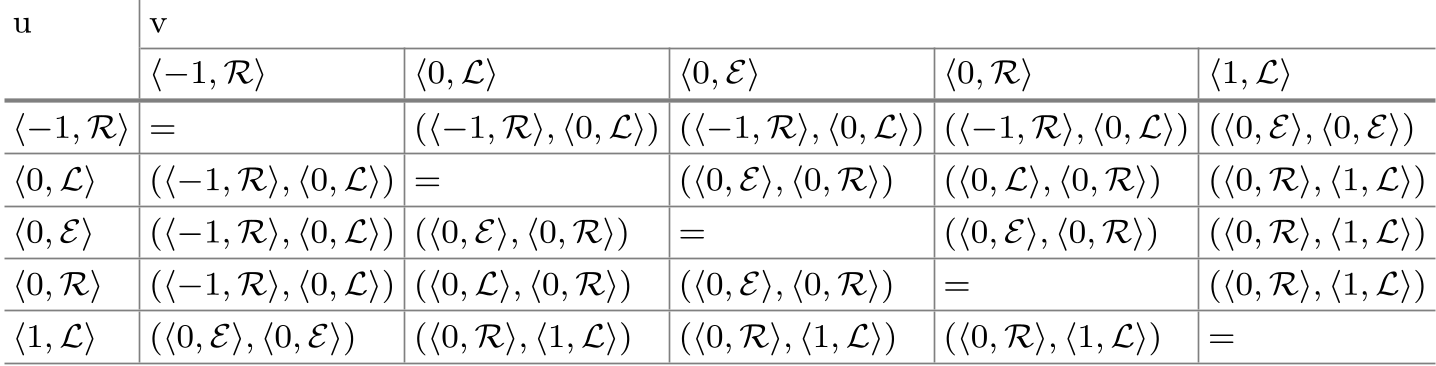 Figure 1: Transition function for the PCP with k=1. Note how weights balance and labels (L, E, R) propagate to reach consensus.
Experimental Insights: Performance and Accuracy
The protocol was analyzed across different network topologies:
- Complete Graphs: Reaches consensus in interactions.
- Arbitrary Graphs: Reaches consensus in interactions.
The "Case II" analysis in the proof is particularly interesting—it handles the situation where the true proportion doesn't land perfectly on an integer weight. By using the labels to "break ties," the protocol ensures that even if weights differ by 1 (the closest possible integer approximation), the output function maps these different internal states to the same external output symbol.
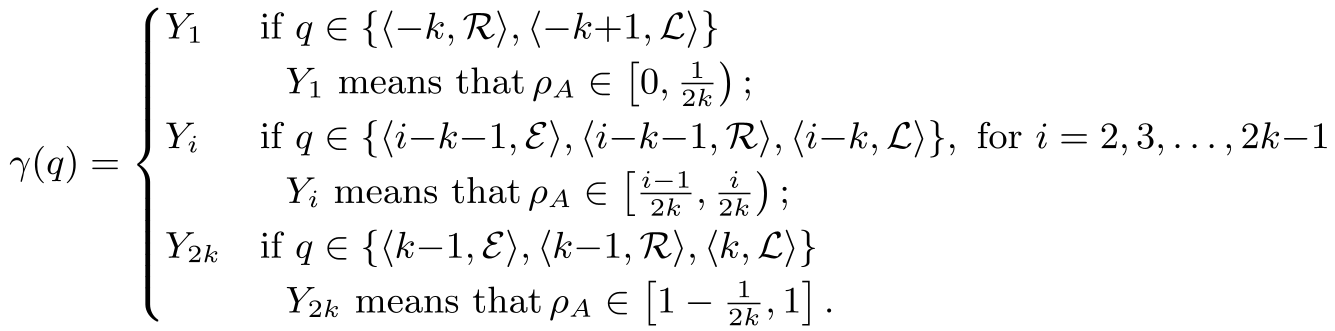 Figure 2: The output function mapping internal states to fixed proportion ranges.
Critical Analysis & Conclusion
The PCP is a significant step forward because it addresses the "Stabilizing Consensus" requirement that previous proportion protocols ignored. Its 5-state configuration for simple majority (where ) even outperforms some specialized 6-state majority protocols by handling ties more elegantly.
Limitations: The convergence time on arbitrary graphs is theoretically steep. While the protocol is space-optimal, there is likely a "speed-space-accuracy" triple trade-off that remains to be fully optimized in future work.
Future Outlook: This framework could be extended to "Plurality Consensus" (more than two opinions) or adapted for noisy environments where agent interactions might occasionally fail.