
CSCVP: Bridging NLP and Mobility for Next-Venue Prediction in Sparse Social Networks
Sparse User Check-in Venue Prediction By Exploring Latent Decision Contexts From Location-Based Social Networks
This paper introduces the Context-aware Sparse Check-in Venue Prediction (CSCVP) scheme, a novel framework designed for Location-Based Social Networks (LBSN). By integrating Temporal-Aware Ngram (TA-Ngram) and Probabilistic Latent Semantic Analysis (PLSA) via a co-training framework, it achieves a significant 30.9% accuracy improvement over state-of-the-art methods in predicting next-venue check-ins.
TL;DR
Predicting where a user will "check in" next on social networks like Foursquare or Yelp is notoriously difficult due to data sparsity. Most users only record a fraction of their daily movement. The CSCVP scheme flips the script by treating location traces like language. By first predicting the category of a venue (using NLP-inspired Ngrams and Topic Modeling) and then narrowing down the specific venue, it achieves a massive 30.9% performance leap over prior SOTAs.
The "Why": Why Traditional Markov Chains Fail
Most existing models rely on the "consecutiveness" assumption: they believe your next location depends primarily on where you were 5 minutes ago. However, LBSN data is sparse. If Alice checks into a restaurant today and a movie theater three weeks later, there is likely zero temporal dependency between those two consecutive data points.
Current models also ignore the Latent Decision Context. They see "Saturday Night" as a timestamp, but they don't see the "Party" or "Relaxation" intent behind it—the hidden state that actually drives the behavior.
Methodology: The Two-Step Semantic Approach
The core innovation of CSCVP is its two-step prediction pipeline combined with a semi-supervised co-training framework.
1. Reducing the Prediction Space
Instead of guessing one venue out of 100,000, CSCVP first predicts one of 9 top-level categories (e.g., "Food", "Arts & Entertainment"). This significantly reduces the noise and allows the model to work even when user data is thin.
2. The Multi-View Predictor
The model looks at user behavior from two "views":
- TA-Ngram (Syntactic View): Captures temporal transitions. It uses a "breaking character" (like a period in a sentence) to stop the model from learning fake dependencies during long gaps in check-ins.
- PLSA (Semantic View): Uses Probabilistic Latent Semantic Analysis to map observable contexts (weather, time, day) to latent decision states.
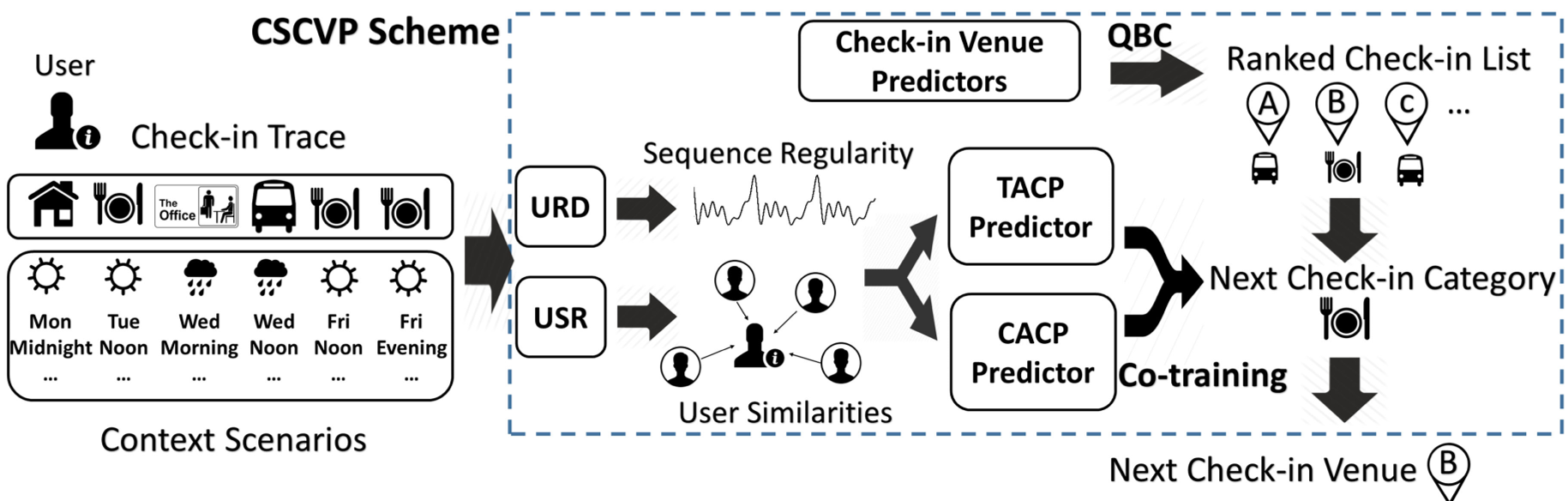 Figure 1: Overview of the CSCVP System Architecture.
3. User Similarity Regulation (USR)
If Alice only has 5 check-ins, the model looks at "Peer Influence." By calculating similarities in check-in patterns and context preferences, the system "borrows" intelligence from similar users to fill Alice's data gaps.
Experiments & Results: Robustness in the Wild
The researchers tested CSCVP in New York, Tokyo, and Paris. The Paris dataset was the true "stress test," with a mere 16.1 check-ins per user on average.
- Accuracy: CSCVP outperformed baselines like ST-LDA and GeoCF across the board.
- Confusion Matrix Analysis: One of the most striking findings was the model's ability to distinguish between "Shop" and "Food." Baselines often confuse the two because users tend to visit them in quick succession. CSCVP used the Latent Decision Context (e.g., "Weekend + Sunny") to correctly identify shopping intent.
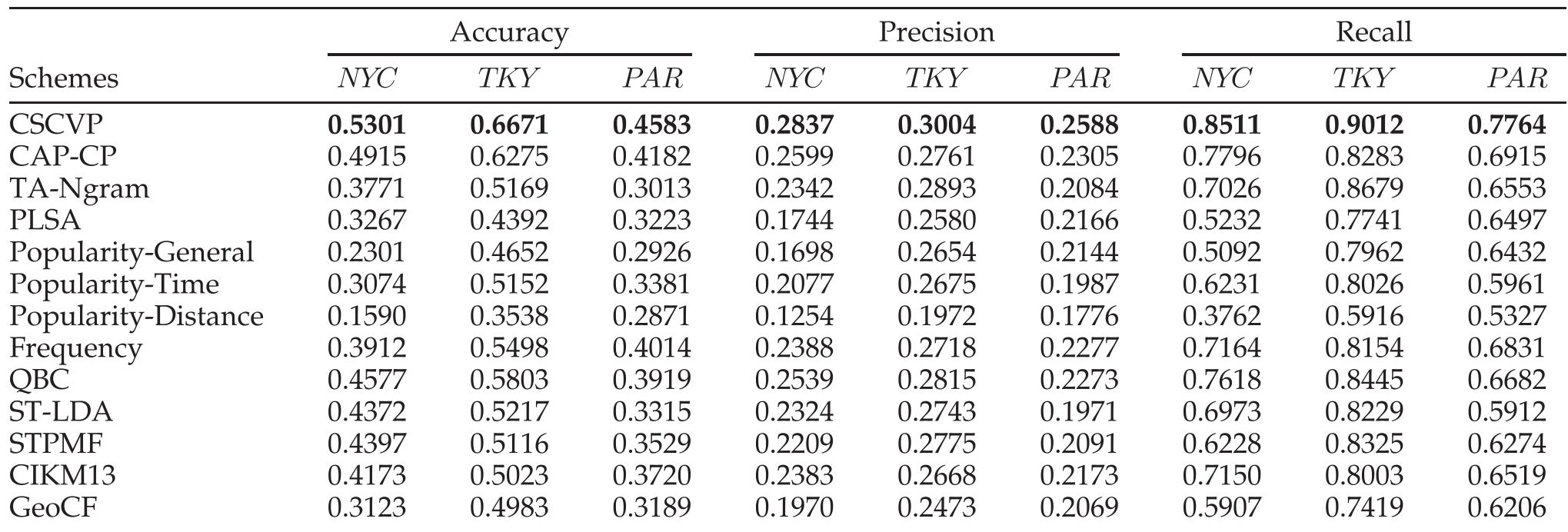 Table 1: Category Prediction Performance across NYC, Tokyo, and Paris traces.
Critical Insight: The Entropy of Movement
A fascinating subset of the study was the User Regularity Detection. The authors used information theory (entropy) to determine how predictable a user is. They found that Tokyo users have much lower entropy (1.796) compared to New Yorkers (2.351), meaning Tokyo mobility is inherently more regular—likely due to structured commuting patterns. The CSCVP system dynamically adapts to this by emphasizing the TA-Ngram for regular users and PLSA for irregular ones.
Summary & Future Outlook
CSCVP proves that mobility prediction is a language problem. By treating check-in sequences as syntax and environmental factors as semantics, we can overcome the massive data gaps inherent in social sensing.
Limitations: The current model focuses on top-level categories. Future iterations could benefit from a hierarchical approach that tackles the thousands of "sub-categories" (e.g., "French Restaurant" vs. "Sushi Bar") to provide even more granular recommendations.
Takeaway: For developers and researchers, the lesson is clear: when data is sparse, don't just hunt for more data—search for the latent intent that links the scattered points you already have.