
ST-EM: Decoding Truth from the Chaos of Spatial-Temporal Social Sensing
Spatial-Temporal Aware Truth Finding in Big Data Social Sensing Applications
The paper introduces ST-EM (Spatial-Temporal Aware Expectation-Maximization), a maximum likelihood estimation framework designed for truth finding in social sensing. By integrating the "when" (freshness) and "where" (source distance) of claims, it achieves a 12% precision increase in real-world Twitter scenarios over traditional EM methods.
TL;DR
Social sensing transforms humans into "sensors," but humans are notoriously unreliable. This paper presents ST-EM, a rigorous analytical framework that incorporates spatial distance and temporal freshness into a Maximum Likelihood Estimation (MLE) model. By accounting for where and when a report was made, it significantly outperforms state-of-the-art baselines, hitting a 12% improvement in precision on real-world Twitter data.
Context: Why "What" is Not Enough
Truth finding is the art of determining the veracity of claims (e.g., "The bridge is down") without knowing the reliability of the sources beforehand. Traditional models (like TruthFinder or Regular EM) treat all reports as equal data points. However, in social sensing:
- Temporal Bias: A report made 5 seconds after an event is far more likely to be an original observation than a retweet or 2nd-hand account made 5 hours later.
- Spatial Bias: A user tweeting from the scene of a disaster is generally more credible than a user tweeting from another continent.
The authors argue that ignoring these variables leads to "truth" being drowned out by the volume of remote or late-arriving misinformation.
Methodology: The ST-EM Framework
The core innovation lies in the expansion of the source reliability parameter. Instead of a single probability for source quality, the authors define —the reliability of source given a freshness degree and a distance level .
1. The Mathematical Intuition
The authors use an Expectation-Maximization (EM) approach to handle the "Chicken and Egg" problem: we don't know if the claim is true (latent variable ), and we don't know the parameters of source reliability ().
- E-Step: Calculate the probability that a claim is true based on who reported it and their current estimated reliability at that specific spatial-temporal context.
- M-Step: Update the source reliability parameters () based on the "consensus truth" established in the E-step, specifically weighting them by distance and time.
2. Model Architecture
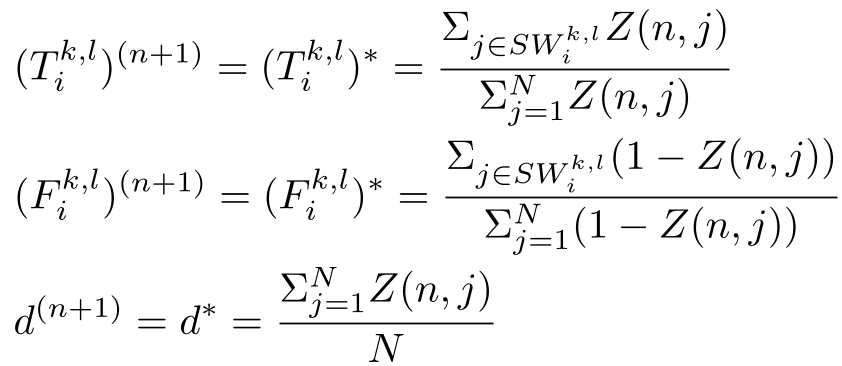 The image above illustrates the iterative update logic (Equation 13) where source parameters are refined based on the latent claim veracity.
Experiments & Results: Putting it to the Test
The framework was tested on a massive dataset from the 2013 Boston Marathon Bombing (123,402 tweets).
Key Findings:
- SOTA Comparison: ST-EM outperformed Voting, Sums, and Regular-EM.
- Precision Boost: ST-EM identified 12% more true claims than the previous best-performing EM model by filtering out "echoes" (non-fresh reports) and remote rumors.
- Robustness: Simulations showed that even as the number of sources increased, ST-EM's error rate in reliability estimation remained consistently lower than baselines.
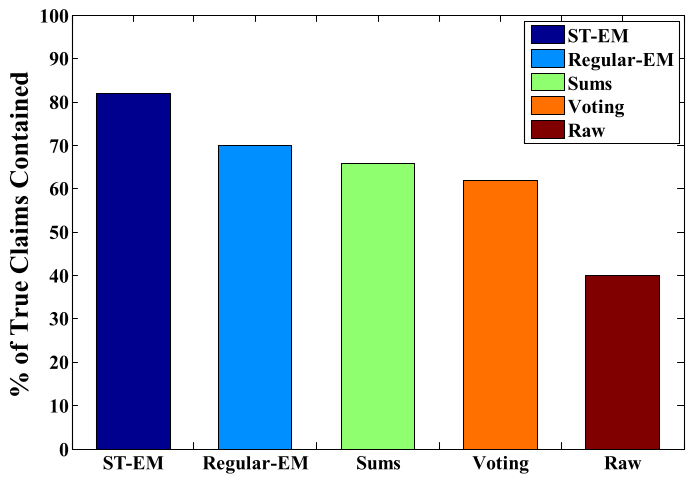 Figure: Comparison of True Claim percentage in the Boston Bombing trace. ST-EM shows a clear margin over traditional EM and Voting methods.
Critical Analysis & Conclusion
The ST-EM framework successfully demonstrates that physical context (space and time) is not just "extra data"—it is a fundamental component of the signal itself.
Limitations:
- Heuristic Dependency: The paper uses simple heuristics for distance (geo-coordinates) and freshness (original tweet vs. retweet). In modern encrypted or privacy-preserving environments, this data might be harder to obtain.
- Binary Constraint: The model focuses on binary (True/False) claims. Extending this to categorical or continuous data (e.g., "The temperature at the fire is degrees") remains an open challenge.
Future Outlook: As we move toward a world of "Big Data Social Sensing," methods like ST-EM provide the necessary mathematical rigor to separate the signal from the noise in the chaotic stream of human observations.