
BSSN: Leveraging "Social" Intelligence for Efficient Cellular Traffic Prediction
Spatial traffic prediction for wireless cellular system based on base stations social network
This paper introduces a Base Stations Social Network (BSSN) framework to predict spatial traffic across a wireless cellular system. By modeling base stations (BSs) as nodes in a social network and identifying Very Important Base Stations (VIBS) using complex network theory, the authors achieve high-accuracy network-wide traffic estimation using only a small subset of BS data and Support Vector Regression (SVR).
TL;DR
Researchers have developed a method to predict the traffic of an entire cellular network by monitoring only 8% of its base stations. By treating base stations as members of a "social network" and identifying highly connected "hubs" (VIBS), they use Support Vector Regression (SVR) to reconstruct the spatial traffic map with a mean error of less than 20%.
Background: The Hidden Connectivity of Cities
Modern cellular networks are exploding with data, making efficient resource management a "holy grail" for operators. Traditionally, traffic was modeled as isolated temporal spikes or simple spatial distributions. However, this paper argues that base stations aren't islands; they are socially connected. If one station in a business district sees a spike, its "friends" (adjacent or functionally linked stations) likely follow a predictable pattern.
Motivation: Why "Social" Networks?
The core insight is that spatial correlation is a powerful, underutilized signal. The authors found that the relationship between base stations is remarkably stable over time (less than 5% parameter error across different weeks). By building a network where edges represent high Pearson correlation coefficients (), they can apply Complex Network Theory to find the "influencers"—the Very Important Base Stations (VIBS).
Methodology: The BSSN-SVR Framework
1. Network Construction
The system processes 15 days of real-world traffic data. A BSSN is created where:
- Nodes: Physical Base Stations.
- Edges: Established if the traffic correlation exceeds a threshold .
- Hubs: BSs with high "degrees" (connected to many others).
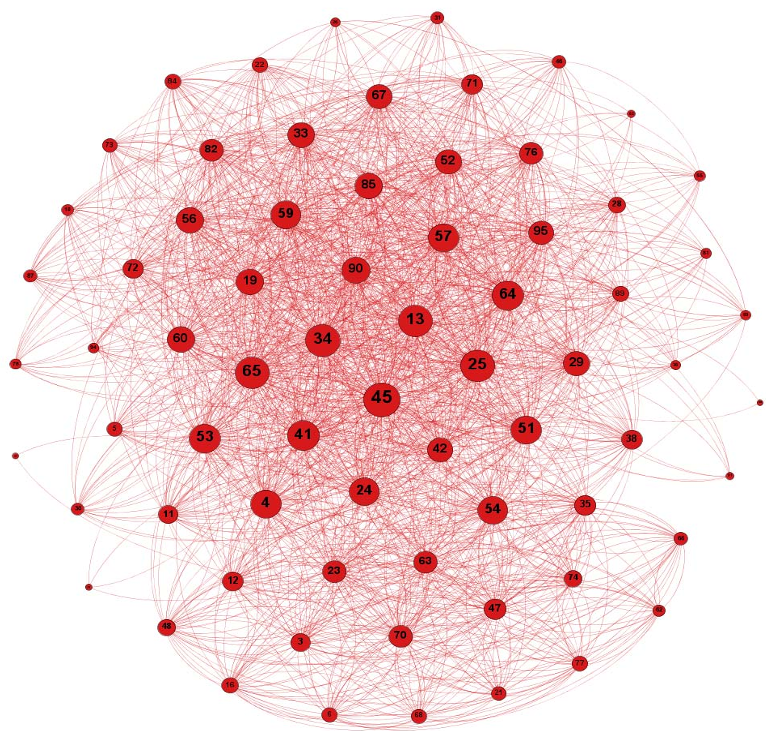 The BSSN visualization: Larger nodes represent VIBS that dictate the network's information flow.
2. SVR Prediction with PSO Optimization
Once the VIBS are identified, their traffic data is fed into a Support Vector Regression (SVR) model. Unlike temporal prediction (predicting tomorrow based on today), this is spatial prediction (predicting Station B based on Station A). The model parameters are fine-tuned using Particle Swarm Optimization (PSO) to find the global optimum for the RBF kernel.
Experiments & Results: Efficiency at Scale
The authors tested their model on 98 base stations in a dense urban area.
- Optimal Sampling: They found that 8 VIBS is the "sweet spot." Fewer stations provide insufficient data; more stations introduce noise that degrades SVR performance.
- Accuracy: The mean SMAPE was 19.7%. This proves that a tiny fraction of the network can act as a "proxy" for the whole.
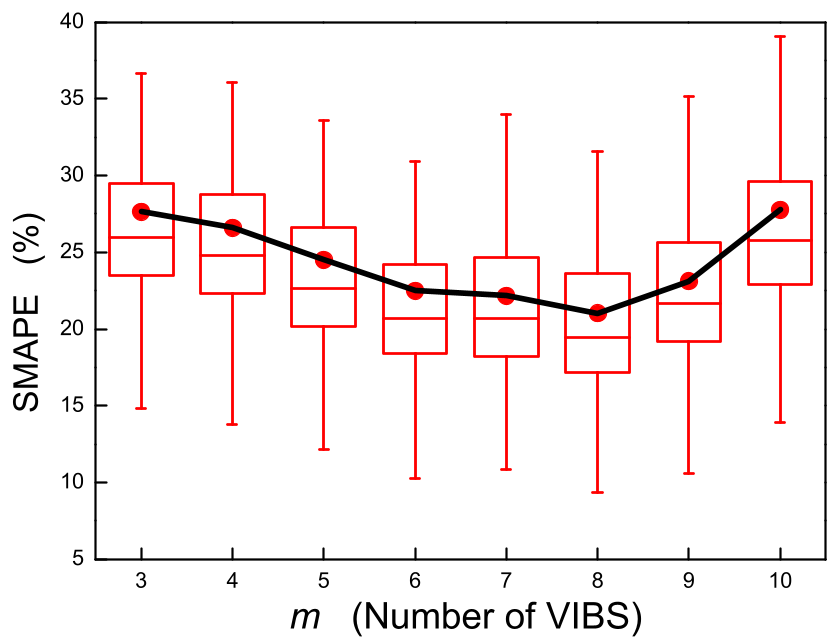 Analysis of prediction performance relative to the number of VIBS selected.
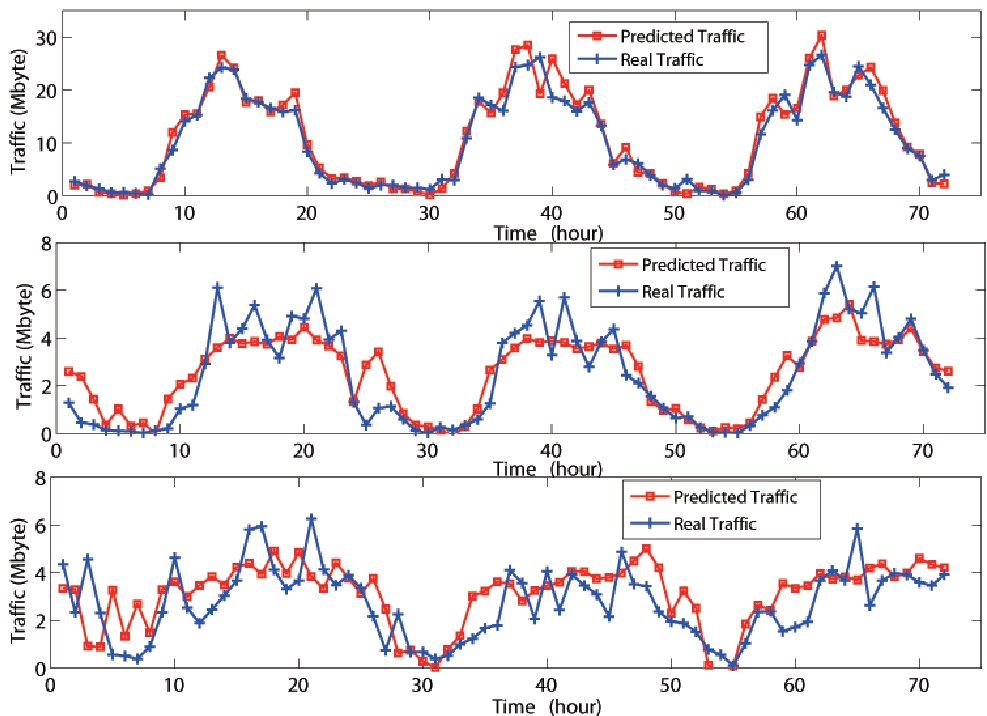 Comparison between actual and predicted traffic: The model captures the periodic "rhythm" of the city with high fidelity.
Critical Insight & Future Outlook
The value of this work lies in Operational Efficiency. For network operators, collecting and processing real-time data from every single BS is computationally expensive and energy-intensive.
Takeaways:
- Resource Savings: Operators can focus monitoring resources on the 8% VIBS.
- Green Communication: This model can facilitate "base station sleeping" strategies. If we can predict that a cluster's traffic will be low based on a hub station, we can safely put peripheral stations into power-saving modes.
Limitations: The current model focuses on linear correlations through Pearson coefficients. Future iterations using Deep Graph Learning could likely capture non-linear "social" dependencies even more accurately.
Conclusion
By shifting the perspective from "Base Station as Hardware" to "Base Station as a Social Node," this paper provides a robust blueprint for lean, data-driven cellular management.