
STBP: Unleashing Spatio-Temporal Dynamics for High-Performance Spiking Neural Networks
Spatio-Temporal Backpropagation for Training High-performance Spiking Neural Networks
The paper introduces Spatio-Temporal Backpropagation (STBP), a direct supervised learning framework for Spiking Neural Networks (SNNs). By utilizing an iterative Leaky Integrate-and-Fire (LIF) model and a surrogate gradient approach, STBP achieves SOTA performance on MNIST (98.89%) and N-MNIST (98.78%) without requiring complex auxiliary training techniques.
TL;DR
Spiking Neural Networks (SNNs) have long promised brain-like efficiency but suffered from a "performance gap" compared to standard Deep Neural Networks (DNNs). This paper introduces Spatio-Temporal Backpropagation (STBP), a framework that treats SNN training as a dual-optimization across space and time. By unfolding the Leaky Integrate-and-Fire (LIF) model into an iterative format and using surrogate gradients, the authors achieve SOTA results on MNIST and N-MNIST without the "black magic" of complex training heuristics.
Background: Why SNNs are Hard to Train
The primary appeal of SNNs lies in their event-driven nature and timing-dependent information encoding. However, they face two massive hurdles:
- The Non-Differentiability Problem: Spikes are discrete "all-or-nothing" events. In calculus terms, the spike function is a Heaviside step function, whose derivative is a Dirac-delta function (zero everywhere, infinite at the threshold). This "kills" standard Backpropagation.
- Temporal Neglect: Most direct training methods treat SNNs like spatial-only networks, ignoring the rich history-dependent state stored in a neuron's membrane potential.
The Core Insight: Iterative LIF and Dual-Domain BP
The authors re-imagine the classic LIF neuron as a recurrent, iterative cell similar to an LSTM unit. This allows for a clear decomposition of gradients.
1. The Iterative LIF Model
Instead of solving the LIF differential equation analytically, the authors use an event-driven iterative rule:
- Spatial path: Aggregates weighted inputs from the previous layer.
- Temporal path: Maintains the "memory" of the membrane potential, modulated by a "forget gate" (the leak) and a "reset" mechanism once a spike is fired.
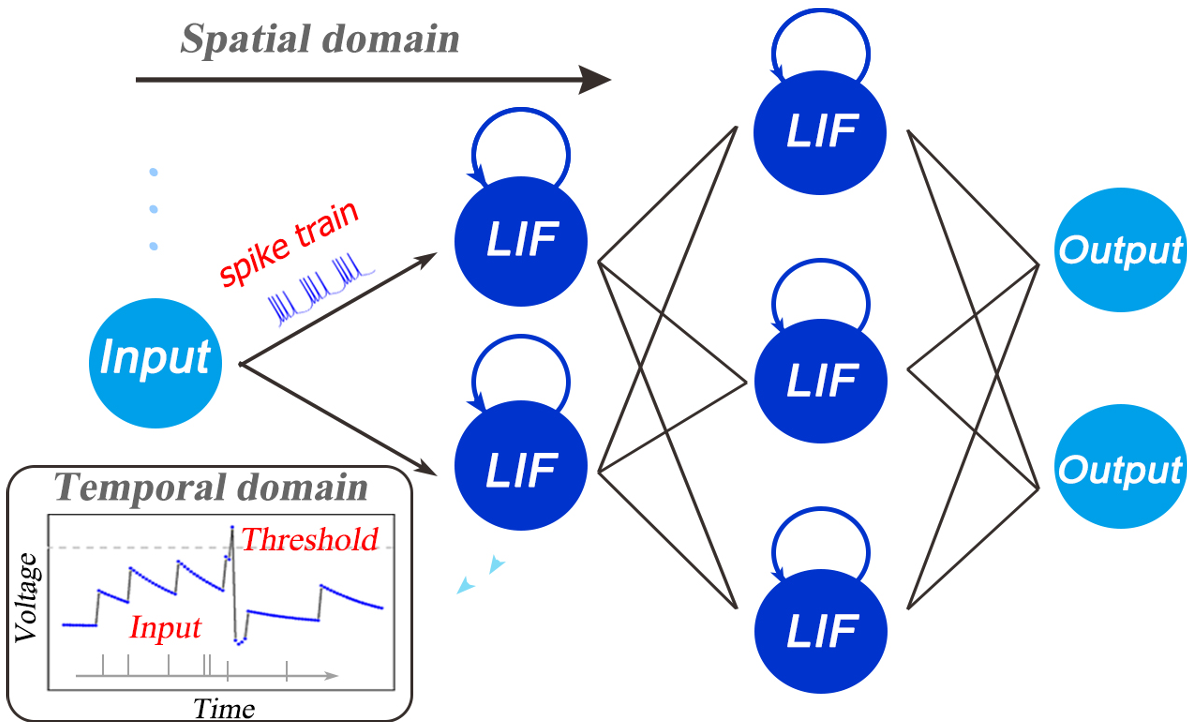 Figure 1: The dataflow of SNNs across Spatial (layer-by-layer) and Temporal (time-step-by-time-step) domains.
2. Surrogate Gradients: "Smoothing" the Spike
To overcome the zero-gradient issue, the authors introduce four approximation curves (Rectangular, Polynomial, Sigmoid, and Gaussian) to represent the derivative of the spike activity. They discovered that the shape of the curve is less important than capturing the nonlinear nature of the activation near the threshold.
Methodology: Spatio-Temporal Chain Rule
The STBP algorithm flows through four cases during the backward pass:
- Spatial Domain (SD): Errors propagate through layers like standard BP.
- Temporal Domain (TD): Errors propagate "backward through time" (similar to BPTT in Recurrent Neural Networks), accounting for how a neuron’s current state affects its future spikes.
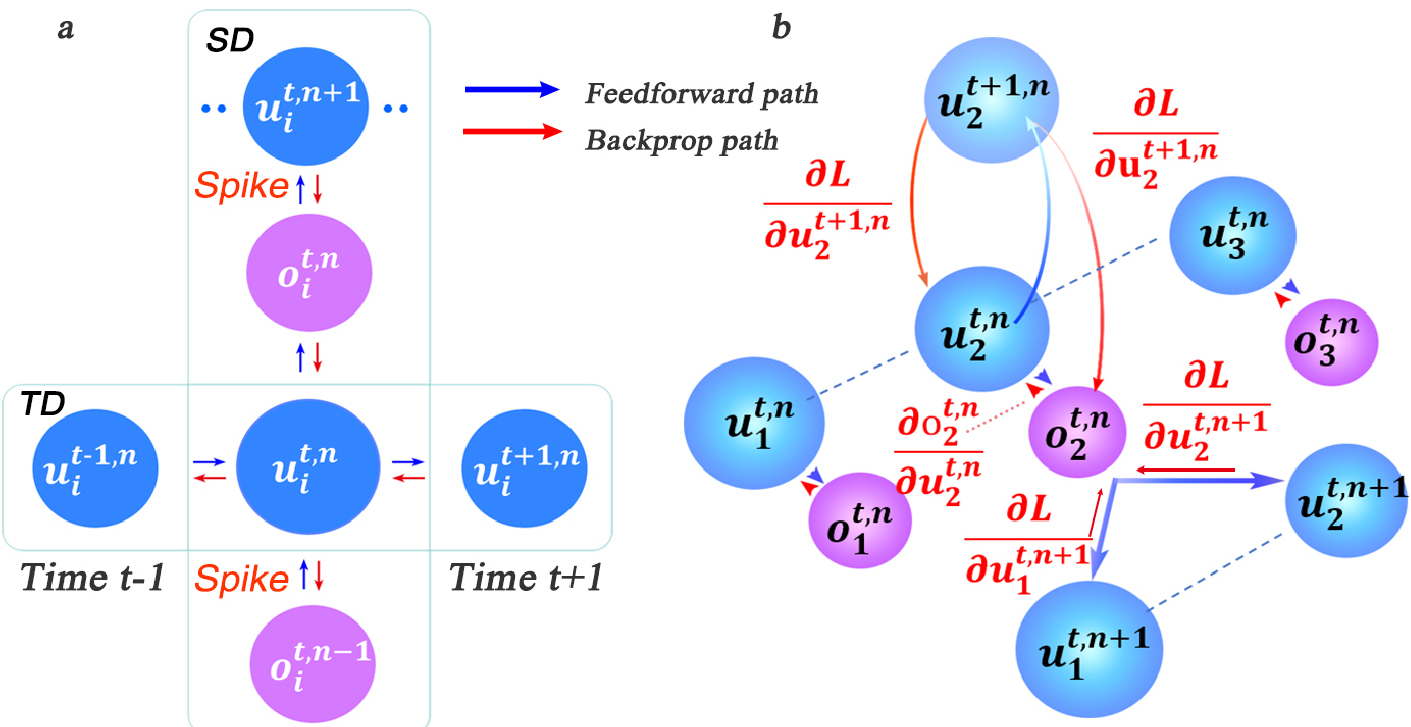 Figure 2: Error propagation at the single-neuron and network levels, showing the interplay between SD and TD gradients.
Experiments & Results
The STBP framework was validated across static (MNIST) and dynamic (N-MNIST) datasets.
SOTA Performance
- MNIST: Achieved 98.89% (MLP) and 99.42% (CNN), outperforming other SNN-based methods that used pre-training or specialized normalization.
- N-MNIST: Reached 98.78%, which is notably better than standard frame-based LSTMs. This proves that SNNs are naturally better suited for natively temporal, event-based data.
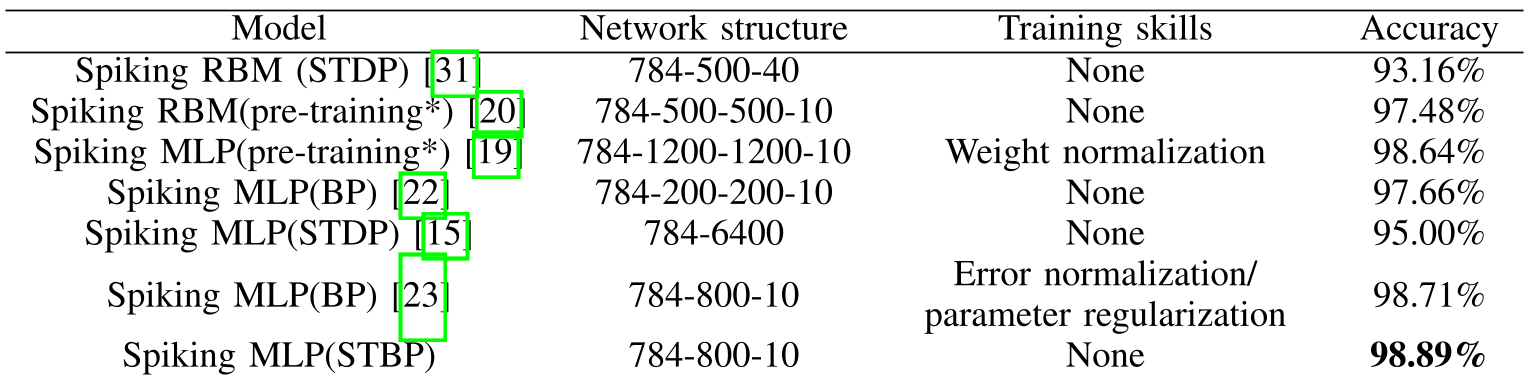 Table 2: STBP significantly outperforms other BP and STDP-based SNNs on the MNIST benchmark.
Why the Temporal Domain Matters
In their ablation study, removing the temporal gradient (SDBP) led to a significant drop in accuracy and stability. The full STBP could reach high performance without needing "complicated skills" like weight normalization or lateral inhibition, suggesting that the temporal dynamics themselves act as a powerful regularizer.
Critical Insight: Conclusions and Future Outlook
This work represents a shift in SNN research from "bio-mimicry for the sake of it" to "bio-inspired engineering." By framing SNNs in a way that respects both their biological roots and the mathematical requirements of gradient descent, STBP provides a robust template for the next generation of neuromorphic AI.
Takeaway for Practitioners:
- SNNs are no longer limited to unsupervised STDP; direct supervised learning is now a viable, high-performance option.
- The key to high performance is the TD gradient—don't ignore the time dimension!
Limitations: The study focuses on relatively small-scale datasets (MNIST/N-MNIST). Scaling STBP to high-resolution, complex datasets like ImageNet remains the ultimate "frontier" for this technology.
References
- Wu, Y., Deng, L., Li, G., Zhu, J., & Shi, L. (2018). Spatio-Temporal Backpropagation for Training High-performance Spiking Neural Networks. Frontiers in Neuroscience/IEEE.