
Beyond Proximity: Ontology-Driven Integration in Spatio-Temporal Data Mining
Research and Application of Spatio-temporal Data Mining Based on Ontology
This paper introduces an ontology-based approach to Spatio-Temporal Data Mining (STDM) to achieve seamless integration of spatial, temporal, and attribute data. The authors propose the Spatio-Temporal Regressive Model Based on Ontology, utilizing a novel Spatio-Temporal Contiguity Measure (STCM) to surpass traditional adjacency-based forecasting methods, achieving an R-squared of 0.7518 in railway passenger flow prediction.
TL;DR
The challenge of Spatio-Temporal Data Mining (STDM) lies in the "curse of separation"—treating time and space as disjointed variables. This paper introduces an Ontology-based integration strategy that treats spatio-temporal objects as atomic entities. By replacing traditional adjacency matrices with a sophisticated Spatio-Temporal Contiguity Measure (STCM), the researchers improved railway passenger flow prediction accuracy by nearly 5% over standard autoregressive models.
The "Divide-and-Conquer" Fallacy
Most existing spatial-temporal systems handle data through a fragmented lens: they store spatial coordinates, append a timestamp, and then apply mining algorithms. The authors argue that this "divide-and-conquer" approach is fundamentally flawed because it loses the inter-attribute correlations that define dynamic systems.
The core insight of this paper is that space and time are often indiscerptible. For instance, in a railway network, the influence of one city on another isn't just about physical distance; it's about the semantic and temporal intensity of their connection.
Methodology: The Power of Spatio-Temporal Ontology
The authors propose a four-phase workflow powered by Ontology:
- Unified Modeling: Integrating spatial, temporal, and attribute characters into a single semantic class.
- Knowledge Sharing: Using ontology to reuse models across different databases.
- The STCM Innovation: Moving beyond simple binary adjacency ( or for neighbors).
Mathematically Capturing Influence
The researchers redefined the spatio-temporal autocorrelation matrix. Instead of assuming all neighbors have equal weight, they calculated a specific autocorrelation coefficient () between different spatial and temporal lags.
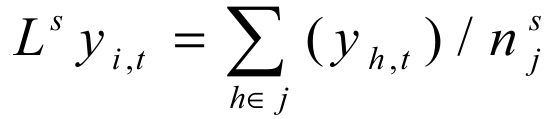
The model follows the General Spatio-Temporal Model (STGM) structure: Where is no longer just a distance matrix, but a matrix of contiguity measures that reflect the actual intensity of interaction between regions (e.g., the dominant influence of the Zhengzhou bureau on the Beijing bureau).
Experiments: Forecasting Railway Passenger Flow
The model was tested using data from 14 Chinese railway bureaus (1994-2002). The experiment aimed to predict passenger quantities based on population and GDP growth.
Key Performance Comparison:
| Model Type | Fit (R²) with Adjacency Matrix | Fit (R²) with Contiguity Measure |
|---|---|---|
| STGM (Proposed) | 0.7028 | 0.7518 |
| OLS (Baseline) | 0.6048 | 0.6048 |
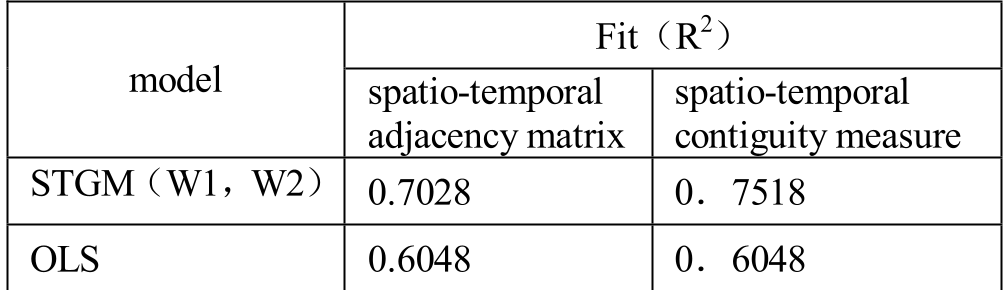
The results demonstrate that the Spatio-Temporal Contiguity Measure (STCM) provides a significantly better fit. It captures the reality that even among first-order neighbors, the "influence extent" is not a direct proportion of distance.
Critical Insight & Conclusion
By using Ontology as a normative system to describe relationships, the authors solved the "spatio-temporal integration" problem that plagues many GIS-based mining tasks.
Takeaway for Practitioners: When modeling network-based flows (like traffic, logistics, or passengers), stop relying on simple Euclidean distance. The semantic relationship—the "Contiguity Measure"—is a much stronger predictor of system behavior than physical proximity alone.
Limitations: While powerful, the ontology-based approach requires significant domain expertise to define the initial "Spatio-Temporal Ontology." Future work should look into automating ontology construction using deep learning to make this method more scalable across diverse industries.