
The Geography of Connection: How Mobility Shapes Our Social Networks
Uncovering the Spatio-temporal Structure of Social Networks Using Cell Phone Records
This paper presents a large-scale analysis of Call Detailed Records (CDRs) to uncover the relationship between human mobility and social network structure. By utilizing a dataset of 404 million calls from 14.6 million users, the authors characterize the spatio-temporal features of social ties and provide empirical evidence for a multi-scale gravity model in social interactions.
TL;DR
By analyzing over 400 million cell phone calls, researchers have mapped the hidden "spatio-temporal" pulse of social networks. The study reveals that we aren't just limited by physical distance; rather, our social status (how many contacts we have) dictates how far our "geographic reach" extends. Crucially, the way distance affects our likelihood of calling someone changes significantly once we move from the city scale to the inter-city scale.
The Problem: The "Static Distance" Fallacy
For years, researchers trying to link social networks with geography relied on a flawed assumption: that the distance between two friends is a constant. They used home addresses or billing zip codes as "proxies" for location. But humans are mobile. We call friends from work, from the car, or while traveling.
Existing models—often called Gravity Models—suggested that the probability of a social tie decays by the square of the distance (). However, these models lacked the high-resolution, dynamic data needed to see if this law holds up in the messy reality of daily movement.
Methodology: Listening to the Network
The researchers used Call Detailed Records (CDRs) from a European operator, covering 14.6 million users. Unlike previous studies, they didn't just look at where users lived. They looked at the BTS (Base Transceiver Station) or cell tower used by both the caller and the receiver at the exact second the call started.
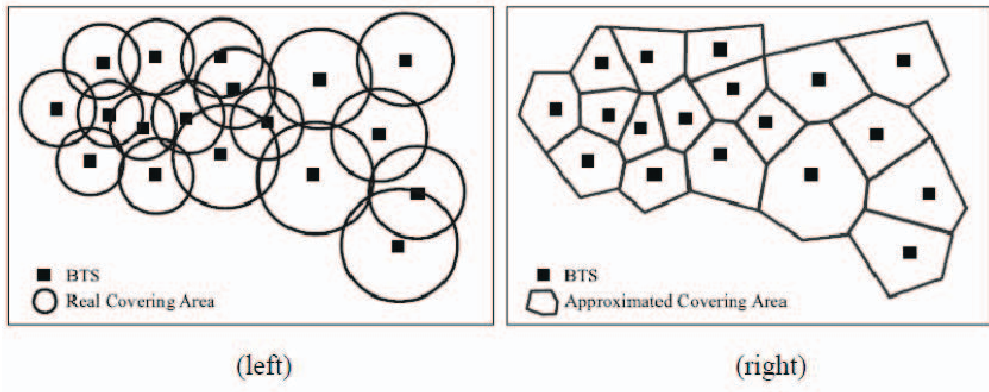
By using Voronoi tessellation to estimate coverage areas, they could calculate the distance for every single interaction. This allowed them to correlate Social Topology (degree , or number of friends) with Spatial Distribution (how far those friends are at call-time).
Core Insights: The "Hub" Effect
The most striking finding is the disparity between "social butterflies" and more isolated individuals.
- Spatial Influence: "Hubs" (users with >45 contacts) don't just talk to more people; they talk to people farther away. Their characteristic call distance mode is 20km, whereas for users with few contacts, it is a mere 1km.
- Duration vs. Distance: There is a strong correlation between how long we talk and how far away the other person is. Long-distance calls (interurban) tend to be longer in duration—likely because they are "conversational"—whereas local calls are often "coordinative" (short messages like "I'm outside").
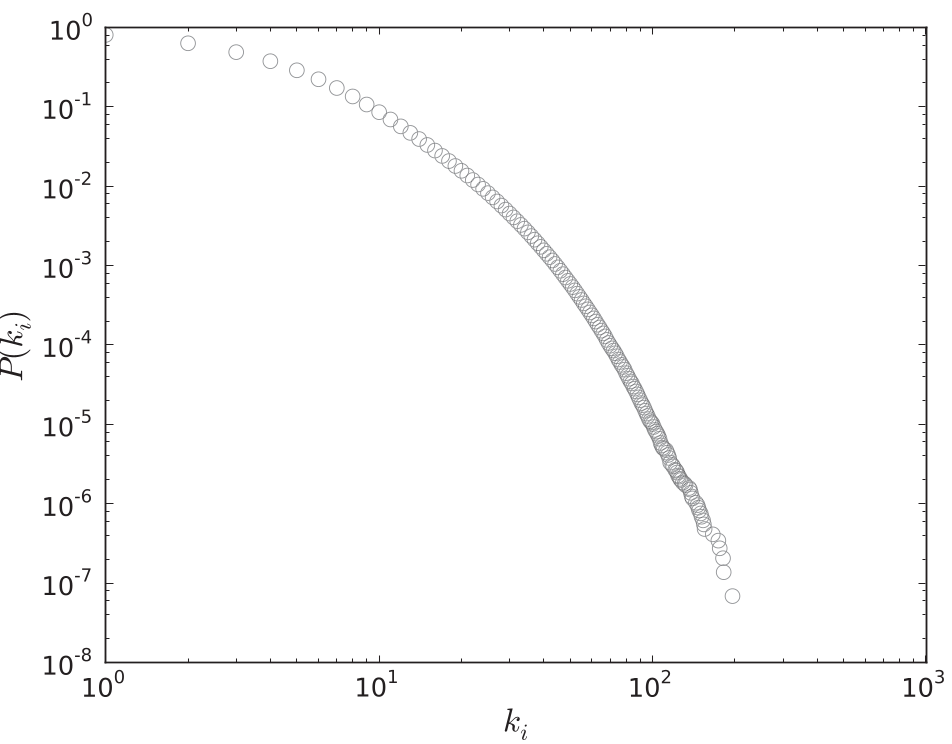 Figure: The non-trivial degree distribution confirms that cell phone social networks follow a heavy-tailed structure, common in complex human systems.
The Two Regimes of Gravity
The study's most significant theoretical contribution is the identification of two distinct decay rates for social interactions. The probability of making a call at distance follows a power law, but the exponent changes:
- Urban Scale (1km - 10km): Decay is relatively slow (). In a city, distance is less of a barrier.
- Interurban Scale (>10km): Decay accelerates (). As you move between cities, the "friction" of distance increases.
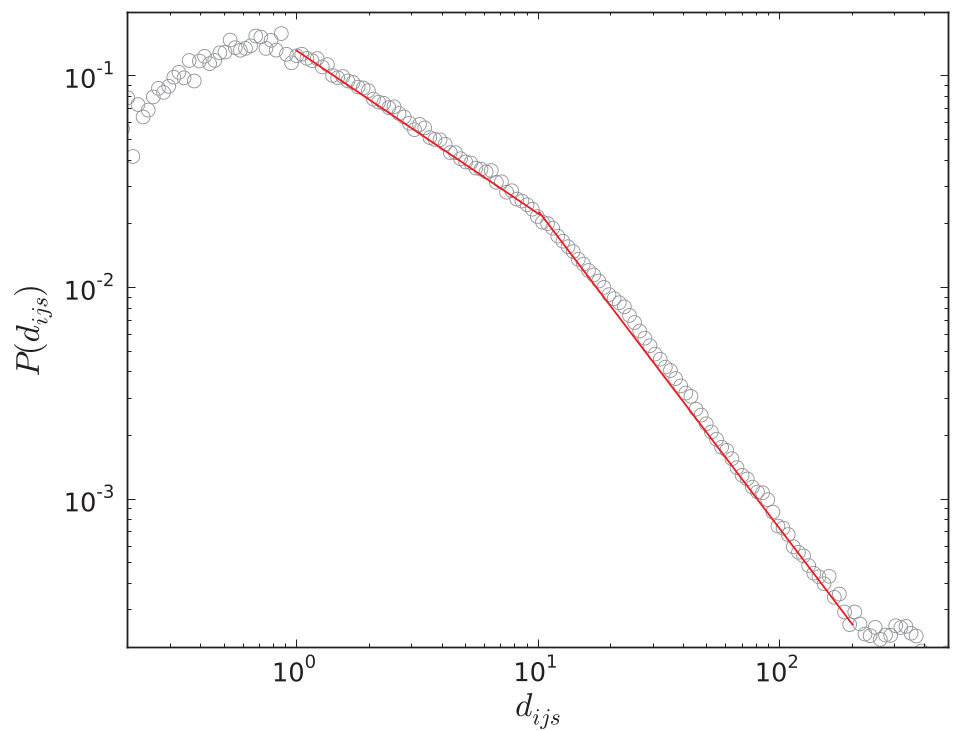 Figure: The "kink" in the graph at 10km reveals the transition from urban to interurban dynamics.
Critical Analysis & Conclusion
This work moves us toward a Dynamically Embedded view of social networks. The takeaway is clear: human displacement and social ties are a feedback loop. Your social network size determines your geographic footprint, and your mobility patterns provide the "pipes" through which those social ties are maintained.
Limitations: While massive, the data is from 2026-era cell records (CDRs), which only capture traditional calls. In the age of WhatsApp and ubiquitous data, "interactions" are more continuous. Future research needs to integrate data-layer interactions to see if "distance is truly dead" in the era of instant messaging, or if the gravity models identified here are a fundamental law of human nature that transcends the medium of communication.