
Who Speaks When: Reinforcing Speaker Diarization with Social Role Priors
Speaker Diarization of Multi-party Conversations Using Participants Role Information: Political Debates and Professional Meetings
This paper introduces a speaker diarization framework that integrates social role information through N-gram turn-taking models. Applied to political debates and professional meetings, the method combines acoustic MFCC features with a structural prior of participant interactions, achieving SOTA-level improvements in speaker error rates.
TL;DR
Researchers from the Idiap Research Institute have bridged the gap between social science and signal processing. By treating conversation as a structured "language" where speaker roles (like Moderators or Project Managers) dictate the sequence of turns, they have enhanced traditional diarization. This method uses Role-based N-grams to act as a prior, reducing speaker error rates by up to 25% in political debates and 19% in meetings.
Background: The Ignored Social Logic
Standard Speaker Diarization—the task of "who spoke when"—is usually treated as a blind clustering problem. We extract MFCCs, cluster them, and hope the math distinguishes the voices. However, the authors argue that this ignores a fundamental truth: human conversation is not random. It follows a socioeconomic "grammar" governed by "turn-taking" rules. For instance, in a debate, a moderator is far more likely to speak after a guest than a second moderator is (since there is usually only one).
The Insight: Roles as a Sequence Prior
The core methodology involves treating the sequence of speakers as a Markov chain. If we know (or can estimate) the roles of the participants, we can predict who is likely to speak next.
1. Modeling Interaction
The authors define a mapping from speakers to roles ().
- In Debates: Roles include Moderator, Group 1 Guests, and Group 2 Guests.
- In Meetings: Roles include Project Manager (PM), User Interface expert (UI), Marketing Expert (ME), and Industrial Designer (ID).
2. The Role N-gram
Instead of just looking at the acoustic likelihood, the system calculates the probability of a speaker sequence based on role transitions. For example, in a debate, the probability of a guest taking a turn after a moderator is significantly higher than a guest speaking twice in a row without an interruption or transition.
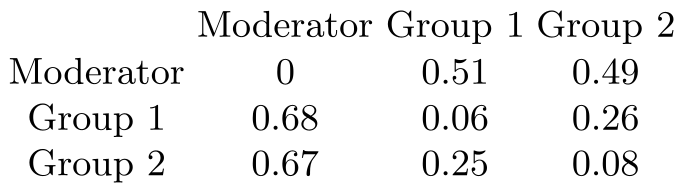 Table: Transition probabilities in political debates. Note the 0% probability of Moderator-to-Moderator transitions.
Methodology: The Hybrid Viterbi Decoder
The authors adapt the standard Viterbi objective function used in Speech Recognition (ASR). The new optimal sequence is found by: Where:
- is the Acoustic Score (GMM-based).
- is the Social Prior (Role N-gram).
- is a scaling factor to balance the two components.
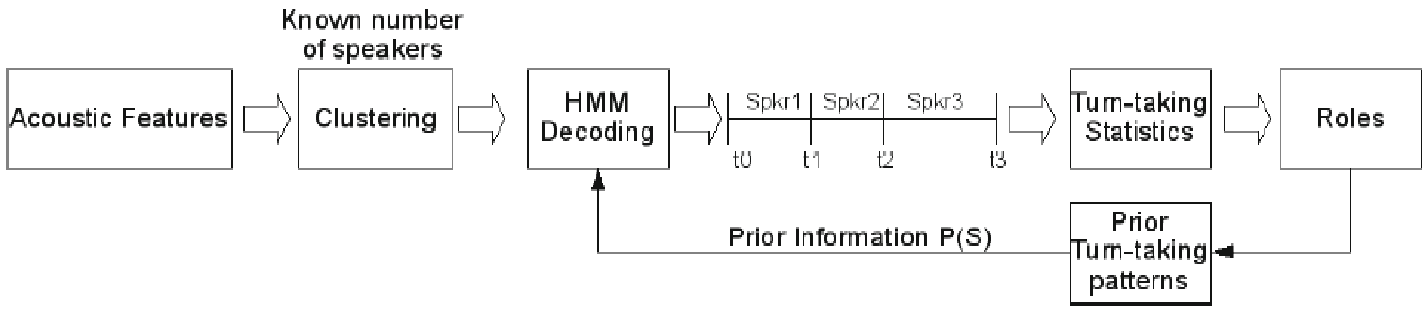 The system first generates an initial diarization, estimates the roles, and then re-runs the decoding with the social prior.
Experiments and Results
The system was tested on two diverse datasets:
- Canal9 Political Debates: High-quality audio, highly competitive interaction.
- AMI Meeting Corpus: Far-field audio, collaborative professional environment.
Key Findings:
- Significant Error Reduction: In Case 1 (where roles are known), speaker errors dropped from 14.4% to 11.5% in meetings.
- Robustness: Even when roles were estimated (Case 2), the system still outperformed the baseline across almost all recordings.
- The "Gatekeeper" Effect: The biggest improvements occurred in identifying the "Gatekeeper" (Moderator or PM). These roles serve as the hub of the conversation, and the N-gram model effectively "anchors" the diarization around their predictable turns.
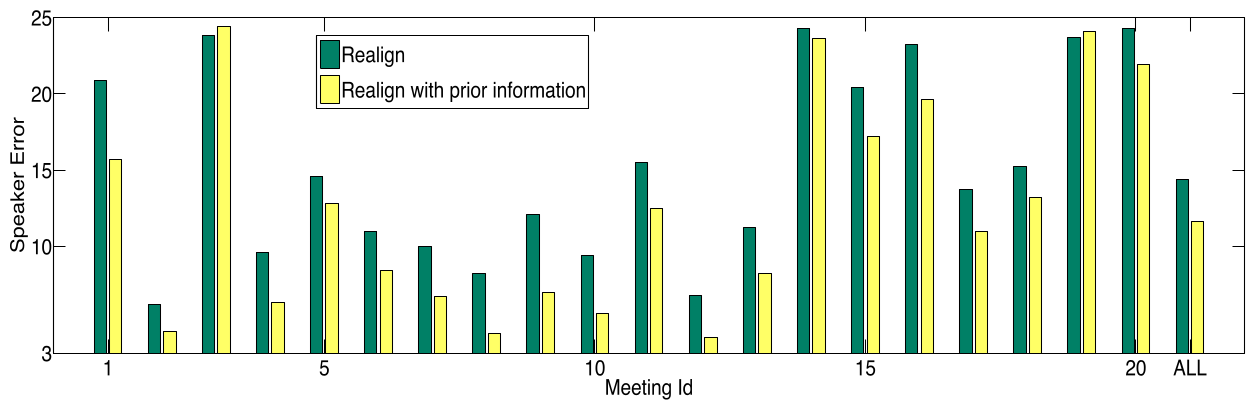 Error rates across 25 debate recordings and 20 meeting recordings, showing consistent improvement with the prior.
Critical Insight & Conclusion
Why does this work so well? The authors found that the acoustic score often fails on short turns. When a participant says a quick "Yes" or "Okay," there isn't enough audio data for a stable GMM calculation. However, the Role N-gram knows that a Moderator likely speaks after a long guest statement to "gatekeep" the next turn, providing the necessary evidence to correctly label that short segment.
Takeaway: Future AI systems for meeting transcription and analysis should not treat audio in a vacuum. By incorporating the "social grammar" of the specific context—whether it's a courtroom, a surgical suite, or a corporate boardroom—we can significantly enhance the precision of speaker tracking.
Limitations: The system currently requires a predefined set of roles and a development set to learn transition probabilities. Future iterations could benefit from unsupervised role discovery.