
The Secret Language of Viral Learning: Analyzing Educational Video Popularity
Speakers’ Language Characteristics Analysis of Online Educational Videos
This study investigates the linguistic determinants of popularity in online educational videos using 1,108 YouTube transcripts. By applying K-Means clustering and a custom popularity metric, the authors identify that high-performance educational content is characterized by faster speech rates and higher sentence complexity.
TL;DR
What makes an MIT OpenCourseWare lecture more popular than a random tutorial? It isn't just the prestige. This research analyzes over 1,100 YouTube transcripts to reveal that popular educational videos are characterized by faster speech and more complex sentence structures. Contrary to the "keep it simple" mantra, the most successful online instructors challenge their audience with high-density information delivered at a brisk pace.
Background: Beyond View Counts
In the era of MOOCs and digital classrooms, the "instructor's style" has transitioned from a classroom vibe to a data-driven metric. The authors of this study position their work at the intersection of Text Mining and Educational Data Science, seeking to quantify the "charisma" of oral teaching through transcript analysis.
The Problem: Why Do Students Tune Out?
Existing research has looked at video metadata (tags, titles) or visual quality, but these are often superficial. The real mystery lies in the audio language. Why does one speaker sound "authoritative and engaging" while another sounds "boring"? The authors hypothesize that the linguistic characteristics—sentence length, vocabulary, and rhythm—are the true drivers of learner retention and popularity.
Methodology: Quantifying "The Vibe"
The authors collected data from 20,830 YouTube videos, filtering down to 1,108 with English transcripts.
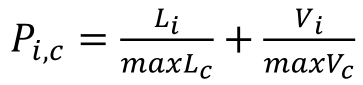
1. The Popularity Formula
To avoid bias from video age or niche topics, they created a normalized popularity score:
2. Feature Extraction
The study extracted several distinctive linguistic markers:
- MicroRhythm: Average words per second of transcript display.
- Sentence Complexity: Measured by the frequency of commas (used as a proxy for parenthetical phrases and logical depth).
- Vocabulary Range: The count of unique words.
3. Clustering
Using SimpleKMeans (K=2), they partitioned the dataset into "High Popularity" and "Low Popularity" clusters to observe the linguistic divergence.
Experimental Results: Fast and Complex Wins
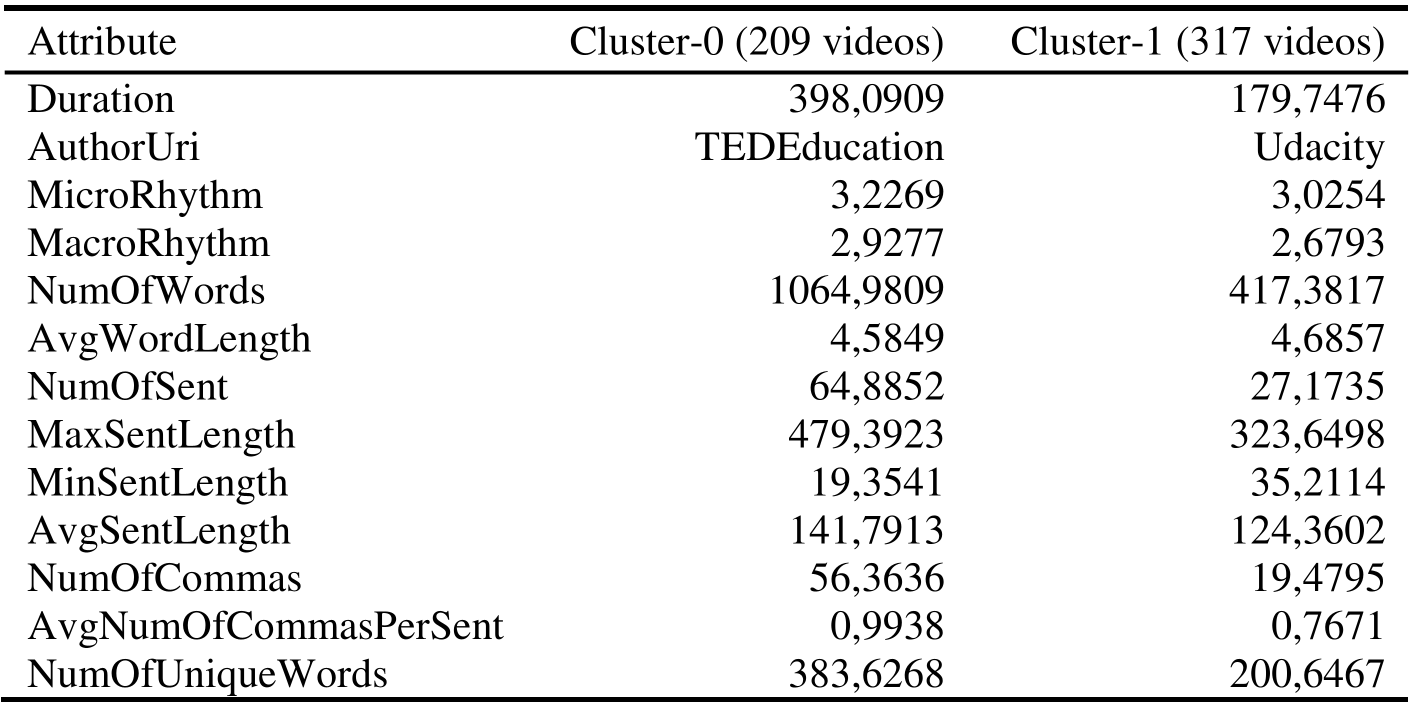
The clustering results (especially for long videos, with 86.36% accuracy) yielded counter-intuitive insights.
Short Videos (< 10 mins)
For short-form content, popular videos (Cluster-0) showed:
- Faster Speech: Higher MicroRhythm.
- Complexity: Significantly more commas and longer maximum sentence lengths.
- Takeaway: In short bursts, speakers must maximize every second by being information-rich.
Long Videos (> 10 mins)
For full-length lectures, popular videos showed:
- Controlled Vocabulary: Interestingly, they used fewer unique words than unpopular ones, likely focusing on specific technical domain terms without wandering off-topic.
- High Complexity, Low Confusion: They used complex sentences (commas) but kept the average sentence length moderate to avoid losing the student.
Deep Insight: The "Cognitive Focus" Hypothesis
The most striking commonality between all popular videos was the fast pace of speech.
In the context of the Attention Economy, a fast-talking instructor acts as a "forcing function" for the brain. If the speaker is fast and the logic (complexity) is dense, the learner is forced to pay closer attention to keep up. Conversely, slow speech allows the mind to wander.
Critical Analysis & Conclusion
Takeaway
If you are building an educational platform or creating content:
- Don't talk down to your audience. Use structured, complex sentences that show logical depth.
- Pick up the pace. A sluggish MicroRhythm is the fastest way to lose a digital student.
Limitations
The study relies on YouTube's auto-generated or uploaded transcripts, which may have punctuation errors (though commas are often injected by NLP models based on pauses). Furthermore, it doesn't account for the visual aids used in the videos, which might mitigate the difficulty of complex speech.
Future Outlook
The next step for this research should be sentiment analysis of the comments to see if "fast" speech is perceived as "enthusiastic" or "expert-level." This work paves the way for AI-driven "teleprompter coaches" that could help professors optimize their scripts for maximum online engagement.