
DMFA-SR: Beyond Explicit Links — Unleashing Deeper Social Awareness for Recommendation
SPECIAL SECTION ON ADVANCED DATA ANALYTICS FOR LARGE-SCALE COMPLEX DATA ENVIRONMENTS
This paper introduces DMFA-SR, a social recommendation model that enhances traditional Matrix Factorization by incorporating "deeper" social relationships. It uniquely combines deeper membership (item rating similarities) and deeper friendship (explicit and implicit social links) into a unified regularization term to improve recommendation accuracy and mitigate data sparsity.
TL;DR
Recommender systems often struggle with the "cold-start" problem where data is too sparse to make accurate predictions. While social recommendation uses friend networks to fill the gaps, most models only scratch the surface. DMFA-SR changes this by mining "deeper" connections—analyzing not just who your friends are, but the shared rating behaviors and the implicit influence of your friends' friends. By integrating these into a Matrix Factorization (MF) framework, it achieves significant SOTA gains on real-world datasets like Epinions and Foursquare.
Problem & Motivation: The Limitations of Surface-Level Socializing
Traditional social recommendation assumes that if User A and User B are friends, they should have similar latent features. However, this "shallow" view has two major flaws:
- Membership Blindness: Two users might rate the same items, but if their rating scales differ (one is a harsh critic, the other a "5-star giver"), a simple Jaccard similarity fails to capture the true preference gap.
- Friendship Sparsity: Explicit social networks are often incomplete. Relying only on direct links ignores the "Two-hop" radius (friends-of-friends) who often share similar interests.
The authors' insight is that by refining Membership (rating preferences) and Friendship (network topology), we can create a much more robust "Social Regularization" term for the model.
Methodology: The "Deeper" Architecture
The DMFA-SR model operates on a unified optimization objective. It doesn't just predict ratings; it constrains the distance between user latent vectors based on their "Comprehensive Deeper Social Relation Similarity."
1. Deeper Membership (The Rating Bias Fix)
Instead of standard similarity, the authors propose an Improved Jaccard Similarity. It multiplies the overlap of items by a User Preference Similarity (UPS). This UPS calculates the squared difference of mean-centered ratings, effectively neutralizing individual rating biases.
2. Deeper Friendship (The Two-Hop Walk)
To expand the reach of the social graph, the model employs a Two-hop Random Walk (TH-RW). It calculates the probability of reaching a user within two steps, allowing the recommender to "learn" from indirect connections that traditional models miss.
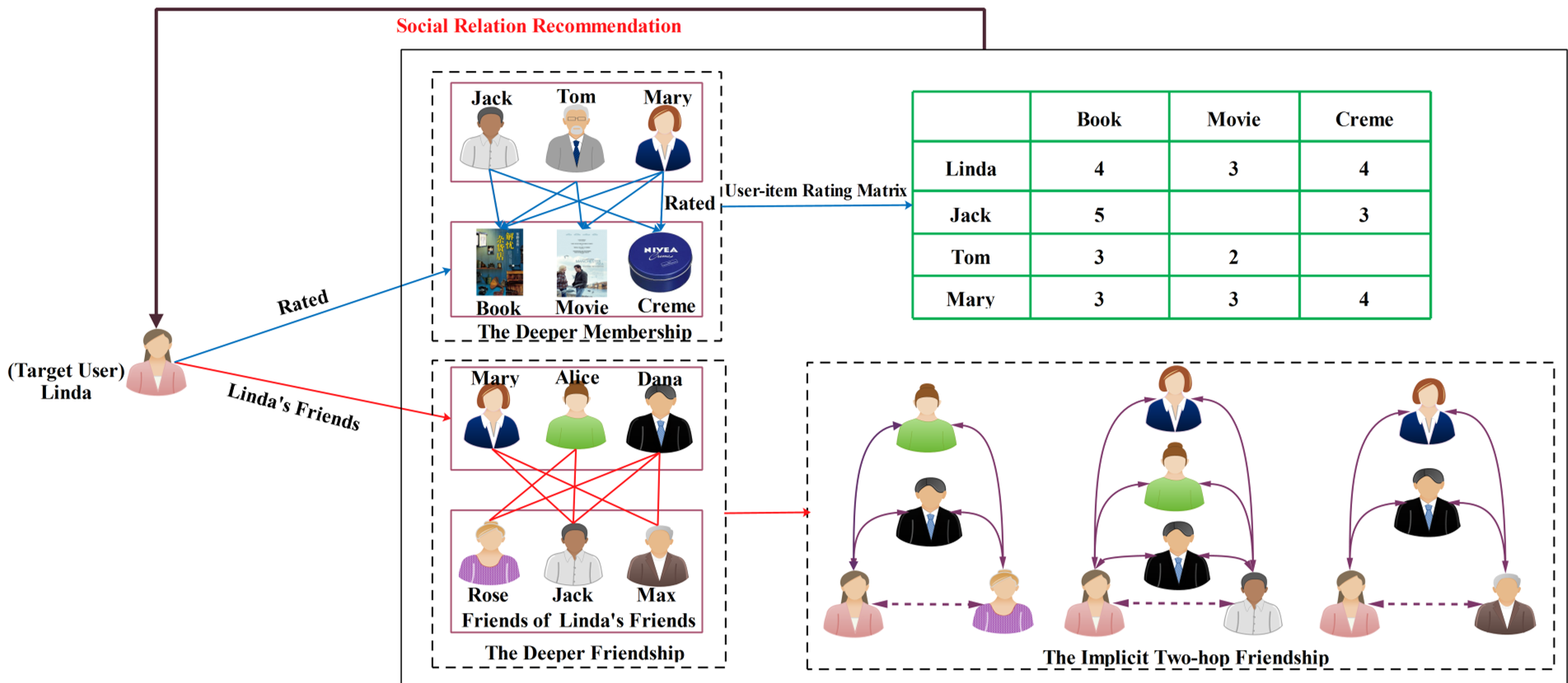 Figure 1: Conceptual overview of DMFA-SR, illustrating the dual-layered awareness of membership and friendship.
3. The Unified Optimization
The core of the model is a Matrix Factorization objective function modified with a social regularization term : Here, controls how much the "deeper social influence" pulls related users together in the latent space.
Experiments & Results: Proving the Value
The authors tested DMFA-SR against several baselines: BasicMF (no social info), GLSIR (global/local influence), and two "ablated" versions of their own model (DM-SR and DF-SR).
Performance Highlights:
- Superior Ranking: Across both Epinions and Foursquare, DMFA-SR consistently topped the charts in MAP and NDCG.
- Membership vs. Friendship: Interestingly, the paper finds that in the Epinions dataset, Membership similarity was more useful, while in Foursquare, the Friendship graph was more dominant. This justifies the "unified" approach—the model adapts to the specific strengths of the dataset.
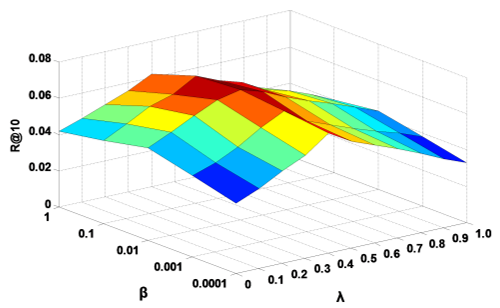 Figure 2: Impact of hyper-parameters (balancing membership/friendship) and (regularization strength) on accuracy.
Top-K Accuracy:
At to , the model maintained a consistent lead over GLSIR and BasicMF, proving that the "deeper" awareness translated directly into better item recommendations for the end-user.
Critical Insight & Conclusion
The success of DMFA-SR lies in its acknowledgment that all social links are not created equal. By mathematically distinguishing between shared tastes (deeper membership) and social connectivity (deeper friendship), then fusing them into a standard MF framework via regularization, the authors provide a practical blueprint for improving modern recommender systems.
Limitations: The current model uses a static TH-RW. In dynamic social networks, these "deeper" relationships evolve. Future extensions incorporating temporal factors (Time-Aware Social Recommendation) or textual analysis of user reviews would likely push these results even further.