
ETDC: Scaling Personalized Job Recommendation with Tree-Based Online Learning
SPECIAL SECTION ON APPLICATIONS OF BIG DATA IN SOCIAL SCIENCES
The paper introduces ETDC, an online mining and recommendation system for professional social networks (PSNs). It leverages a tree-based Contextual Multi-Armed Bandit (CMAB) framework to provide bilateral job/candidate recommendations while handling big data scale and the cold-start problem.
TL;DR
In the rapidly shifting landscape of Professional Social Networks (PSNs), matching the right candidate to the right job is a "moving target" problem. Researchers have introduced ETDC (Expandingly Tree-based and Dynamically Context-aware Online Learning), a bandit-based framework that solves the twin challenges of Big Data scale and the Cold-Start problem. By organizing items into a dynamic tree and using implicit signals (like reading time), ETDC achieves sublinear regret and outperforms traditional collaborative filtering in high-freshness environments.
The Scale Problem in Professional Social Networks
Recommender systems for platforms like LinkedIn or XING face unique hurdles that traditional movie (Netflix) or product (Amazon) recommenders do not:
- Item Expiration: Unlike a movie that remains relevant for years, a job posting becomes "expired" the moment it is filled.
- Bilateral Constraints: A job needs exactly one (or few) hires; a candidate needs one job. This high turnover means historical interaction data for a specific item vanishes quickly.
- Computational Explosion: Scoring millions of candidates against millions of jobs in real-time under a "context-aware" lens is computationally prohibitive for standard algorithms.
Existing Contextual Multi-Armed Bandit (CMAB) algorithms often assume a fixed number of "arms" (items) or use linear assumptions that don't hold in complex social data.
Methodology: Hierarchical Exploration & Dynamic Partitioning
The core innovation of ETDC lies in its dual-tree approach to both items and contexts.
1. The Growing Item Tree
Instead of scoring every job individually, ETDC clusters similar items into a binary tree. The system scores "clusters" (nodes) rather than individuals. If a cluster shows high potential (measured via an Upper Confidence Bound), the algorithm "drills down" into child nodes. This reduces the search space from to .
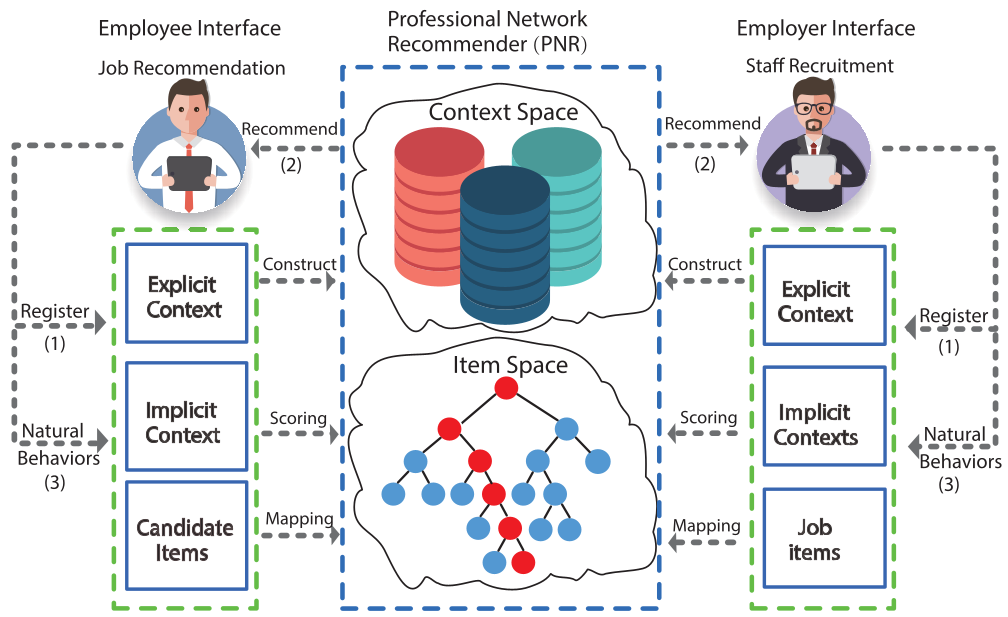 Figure 1: The ETDC workflow, showing the transition from user context to tree-based item selection.
2. Dynamic Context Awareness
To solve the cold-start problem, ETDC assumes that users with similar background features (Age, Skills, Salary expectations) will behave similarly. By using a Lipschitz Condition as an inductive bias, the system can recommend a new job to a new user by looking at how "similar" users interacted with "similar" jobs in the past.
3. Exploiting Implicit Feedback
Explicit ratings (like/dislike) are rare. ETDC extracts "rewards" from:
- Reading Time: How long did the candidate stay on the job page?
- Saved Actions: Did they save the job for later?
- Deletions: Did they explicitly hide the recommendation?
Experimental Validation: SOTA Performance
The researchers tested ETDC against the ACM RecSys Challenge dataset, which includes over 300 million interaction logs.
Key Findings:
- Regret Convergence: ETDC achieves the theoretical golden standard of sublinear regret, meaning the algorithm gets smarter over time and eventually finds the "optimal" recommendation policy.
- Superiority over Context-Free Models: Traditional UCB and HCT models (which ignore user background) show almost linear regret, proving that in PSNs, personalization is not a luxury—it's a requirement.
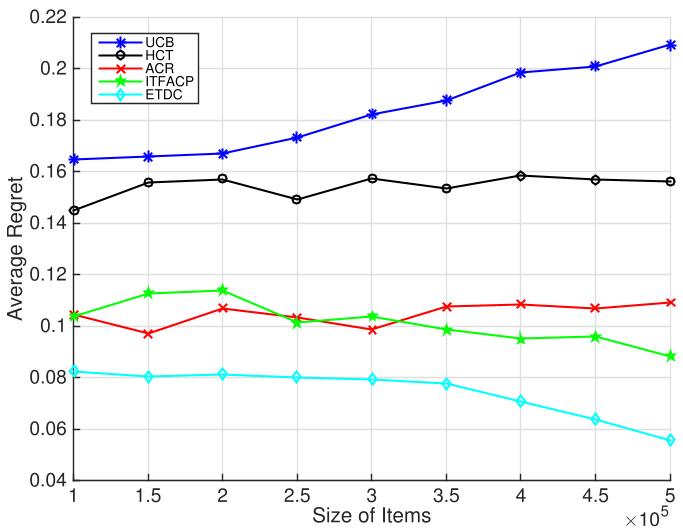 Figure 2: Cumulative regret comparison. ETDC (bottom curve) shows significantly lower cumulative error than ACR and ITFACP.
Scalability and Robustness
One of the most impressive feats is the "Adaptive AddItem" mechanism. As thousands of new jobs are posted per hour, ETDC inserts them into the existing tree structure at the appropriate leaf, allowing the system to harness new data without retraining from scratch.
Critical Insight: Why Tree Expansion Matters
Most tree-based recommenders build their trees offline. ETDC builds its tree online. It only splits a node into children (expanding the tree) when it has "sufficient evidence" (defined by a threshold ) that the cluster has been explored enough to justify more granular analysis. This prevents the model from over-fitting to noise early in the learning process.
Conclusion and Future Outlook
ETDC represents a significant step forward for bilateral marketplaces. By moving from individual item scoring to hierarchical cluster scoring, it provides a blueprint for "Big Data" recommenders that need to be both real-time and contextually aware.
Future Direction: The authors identify Privacy preservation as the next frontier. Using explicit user contexts (career level, location) is powerful but carries risks of data leakage, suggesting that Federated Learning or Differential Privacy could be the next layer for this tree-based architecture.