
Beyond Social Links: How Search Engines Redefine the Influence of Super-Spreaders
SPECIAL SECTION ON CYBER-PHYSICAL-SOCIAL COMPUTING AND NETWORKING
This paper introduces the Probably-Established Subcritical Path (PSP) method, a novel approach to identifying super-spreaders in social networks by accounting for the structural changes induced by search engines. By integrating a probabilistic connection model with Collective Influence (CI) theory, the authors achieve superior information cascade performance compared to the traditional CI-TM baseline.
TL;DR
Modern social networks are no longer isolated silos of direct connections. This paper argues that search engines act as bridges—or "wormholes"—that allow information to jump between disconnected nodes. The authors present the PSP (Probably-Established Subcritical Path) algorithm, which uses probability theory and Collective Influence (CI) to identify a more potent set of "super-spreaders" than any traditional topology-based method.
The "Wormhole" Effect: Why Traditional Centrality Fails
In classical network theory, if Node A is not connected to Node B, Node A cannot influence Node B. However, in the real world, a user can search for a topic and find a spreader they don't follow. This search engine influence creates "probably-established connections."
Existing SOTA methods like CI-TM (Collective Influence Threshold Model) fail because they only look at the "1s and 0s" of the adjacency matrix. They ignore the "shadow graph" created by search engine results, leading to an inaccurate ranking of who truly controls the flow of information.
Methodology: Quantifying the Invisible
The core of the paper lies in a three-step mathematical re-modelling of social influence:
1. The Probabilistic Adjacency Matrix
The authors replace the binary connection model with a probability . If a real link exists, . If not, is calculated based on search engine rankings using a modified exponential distribution: This ensures that high-ranking nodes in search results have a significantly higher probability of influencing others.
2. Probably-Established Subcritical Paths (PSP)
The research builds on CI theory which states that influence spreads through "subcritical" nodes (nodes just one neighbor away from activation). The PSP model extends this by calculating Dynamic Subcritical Values (DSV), which are the products of probabilities along a path.
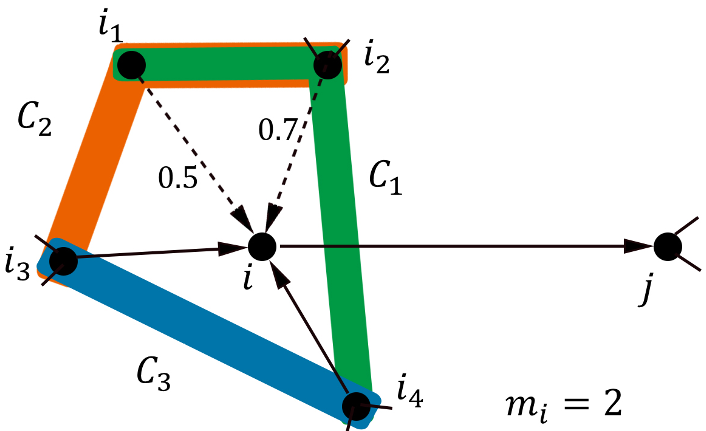 Figure 1: Illustration of message passing taking search engines into account. Dotted lines represent connections established via search.
3. The PSP Algorithm
The algorithm iteratively selects seeds by calculating the value for each node within a radius . Crucially, it removes activated clusters () to account for influence overlap, a common flaw in simpler models like High Degree (HD) or PageRank.
Experiments: Superior Cascading Performance
The authors tested the PSP algorithm against CI-TM on several datasets, including Sina Weibo and Facebook.
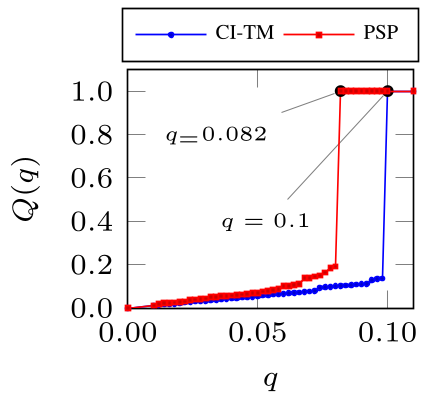 Figure 2: Performance comparison on random and real-world networks showing Q(q) (fraction of activated nodes) vs q (fraction of seeds).
Key Findings:
- Efficiency: In every test case, the PSP algorithm reached a full network cascade () using fewer seeds than the baseline CI-TM.
- Network Density: On sparse networks (where search engines are the primary bridge), the performance gain was even more pronounced.
- First-order Transition: Search engines accelerate the "tipping point" where a small increase in seeds leads to a total network explosion of information.
Critical Insight: The Value of "Probably"
The genius of this work isn't just in the algorithm, but in the shift from deterministic to probabilistic topology. By treating the network as a fluid structure where connections exist on a spectrum, the PSP algorithm mirrors the complexity of the modern internet much more closely than previous models.
Limitations and Future Work
- Complexity: The complexity might still be a hurdle for billion-node graphs without further optimization.
- Dynamic Ranking: Search engine rankings change in real-time; the model currently uses a static snapshot of rankings.
Conclusion
This paper serves as a wake-up call for researchers in information security and social dynamics. Whether you are trying to viralize a marketing campaign or block the spread of a malicious computer virus, ignoring the "search engine wormhole" means you are only seeing half the map. The PSP algorithm provides the first step toward a more accurate, probabilistic view of modern influence.