
Decoding Group Vitality: Equilibrium Index and the Mathematics of Social Extinction
SPECIAL SECTION ON CYBER-PHYSICAL-SOCIAL COMPUTING AND NETWORKING
The paper introduces the Equilibrium Index and Core Node Set frameworks to analyze dynamic behaviors in "New Social Networks." It utilizes big data dissemination metrics to measure network stability and identify influential node clusters, achieving a robust characterization of group life stages across 300 real-world social groups.
TL;DR
Researchers from HUST have pioneered a new way to measure the "pulse" of digital communities. By moving away from static snapshots and focusing on the dynamic flow of big data (), they introduced the Equilibrium Index. This metric doesn't just rank influencers; it predicts whether a group is thriving, receding, or heading toward total extinction based on how "balanced" or "core-heavy" the conversation is.
Perspective: From Static Graphs to Fluid Dynamics
For years, Social Network Analysis (SNA) was obsessed with "Who is at the center?" (Centrality) and "How many friends do they have?" (Degree). While useful for ancient tribes or 1990s email chains, these metrics fail in the age of 24/7 mobile connectivity. In modern groups—like WeChat or WhatsApp—the structure isn't set in stone. It is a fluid process where different people drift into the "Core Node Set" depending on whether the topic is politics, pets, or weekend plans.
The Core Mechanism: The Equilibrium Index
The paper's breakthrough is the Equilibrium Index Function. Imagine a perfectly democratic group where every member contributes exactly the same amount of information. The index would be 0.
The authors define the index as the difference between the actual proportion of data contributed by the top nodes and the expected proportion in a perfectly balanced network ().
 Fig 1. Node categories: (a) origin node, (b) mid node, (c) end node.
The Finding of the "Core Node Set"
By optimizing this function, the authors identify the Core Node Set—the smallest group of people that maximizes the imbalance. If this set is too small and the index is too high, the group is essentially a top-down broadcast, making it fragile and prone to "extinction."
Methodology: High-Efficiency Algorithms
Calculating every possible subset of nodes to find the core would take time—impossible for large groups. The authors propose a sorting-based heuristic (Algorithm 2) that reduces complexity to , making it feasible to track hundreds of groups in real-time.
Results: Predicting the Death of a Group
Using three years of desensitized data from Alibaba and Tencent, the research categorized groups into four life stages. The Equilibrium Index acted as a "thermometer" for these stages:
- Stable (~0.23): High participation, diverse interests.
- Unstable (~0.5): Participation drops; core nodes do the heavy lifting.
- Recession (~0.8): The group becomes a ghost town with only 2-3 people talking.
- Extinction (>0.87): The group exists "in name only."
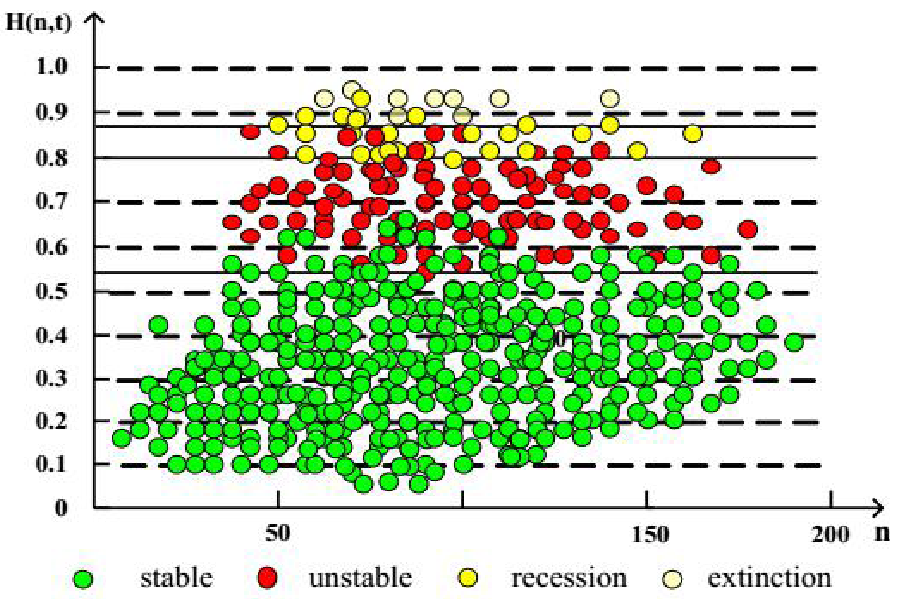 Fig 2. The relationship between the Equilibrium Index and the stages of a social group's life.
Topic-Driven Dynamics
One of the most fascinating findings is the "Breaking News" effect. When major news hits, the Equilibrium Index drops sharply. Why? Because everyone rushes to participate, briefly turning an imbalanced "core-led" group into a truly balanced community.
Critical Insight & Future Directions
The value of this work lies in its predictive power. By monitoring the index, platform administrators could identify groups that are "hollowing out" and introduce interventions (e.g., suggesting new topics of common interest) to prevent extinction.
Limitations: The study primarily focuses on "shallow data" (metadata like packet size and frequency) due to privacy constraints. Future research integrating Natural Language Processing (NLP) could link the sentiment of the core node set to group longevity, providing an even more nuanced view of the digital social fabric.
Takeaway
If you want to know if an online community will survive the next six months, don't look at its member count—look at its Equilibrium Index. A group kept alive by only two people isn't a community; it's a countdown to a dead link.