
Toward Emotion-Aware Computing: Smart Loop Selection via Machine Learning
SPECIAL SECTION ON EMOTION-AWARE MOBILE COMPUTING
This paper introduces an ML-based loop selection approach for Speculative Multithreading (SpMT) to accelerate compute-intensive emotion-aware applications. By utilizing a K-Nearest Neighbor (KNN) classifier to predict profitable loops, the method achieves an average speedup of 1.87 on a 4-core Prophet processor.
TL;DR
Emotion-aware computing is a computational beast, demanding high-performance parallel execution. This paper moves away from rigid, "one-size-fits-all" parallelization strategies by introducing a Machine Learning-based loop selection approach. By using KNN to predict which loops are actually "profitable" for Speculative Multithreading (SpMT), the authors achieved a consistent speedup, outperforming legacy heuristics by 6.7% and reaching a total average speedup of 1.87x on a 4-core system.
Context: Why Speculative Parallelism?
Emotion-aware systems (like intelligent medical recommenders or affective film retrieval) process massive amounts of data to simulate human affect. These programs are often sequential but spend the vast majority of their time in loops.
While standard parallelization requires guaranteed independence, Speculative Multithreading (SpMT) allows threads to run in parallel even if dependencies are uncertain. If a conflict occurs, the system "squashes" the speculative thread and restarts. The million-dollar question is: Which loops are worth the risk of a squash?
The Pain Point: The "One-Size-Fits-All" Trap
Existing compilers typically use simple heuristics—like parallelizing only the innermost or outermost loops. These methods ignore the unique DNA of a loop (its "features"). If you pick a loop with heavy data dependencies, you get constant squashes; if you pick one too small, the overhead of spawning a thread destroys any performance gains.
Methodology: KNN-Driven Profitability Prediction
The authors propose a loop-aware selection scheme. Instead of guessing, they treat loop selection as a Classification Problem.
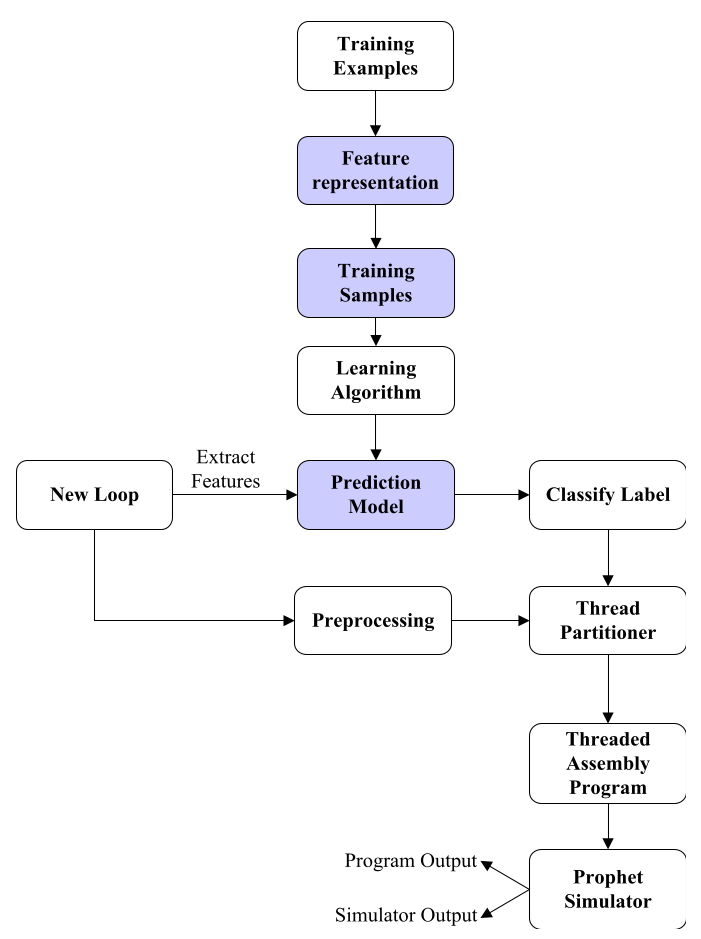
1. Feature Extraction
The system extracts 10 distinct features categorized into:
- Static Features: Block count, iteration count, static instruction count, loop depth.
- Dynamic Features: Dynamic instruction count (via profiling), Branch probability, Data Dependence Count (DDC), and Data Dependence Distance (DDD).
2. The Training Pipeline
Because real-world benchmarks are limited, the authors generated "virtual programs" to expand their training set. They used a profiler to collect runtime behavior and a simulator to label each loop as YES (speedup > 1) or NO (speedup ≤ 1).
3. Loop Thread Partitioning
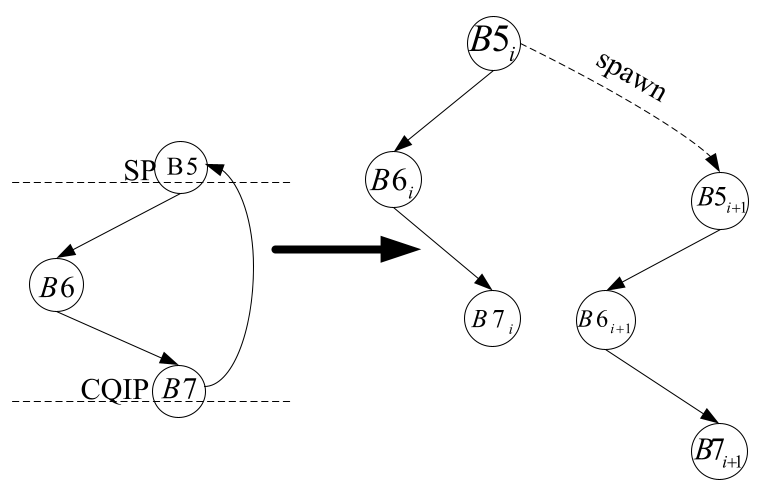
Once the KNN model predicts a loop is "profitable," the Prophet compiler uses the SP-CQIP (Spawning Point - Control Quasi Independent Point) mechanism to mark the threads.
Experimental Insights
The ML-based approach was tested using the Prophet simulator (modeling a 4-core MIPS-based processor) on the Olden benchmarks.
Performance Gains
The results were striking. In programs like em3d (electromagnetic wave modeling), the ML approach achieved a 24.97% improvement over the multilevel heuristic. Why? Because the KNN model recognized that nested loops in em3d had a specific data dependence structure that the heuristic was mismanaging.

Fine-Grained vs. Coarse-Grained
The ablation study showed that loop profitability is highly sensitive to thread size. Some programs (like bh) benefited from small, fine-grained threads (~42 instructions), while others (like voronoi) required larger chunks. The ML model automatically identified these preferences, leading to a more stable speedup profile.
Critical Analysis & Conclusion
Takeaway
The core value of this research is the shift from Man-made Heuristics to Data-driven Compiling. By identifying the "Inductive Bias" in loop structures, the KNN model successfully filters out loops that would otherwise cause "thread thrashing."
Limitations
- Profiling Overhead: The method relies on dynamic profiling (executing the program multiple times with different inputs), which may not be feasible for all real-time production environments.
- KNN Simplicity: While KNN is effective, it requires keeping the entire sample set in memory. Future work could explore more compact representations like Decision Trees or even lightweight Neural Networks.
Final Word
As emotion-aware computing moves toward mobile and edge devices, the ability of a compiler to "sense" the best parallelization strategy without human intervention is no longer a luxury—it’s a necessity. This paper provides a robust blueprint for reaching that goal.