
Safeguarding Social Networks: A Location-Aware Approach to Attribute-Based Access Control
Specification and Enforcement of Location-Aware Attribute-Based Access Control for Online Social Networks
The paper proposes a "Location-Aware Attribute-Based Access Control" (LA-ABAC) model for Online Social Networks (OSNs) to mitigate risks of stolen credentials. By integrating geolocation data into the NIST Policy Machine framework, it authenticates users by correlating their current IP-based location with historical "geographical footprints" extracted from past social media activity.
TL;DR
As Online Social Networks (OSNs) become repositories for nearly every aspect of our personal lives, the risk of credential theft grows. This paper introduces a Location-Aware Attribute-Based Access Control (LA-ABAC) model. Rather than just checking who you are (password), it checks where you are based on your historical behavior. By extending the NIST Policy Machine with "Location Containers," the system calculates a confidence score that can thwart attackers even if they have your login credentials.
The Motivation: When Passwords Aren't Enough
Online Social Networks are currently dominated by Relationship-Based Access Control (ReBAC)—the idea that if you are a "Friend," you can see my photos. However, ReBAC does nothing to stop an attacker who has stolen a user's password.
Existing solutions like simple IP whitelisting are too rigid for modern life. Users travel, move between cities, and post from new cafes. The authors identified a need for a system that is:
- Dynamic: It adapts as the user moves.
- Context-Aware: It looks at the "where" and "when" of an access request.
- Probabilistic: It understands that a "new" location near an "old" one is less suspicious than a login from across the globe.
Methodology: Location as a First-Class Attribute
The core innovation lies in bridging the gap between NIST Policy Machine (PM) and Geospatial Data.
1. Extending NIST Policy Machine
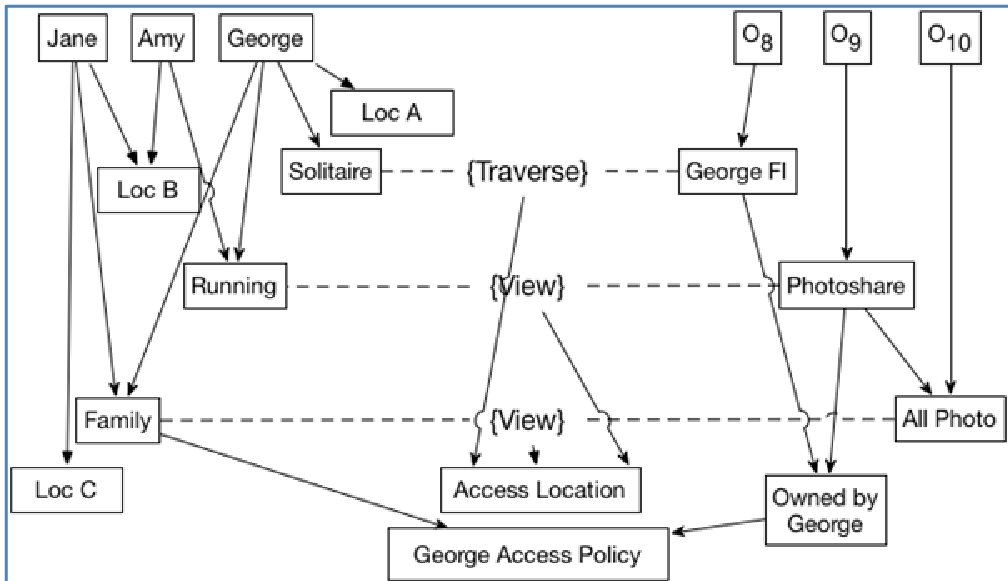
In a standard PM, access is determined by user and object "containers." The authors added Location Containers.
- User-Location Association: If Jane often posts from Fort Collins, she is assigned to the "Fort Collins" location container.
- Environmental Constraints: Permissions are augmented with spatial constraints. An "Access Location" container ensures that the user is physically where their profile says they should be.
2. The Confidence Evaluation Formula
How do we decide if a location is "reasonable"? The authors propose a Confidence Score ():
- Quality Score (): Measures proximity. If you are 5 miles from a previous post, is high (0.9). If you are 35 miles away, drops to 0.
- Quantity Value (): Measures frequency. If 30% of your total posts came from this area, the system is very confident that it’s you.
3. Geocode Correlation Process
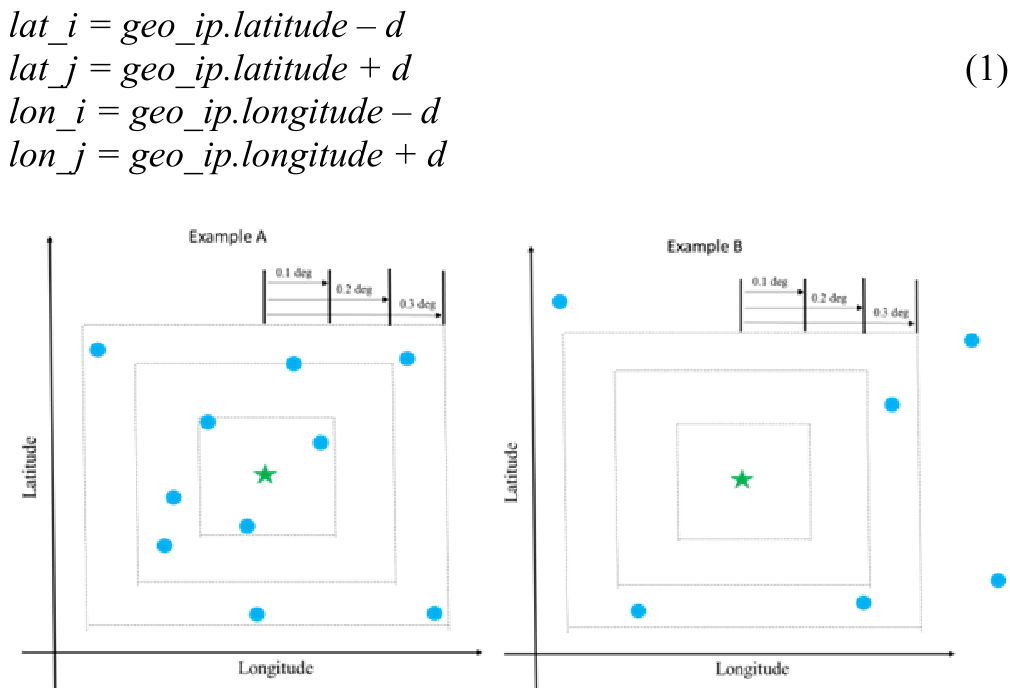
When a user logs in, the system grabs their IP, converts it to a Geocode (lat/long), and creates a Postal Code Range Zone. It then queries the user's history (R_geo) to find spatial matches within that zone.
Experiments: Real-World Scenarios
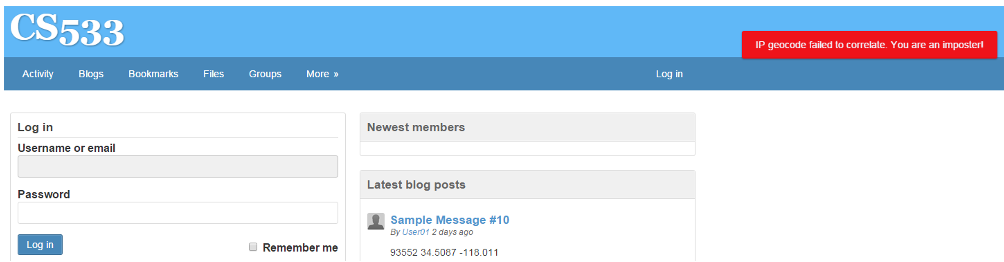
The authors built a test bed using Elgg (an open-source social engine). They tested three key scenarios:
| Scenario | Location | History Match | Result |
|---|---|---|---|
| Legitimate User | New city, nearby | High Proximity | Access Granted () |
| Atypical Login | Further away | Low Proximity/Low Count | Access Denied () |
| Attacker | Out of State | No History | Access Denied () |
Critical Insight & Future Outlook
The beauty of this approach is its use of passive metadata. The user doesn't have to do anything; their past activity (geotagged photos, check-ins) builds the security model for them.
However, there are limitations:
- Privacy: Building a database of every user's location history (
R_geo) creates a massive target for hackers. The "protector" must be a "vigilant steward" of this metadata. - Cold Start: What happens to a new user with zero posts? The paper suggests falling back to additional authentication (like 2FA).
Conclusion: This paper moves OSN security away from static "who-you-know" relationships toward a multi-dimensional "how-you-behave" model. By integrating location into the NIST PM framework, it provides a blueprint for an ABAC standard that could eventually secure everything from Facebook to the Internet of Things (IoT).