
SpectralLink: Leveraging Spectral Manifolds for Friend Recommendation in Signed Social Networks
Spectral clustering for link prediction in social networks with positive and negative links
The paper introduces SpectralLink, a link prediction framework for Online Social Networks (OSNs) that utilizes multi-way spectral clustering on the normalized Laplacian matrix. It effectively recommends friends by capturing global manifold structures and latent associations, significantly outperforming local heuristics and traditional clustering in both unsigned and signed networks.
TL;DR
SpectralLink is a novel link prediction framework that uses the eigenvectors of the normalized Laplacian matrix to cluster users and predict future friendships. By mapping the social graph into a low-dimensional spectral space, it captures non-convex cluster shapes that traditional K-means ignores, and it effectively utilizes negative links (distrust) to sharpen the accuracy of positive friend recommendations.
Problem & Motivation: The Gap Between Local and Global
Most commercial OSNs like Facebook and Hi5 rely on the "Friend of a Friend" (FOAF) logic. While efficient, this local approach only looks at pathways of length 2. If two users are separated by a slightly longer path but share a deep latent community structure, local methods fail to "see" them.
Conversely, global methods like Random Walk with Restart (RWR) or Katz Index consider the entire graph structure. While accurate, they often involve matrix inversions or dense computations that don't scale to millions of nodes ().
The authors' insight is rooted in Spectral Clustering. By looking at the top-k eigenvectors, we can perform a "soft" dimensionality reduction that filters out the noise of sporadic links and focuses on the "main linking trends."
Methodology: The Spectral Advantage
The core of SpectralLink involves a Three-Step Pipeline:
- Normalization: Construct the normalized Laplacian matrix . This matrix is better suited for graphs with varying node degrees than the standard Adjacency matrix.
- Spectral Embedding: Use the Lanczos method to efficiently find the top-k eigenvectors. This transforms nodes from a high-dimensional discrete space into a continuous k-dimensional Euclidean space.
- Clustered Similarity: Instead of just using Euclidean distance, the authors propose a similarity measure based on the Triangle Inequality relative to cluster centroids.
Architecture Overview

The logic for similarity is split:
- Within Cluster (): . If two nodes are at a similar distance from their community center, they are likely related.
- Between Clusters (): A penalized score that ensures most recommendations stay within the user's spectral community unless necessary.
Handling the "Dark Side": Signed Networks
A standout feature of this research is the treatment of Negative Links. In networks like Epinions, users can express "distrust." The authors adopt Structural Balance Theory (the enemy of my enemy is my friend). By using a Signed Normalized Laplacian, they can embed distrust as a structural feature that actually helps predict where trust (positive links) will form.
Experiments and Results
The authors tested SpectralLink across synthetic datasets and real traces from Facebook and Hi5.
Performance Metrics
- Accuracy: On the Facebook 3.7K dataset, SpectralLink achieved a MAP of 0.395, significantly higher than FOAF (0.105) and K-means (0.334).
- Signed Accuracy: In Epinions, adding negative link information () pushed the AUC higher than models using only positive data.
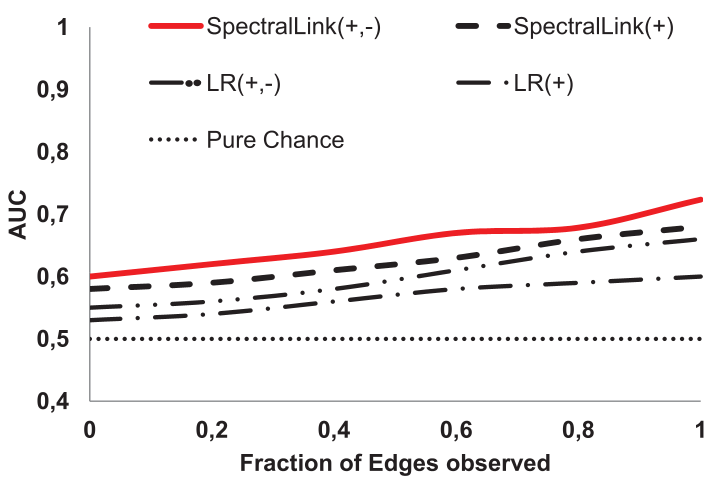
As seen in the PR-curves, the spectral approach maintains higher precision as recall increases compared to logistic regression baselines.
Critical Analysis & Conclusion
SpectralLink succeeds because it treats link prediction as a manifold learning problem rather than a simple counting exercise. By clustering in the spectral domain, it respects the natural "clusters" of human society which are rarely perfectly spherical.
Limitations:
- Cold Start: Spectral methods still struggle with entirely new nodes that have zero links.
- Parameter Sensitivity: The choice of (number of clusters) is crucial. The paper suggests , but in highly heterogeneous networks, this heuristic might fail.
Takeaway: If you are building a recommendation engine, don't just count common neighbors. Look at the "vibrations" (eigenvalues) of your graph. And never ignore your users' negative feedback—it’s often as informative as their likes.