
Gen-SM in Massive MIMO: Redefining the Efficiency Frontier for 5G Networks
15553_Spectral, Energy, and Economic Efficiency of 5G Multicell Massive MIMO Systems With Generalized Spatial Modulation.
Summary
Problem
Method
Results
Takeaways
Abstract
This paper investigates the performance of Generalized Spatial Modulation (Gen-SM) in multicell multiuser massive MIMO systems. It proposes a linear-processing-based detection algorithm and an analytical framework to evaluate sum-rate, spectral efficiency (SE), energy efficiency (EE), and economic efficiency (ECE) under practical 5G constraints like pilot contamination and antenna correlation.
## TL;DR
Researchers have long sought to balance the raw speed of Massive MIMO with the energy constraints of mobile devices. This paper introduces a comprehensive framework for **Generalized Spatial Modulation (Gen-SM)** in multicell environments. By mapping data to antenna indices as well as signal phases, Gen-SM reduces hardware costs (fewer RF chains) while maintaining high throughput. The study proves that while SM might offer lower peak speeds, its **Energy Efficiency (EE)** and **Economic Efficiency (ECE)** often surpass traditional MIMO in practical 5G deployments.
## The Core Challenge: The RF Chain Bottleneck
Massive MIMO is a cornerstone of 5G, but it has an "expensive" secret: each active transmit antenna typically requires its own Radio Frequency (RF) chain, including DACs, mixers, and power amplifiers. This leads to high power consumption and hardware complexity.
**Spatial Modulation (SM)** offers a clever workaround. It conveys information bits by choosing *which* antenna is active. **Generalized SM (Gen-SM)** takes this a step further by allowing multiple active antennas but still fewer than the total available, striking a balance between the single-RF chain simplicity of SM and the high-speed multiplexing of traditional MIMO.
## Methodology: Two-Stage Linear Detection
Detecting Gen-SM signals in a multicell environment is notoriously difficult due to **pilot contamination**—where users in different cells reuse the same pilot sequences, blurring the channel estimates.
The authors propose a suboptimal but highly efficient two-stage detection algorithm:
1. **Antenna Detection**: Uses Matched Filter (MF) or Zero-Forcing (ZF) processing and **order statistics** to identify the most likely combination of active antennas.
2. **Symbol Detection**: Once the antennas are identified, the actual data symbols are decoded using standard constellation quantization.
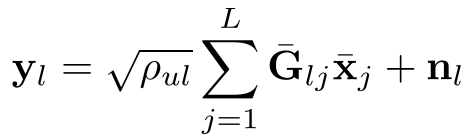
*The system accounts for multicell interference, spatial correlation, and imperfect CSI.*
## Experiments & SOTA Insights
The paper utilizes an asymptotic framework to approximate the "Sum-Rate" for large antenna arrays ($M o \infty$). Key findings include:
* **MF vs. ZF**: In low-to-moderate antenna regimes ($M$), MF detection is more robust because it captures signal energy even if the antenna index is slightly misidentified. However, as $M$ grows, **ZF detection** becomes the winner by effectively suppressing inter-stream interference.
* **The Pilot Penalty**: Gen-SM requires a longer training period ($ au = NK$) because the base station needs to know the channel for *every* antenna, not just the active ones. This reduces the time available for data transmission, creating a "Spectral Efficiency (SE)" ceiling.
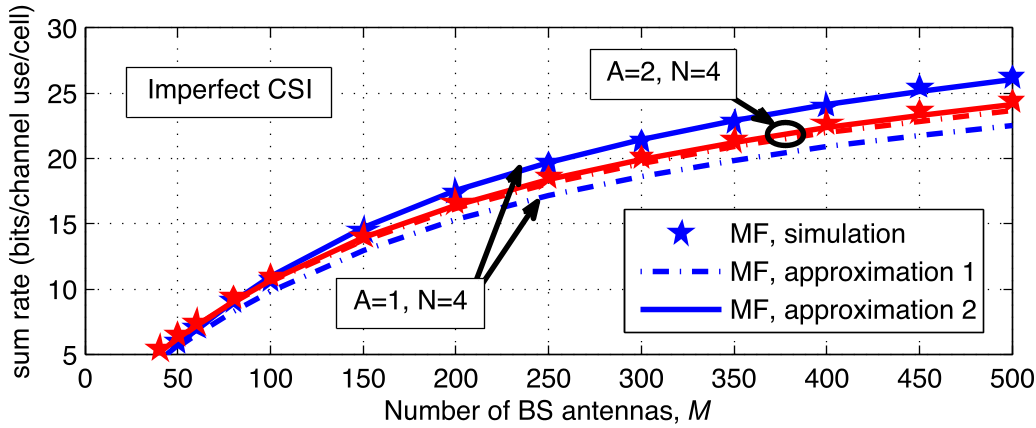
*Figure 1: Comparison of analytical approximations and simulation results for MF detection.*
## The Triple-E Trade-off: SE, EE, and ECE
The most significant contribution is the analysis of the **Economic Efficiency (ECE)**. By modeling revenue (bits per second) against costs (Watt-seconds and hardware), the authors show:
1. **SM ($A=1$)** is the EE champion among all Gen-SM variants.
2. **Pareto Optimality**: There isn't one "best" mode. At high data rates, traditional MIMO wins; at low-to-moderate rates, SM is far more energy-efficient.
3. **The Profit Angle**: In "Cost Set-up 2" (high energy costs, lower revenue per bit), SM actually generates more profit for operators than conventional massive MIMO.
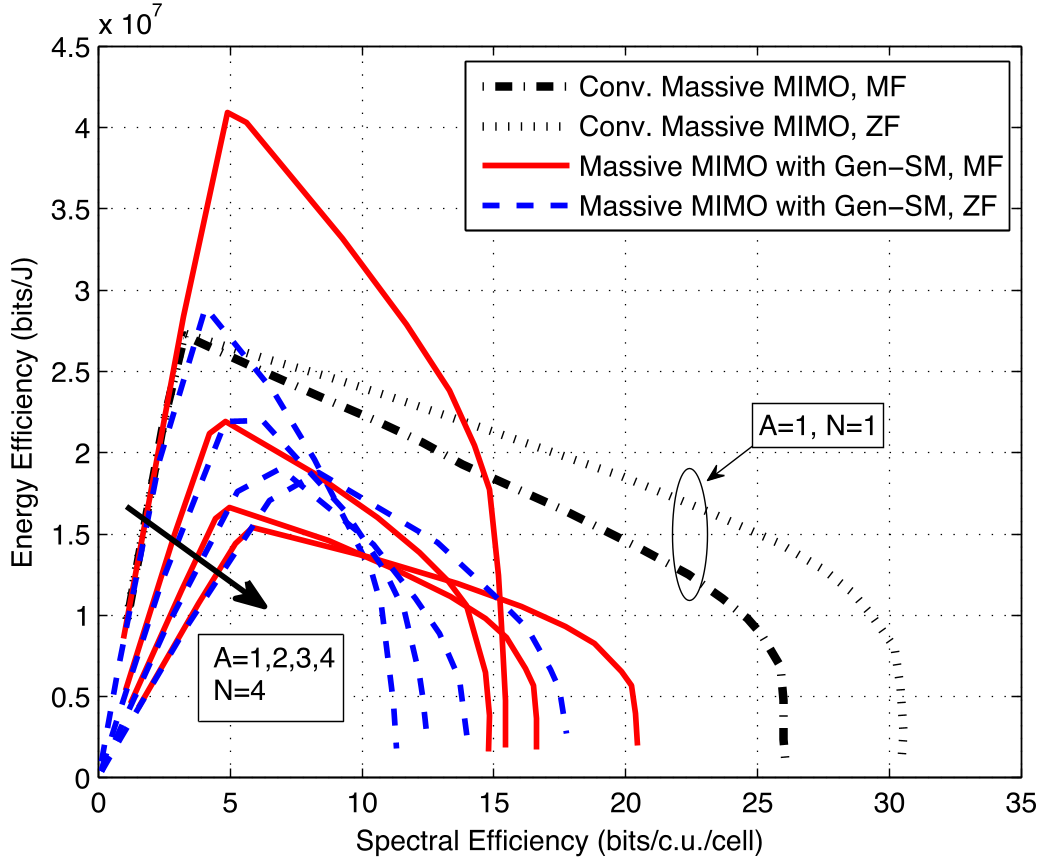
*Figure 5: The Pareto frontier showing where SM outperforms traditional MIMO.*
## Critical Analysis & Conclusion
This research moves SM from a theoretical oddity into a practical 5G/6G candidate. By treating **Economic Efficiency** as a first-class citizen alongside typical engineering metrics, the authors provide a roadmap for operators.
**Limitations**: The model assumes a "homogeneous" network. Real-world 5G is "heterogeneous" (small cells mixed with macro cells), where interference patterns and channel statistics are vastly more chaotic.
**Future Outlook**: The next frontier involves **dynamic switching**. Imagine a smartphone that uses Gen-SM during low-power background tasks and switches to full Massive MIMO only when downloading 4K video. This paper provides the mathematical foundation for such an intelligent adaptive system.