
Speculating Server Applications: A Nonintrusive Power Trace Approach
Can We Speculate Running Application With Server Power Consumption Trace?
This paper introduces a nonintrusive method to identify running applications in servers by classifying power consumption time series. The authors propose a novel Local Time Warping (LTW) distance measure and a hybrid LSTM/LTW classifier, achieving a state-of-the-art accuracy of 93% on real-world data center datasets.
TL;DR
Researchers have developed a way to "spy" on what a server is doing by looking only at its power consumption. By combining a novel, fast distance metric called Local Time Warping (LTW) with LSTM neural networks, they can identify running applications (like Spark, Hadoop, or Web Servers) with 93% accuracy. This nonintrusive method bypasses the need for administrative access while maintaining high privacy.
Background: The Price of Monitoring
In modern green data centers, monitoring workload is vital for energy efficiency. However, installing monitoring agents (intrusive) is often a security and administrative nightmare. Power traces offer a "side-channel" for monitoring, but the signals are noisy and often misaligned. Standard metrics like Euclidean distance fail here because they can't handle the "stretching" or "shrinking" of application execution patterns over time.
The "Why": Beyond Dynamic Time Warping (DTW)
For decades, Dynamic Time Warping (DTW) has been the gold standard for time series. It uses dynamic programming to find the best alignment between two sequences. However, the authors of this paper made a bold observation:
- DP is Expensive: O(N^2) complexity is too slow for real-time data center monitoring.
- Commutativity is a Constraint: In proximity search, why must the distance from A to B be the same as B to A?
- Global vs. Local: Most patterns in power traces are local ripples rather than global shifts.
Methodology: The LTW and LSTM Hybrid
The authors propose a dual-track solution.
1. Local Time Warping (LTW)
Instead of solving a global optimization problem, LTW warps time locally using a predefined index set. It selects the minimum difference between a point in sequence and a small neighborhood in sequence .
This results in a measurement that is linear in time complexity and noncommutative, which adds flexibility to the classifier.
2. The Hybridization (LSTM/LTW)
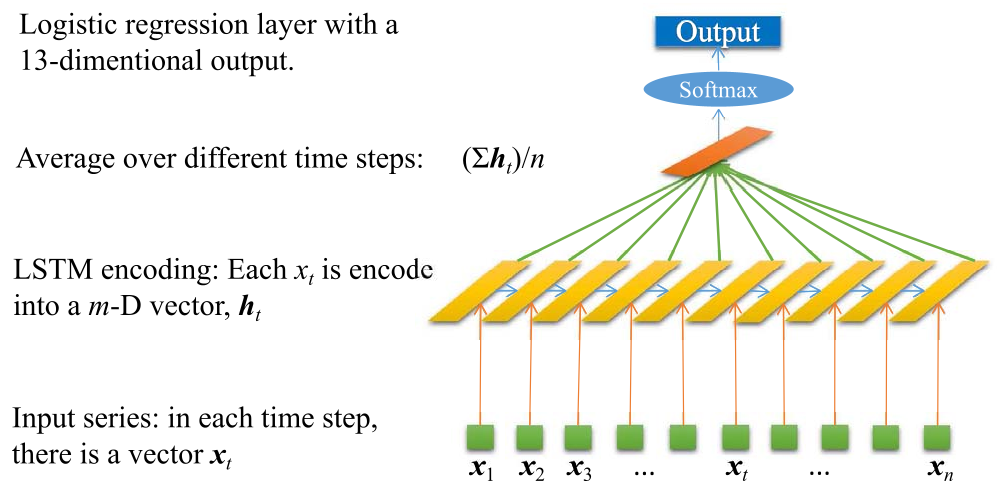
The researchers noticed that LSTM (a deep learning model) and LTW (a k-Nearest Neighbor approach) made different types of mistakes. By combining them—specifically by adding their predicted probability vectors—the hybrid model achieves a "best of both worlds" result.
Experimental Battleground
The team collected 13 classes of power data from Spark/Hadoop clusters and Web Servers.
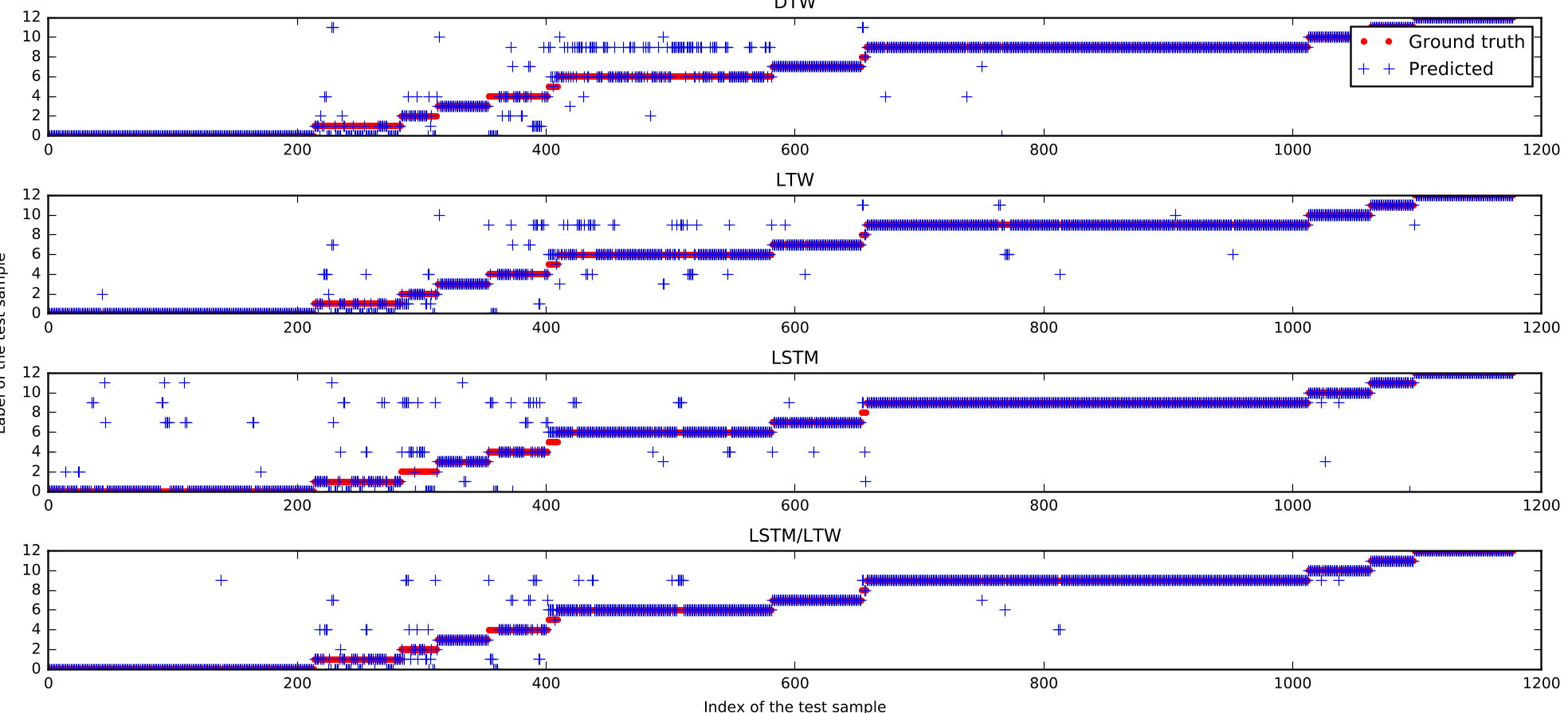
- Baseline (DTW): 84% accuracy.
- The Contender (LTW): 90% accuracy.
- The Champion (LSTM/LTW Hybrid): 93.1% accuracy.
Notably, the linear version of LTW performed as fast as the fastest known lower-bound methods (like LB_Keogh) but maintained significantly higher accuracy.
Deep Insight: Why did the Hybrid win?
As shown in the "Union Accuracy" analysis, the set of samples correctly identified by LSTM and 1NN-LTW only partially overlap. LSTM excels at capturing long-term dependencies and "stage-patterns" in MapReduce jobs, while LTW is superior at matching specific local signal signatures. Their hybridization pushes the accuracy toward the theoretical limit.
Critical Analysis & Conclusion
This work proves that we don't always need complex, global optimization like DTW for time-series tasks. Sometimes, local, noncommutative warping is not only faster but more accurate.
Limitations: The method currently assumes single-application execution. In real-world multi-tenant environments, power traces would be a "mixture" of signals. Future Outlook: The next frontier is Source Separation—unmixing power traces to identify multiple concurrent applications, much like the "Cocktail Party Problem" in audio processing.
This paper is a must-read for anyone looking to optimize time-series pipelines where inference speed and "warping" robustness are equally critical.