
Speech Emotion Recognition among Couples: Leveraging the Peak-End Rule and Transfer Learning
Speech Emotion Recognition among Couples using the Peak-End Rule and Transfer Learning
2020-10-25
Summary
Problem
Method
Results
Takeaways
Abstract
This short paper presents a Speech Emotion Recognition (SER) system for couples by leveraging the psychological "Peak-End Rule" and Deep Transfer Learning. Using the YAMNet CNN architecture and SVM classifiers, the study predicts end-of-conversation valence from specific 10-minute conflict audio segments.
## TL;DR
How we remember an experience is often dictated by its most intense moment and its conclusion. This study applies this psychological "Peak-End Rule" to machine learning, achieving a **74.8% accuracy** in predicting how women feel after a conflict by analyzing just a few seconds of their most "extreme" audio peaks.
## Problem & Motivation: The Complexity of Couple Dynamics
Analyzing romantic conflict is a cornerstone of psychological research, traditionally requiring hours of manual labor to "code" emotions. Existing automated solutions often fall short because:
1. **Acted vs. Real**: Models trained on actors don't generalize to the messy, subtle cues of real couples.
2. **Subjectivity**: External raters often miss how a partner *actually* feels internally.
3. **Data Scarcity**: Real-world datasets with high-quality self-reports are extremely small.
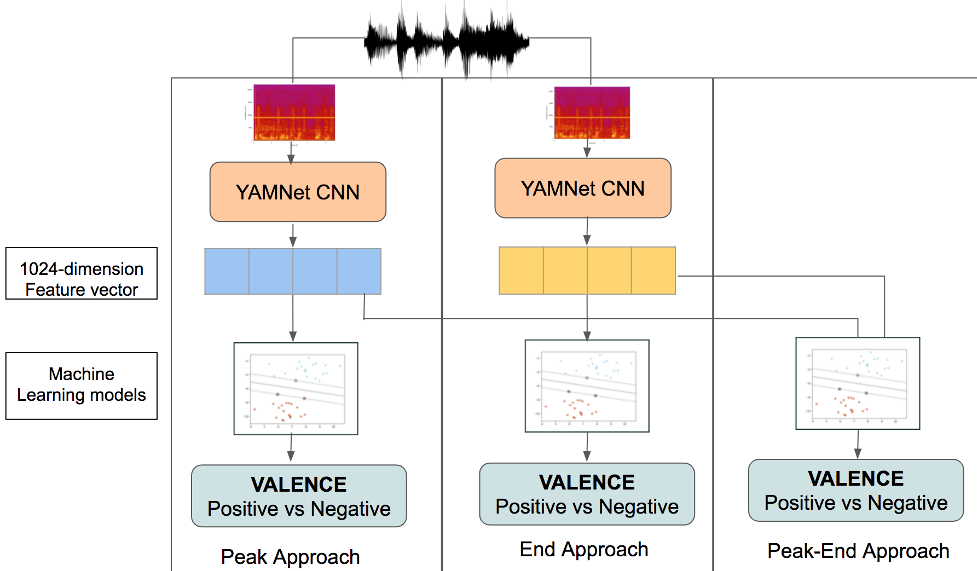
The authors hypothesized that we don't need to analyze a full 10-minute conversation. Instead, inspired by Daniel Kahneman’s **Peak-End Rule**, they focused on the "peaks" (emotional highs/lows) and the "end" (the wrap-up) to predict post-conversation sentiment.
## Methodology: Psychological Heuristics meets Deep Learning
The workflow combined classical psychology with modern Deep Transfer Learning.
### 1. Data Capture
101 Dutch-speaking couples engaged in a 10-minute conflict. They provided **moment-by-moment self-ratings** using a joystick, allowing researchers to pinpoint the exact "peaks" of their emotional experience.
### 2. Feature Extraction (The Transfer Learning Angle)
Because the dataset was small, the researchers avoided "hand-crafted" features. Instead, they used **YAMNet**, a Convolutional Neural Network pre-trained on millions of YouTube clips (AudioSet).
* **Input**: Log-mel spectrograms.
* **Output**: 1024-dimensional embeddings representing the "essence" of the sound.
### 3. Classification
These embeddings were fed into a **Support Vector Machine (SVM)** to classify the partner's valence as positive or negative.
## Experiments & Results: A Surprising Gender Gap
The researchers compared three segment-based approaches: Peak only, End only, and Peak-End combined.
| Approach | Male (Balanced Acc %) | Female (Balanced Acc %) |
| :--- | :---: | :---: |
| **Partner Perception (Human Baseline)** | 73.2 | 74.3 |
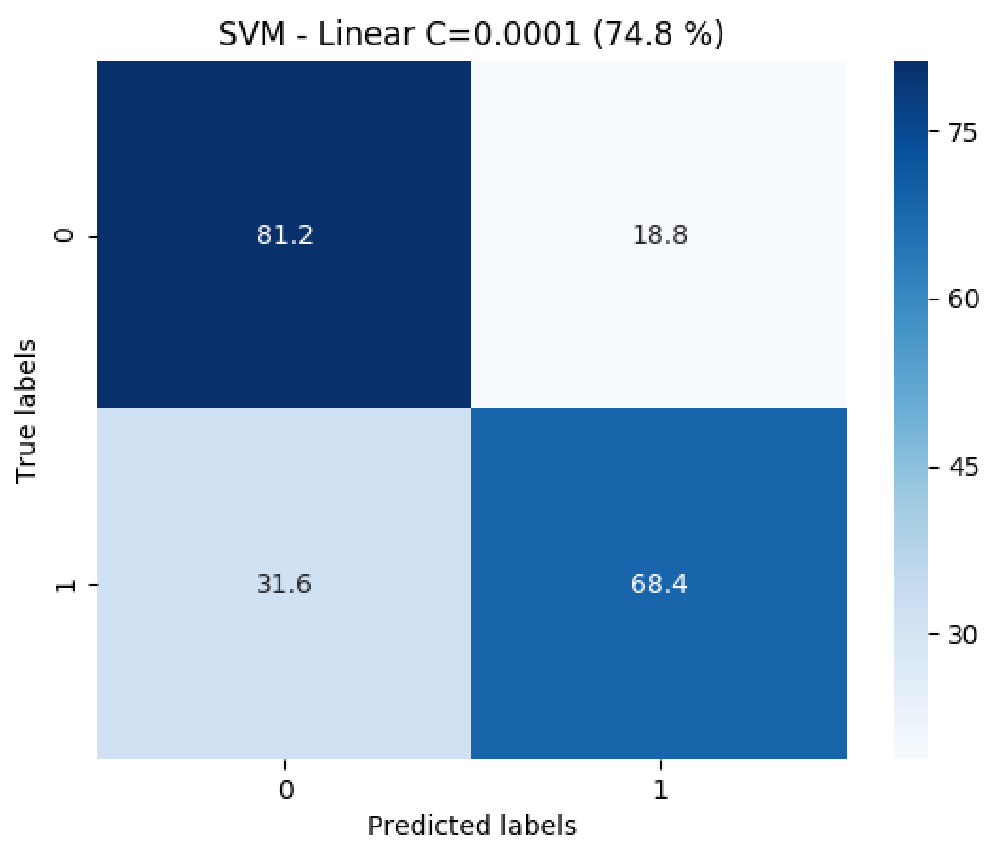
| **Peak (Machine)** | 48.8 | **74.8** |
| **End (Machine)** | 50.0 | 58.6 |
| **Peak-End (Machine)** | **53.3** | 54.4 |
### Critical Findings:
* **Female Accuracy**: For women, the "Peak" segments (roughly 1.1% of the total audio) were more predictive of their final mood than their own partners' perceptions (74.8% vs 74.3%).
* **Male Divergence**: The model struggled with men, barely beating random chance. This suggests that men might not express their "peak" emotions through acoustic channels as clearly as women do, or perhaps they express them more through linguistic/verbal content.
* **The Peak Matters More**: In almost all cases, the "Ending" was less predictive than the "Peak," challenging the idea that the last thing said is the most important.
## Critical Analysis & Conclusion
### Takeaway
This research provides a "litmus test" for how we should build affective computing systems for therapy. It demonstrates that **more data isn't always better**—focusing on psychologically salient moments can yield superior results than broad-spectrum analysis.
### Limitations & Future Work
* **Acoustics vs. Linguistics**: This study looked only at *how* things were said (pitch, tone), not *what* was said. Incorporating NLP (LLMs) could bridge the gap in male emotion recognition.
* **Arousal Dimensions**: The study focused on Valence (Positive vs. Negative). Future work must incorporate Arousal (Calm vs. Excited) for a full emotional picture.
Ultimately, this work paves the way for "digital relationship assistants" that can help couples understand their emotional trajectories in real-time, potentially intervening before a conflict spirals.