
Deciphering the Golden Years: Advanced Emotion Recognition for the Elderly
4466_Speech Emotion Recognition among Elderly Individuals using Multimodal Fusion and Transfer Learning.
This paper presents a speech emotion recognition (SER) framework specifically tailored for elderly individuals using the USOMS-e dataset. The authors employ a transfer learning approach, utilizing pretrained YAMNet for acoustic features and German-specific BERT/SBERT for linguistic features, achieving a significant 8.8% UAR improvement over the INTERSPEECH 2020 COMPARE baseline for valence classification.
TL;DR
Recognizing emotions in the elderly is a critical yet underserved frontier in mental health technology. This study tackles the challenge using the USOMS-e dataset, moving away from traditional feature engineering toward Transfer Learning. By leveraging pretrained YAMNet and BERT models, the authors achieved an 8.8% boost in valence detection accuracy, proving that "listening" to what is said is often as important as "how" it is said.
Context & Motivation: The Gap in Affective Computing
Most AI models today are "trained on the young." Standard datasets like IEMOCAP often feature younger adults or professional actors, whose vocal hygiene and emotional intensity differ starkly from an 80-year-old individual narrating a personal story. For the elderly, factors like vocal cord atrophy or different linguistic patterns make standard emotion recognition models fail.
The authors aimed to solve this by participating in the INTERSPEECH 2020 COMPARE challenge, focusing on three-class classification (Low, Medium, High) of Arousal (intensity) and Valence (positivity/negativity).
Methodology: Synergy of Sound and Semantics
The core insight of this work is that handcrafted features (like those from openSMILE) are no longer the gold standard. Instead, the authors treat pretrained deep networks as universal feature extractors.
1. Acoustic Stream (The Tone)
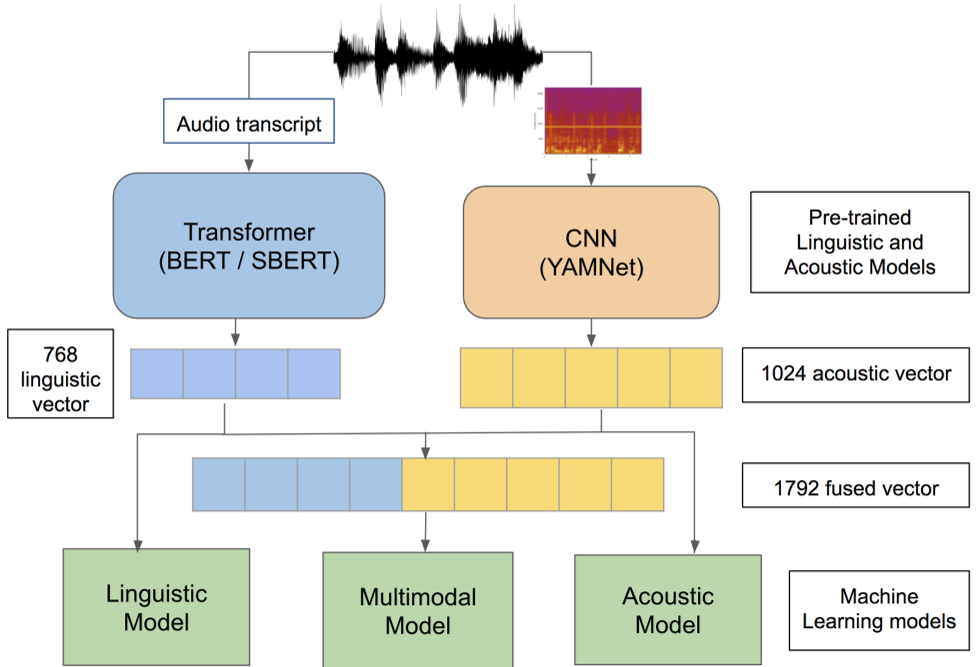
They used YAMNet, a MobileNet-based CNN pretrained on millions of YouTube clips (AudioSet). It converts audio into mel-spectrograms and then into 1024-dimensional embeddings.
2. Linguistic Stream (The Content)
Recognizing that emotion is deeply embedded in word choice, they used German BERT and Sentence-BERT (SBERT). SBERT is particularly effective here as it optimizes sentence-level embeddings to be semantically meaningful in vector space.
3. Multimodal Fusion
The researchers implemented Early Fusion, concatenating acoustic and linguistic vectors into a single 1792-dimensional representation before feeding them into a Support Vector Machine (SVM).
Experimental Battleground: Linguistic Superiority
The results reveal a fascinating hierarchy in technical performance:
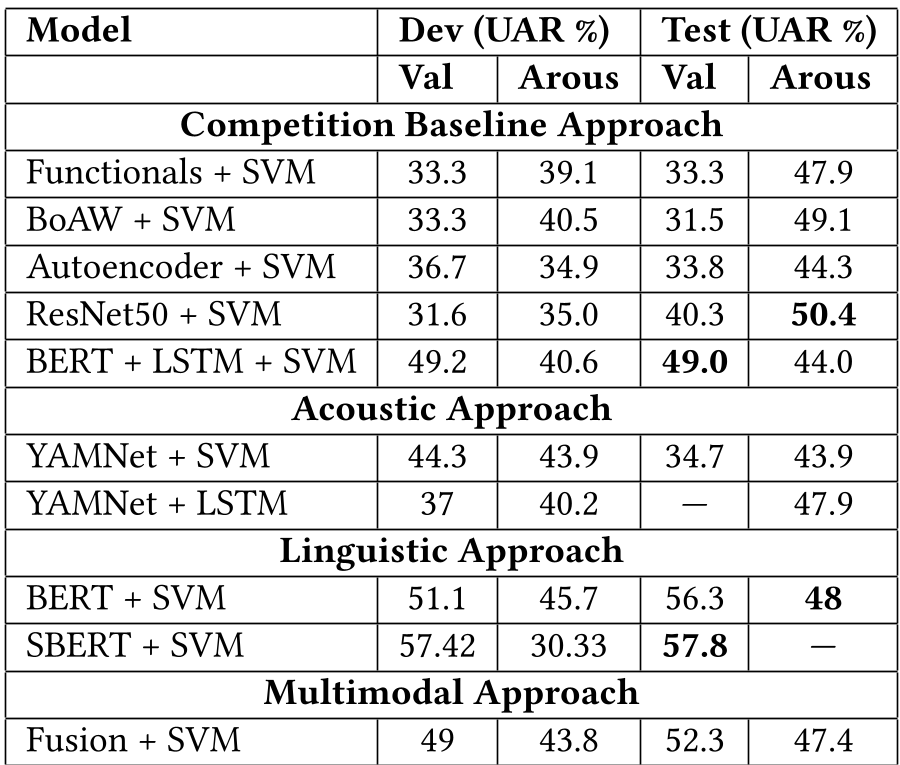
- Linguistic Wins: Remarkably, the linguistic models (BERT/SBERT) outperformed the acoustic ones. SBERT reached a 57.8% UAR for valence.
- Acoustic Challenges: Raw audio was noisier and harder to classify, suggesting that for elderly individuals, the "sentiment" of their words is a more stable indicator of valence than their vocal frequency variations.
- Transfer Learning vs. Baselines: The proposed method beat the competition's ResNet50 and Handcrafted (Functionals) baselines significantly.
Deep Insight: Why Multimodal wasn't #1?
In many studies, fusion is the silver bullet. Here, however, the linguistic-only model often performed best. This suggests a modality noise issue: if the acoustic features are sufficiently noisy (due to age-related vocal changes or recording environment), adding them to clean linguistic data can actually dilute the signal.
Critical Analysis & Future Outlook
Strengths:
- Proves that feature engineering is becoming obsolete in SER.
- Successful application of SBERT to the German language in a clinical context.
Limitations:
- Manual Transcripts: The linguistic success relied on manual transcripts. In a real-world product, an ASR (Automatic Speech Recognition) engine would introduce errors that might degrade the BERT model's performance.
- Acoustic Fine-tuning: The YAMNet model was used "as-is." Fine-tuning on emotional data specifically could likely bridge the gap in arousal detection.
Conclusion
This study serves as a vital stepping stone for mental health interventions in nursing homes and elderly care. By proving that transfer learning can handle the nuances of elderly speech, it opens the door for ambient emotional monitoring systems that can alert caregivers to depressive shifts or anxiety without intrusive questioning.