
Wide Residual Networks for SER: Rethinking Complexity in Acoustic AI
14404_Speech Emotion Recognition Using MFCC and Wide Residual Network.
The paper introduces a robust Speech Emotion Recognition (SER) system using Mel-frequency Cepstral Coefficients (MFCC) for feature extraction and a Wide Residual Network (WRN) for classification. It achieves a State-of-the-Art (SOTA) accuracy of 90.09% across 8 emotional categories.
TL;DR
Speech Emotion Recognition (SER) is a complex challenge where traditional deep learners often fail as class diversity grows. This paper proposes a breakthrough by leveraging Wide Residual Networks (WRN) and MFCC feature extraction. By focusing on network width rather than just depth, the authors achieved a remarkable 90.09% accuracy in classifying 8 emotions, significantly outperforming existing deep learning benchmarks.
Problem & Motivation: The Depth Trap
In the quest for higher accuracy, researchers usually default to "deeper is better." However, in Speech Emotion Recognition, increasing depth often leads to diminishing feature reuse—where the gradient effectively "skips" useful acoustic information.
Furthermore, raw audio is chaotic. The core challenge is two-fold:
- Feature Obscurity: Which part of the signal—pitch, timbre, or energy—truly represents "disgust" versus "sadness"?
- Architectural Efficiency: How can a model process these features without losing the subtle context of a 2-second utterance?
Methodology: The "Width" Insight
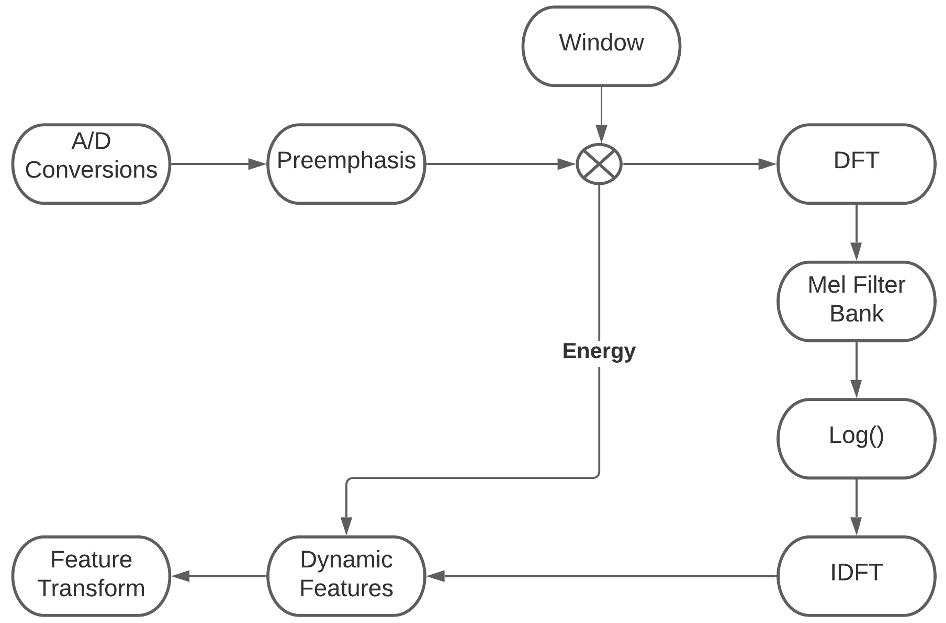
The proposed pipeline transforms raw audio through a rigorous preprocessing stage into MFCC vectors. These vectors are then reshaped into 13x100 "images," allowing the model to treat audio like a spatial vision task.
1. Feature Extraction (MFCC)
As shown in the logic below, the system utilizes the Librosa library to perform Discrete Fourier Transforms (DFT) and Mel-scaling to mimic human hearing.
2. Wide Residual Architectures
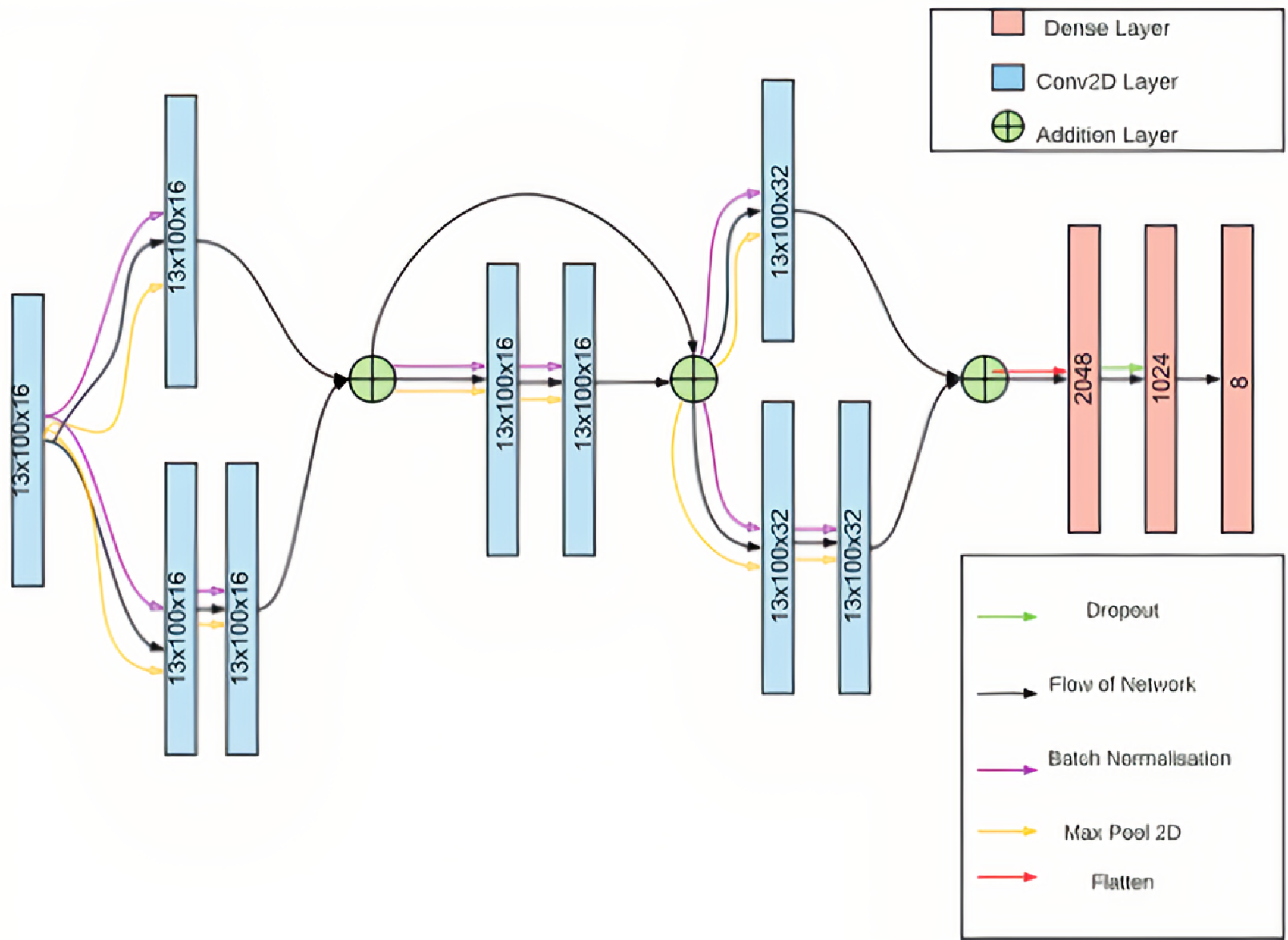
Instead of stacking hundreds of thin layers, the Wide Residual Network expands the channel capacity. The architecture uses shortcut connections to ensure that if a layer doesn't learn anything new, the original signal is still preserved for the subsequent layers.
Experiments & Results
The authors combined RAVDESS (professional actors) and TESS (female speakers) to create a diverse evaluation ground.
SOTA Comparison
The WRN approach destroyed previous benchmarks:
- GResNet: 64.48%
- Bagged SVMs: 75.69%
- Deep BiLSTM: 77.02%
- Proposed WRN: 90.09%
Performance Visuals
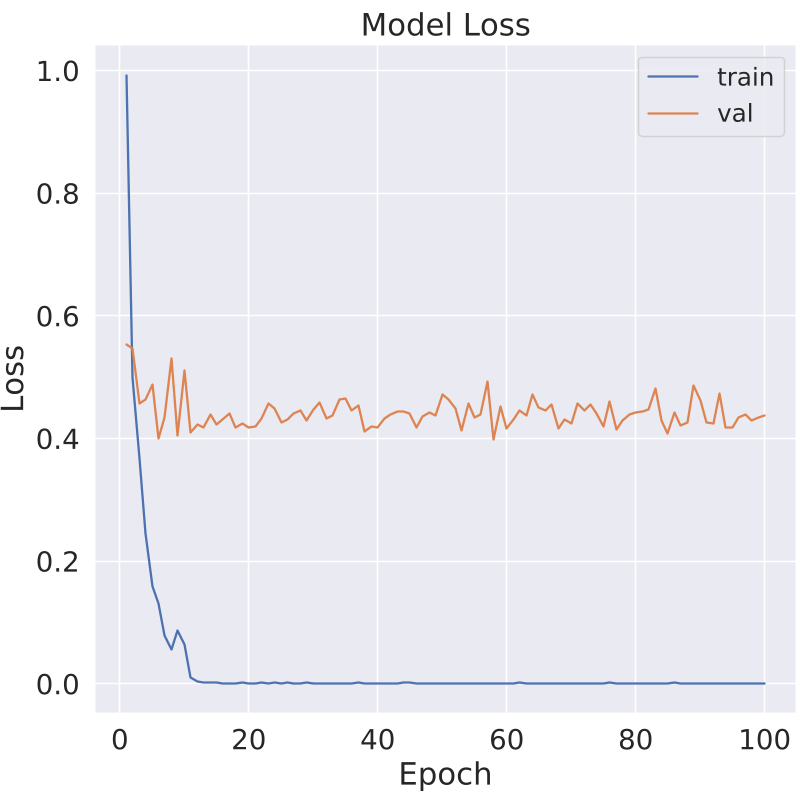
The training curves demonstrate that the model converges rapidly, reaching 100% training accuracy while maintaining high generalization on the validation set.
Interestingly, the model was most effective at recognizing "Angry" (94%) and "Disgust" (92%), likely because these emotions have distinct spectral signatures in the MFCC domain.
Critical Analysis & Conclusion
Takeaway
The success of this method proves that for medium-sized datasets, architectural width is a more significant driver of performance than raw depth. By treating audio features as 2D inputs for a WRN, the model captures local spectral-temporal patterns that simpler RNNs or standard CNNs miss.
Limitations
Despite the high accuracy, the model struggled with the "Calm" emotion (69% recall), often confusing it with "Sad." This suggests that for low-energy, subtle emotions, MFCCs alone may not be sufficient, and future work might need to incorporate prosodic features like jitters or shimmers.
Future Outlook
This work sets a new baseline for real-time SER systems. Applying this WRN framework to Cross-Corpus recognition (training on one dataset and testing on a completely different one) would be the next logical step to verify its "real-world" robustness.