
Growth Transform Neurons: Bridging SVM Optimization with Spiking Dynamics
Spiking, Bursting, and Population Dynamics in a Network of Growth Transform Neurons
This paper introduces a "Growth Transform Neuron" model that bridges the gap between top-down machine learning objectives (SVMs) and bottom-up neuromorphic dynamics. By implementing an asynchronous mapping based on polynomial growth transforms, the network produces emergent Delta-Sigma modulation, spiking, and bursting behaviors while solving classification tasks.
TL;DR
Researchers have developed a "Growth Transform" neuron model that naturally links Support Vector Machines (SVMs) to biological behaviors like spiking and bursting. By treating neural activity as a continuous optimization process in a "dual space," the network produces temporal spikes that aren't just data points—they are mathematical encodings of classification margins.
The Gap Between AI and Biology
Historically, there has been a divide in neuro-inspired computing:
- Top-down AI (SVMs, DNNs): Excellent at classification but use "lifeless" static activations.
- Bottom-up Neuromorphic (Spiking Networks): Mimic biological pulses but are notoriously hard to train for high-performance classification.
This paper proposes a unifying framework: what if spiking is simply the result of a system trying to solve a constrained optimization problem?
Methodology: Primal-Dual Growth Transforms
The core innovation lies in the Growth Transform Neuron. Instead of a simple threshold, each neuron updates its state through a polynomial growth transform—a fixed-point algorithm that ensures the system evolves on a stable manifold.
The Geometric Insight
The authors map neural responses into a dual optimization space. When a neuron reaches a "discontinuity" in its potential function (representing the classification boundary), it begins to switch rapidly. This switching manifests as Delta-Sigma modulation, spikes, or bursts.
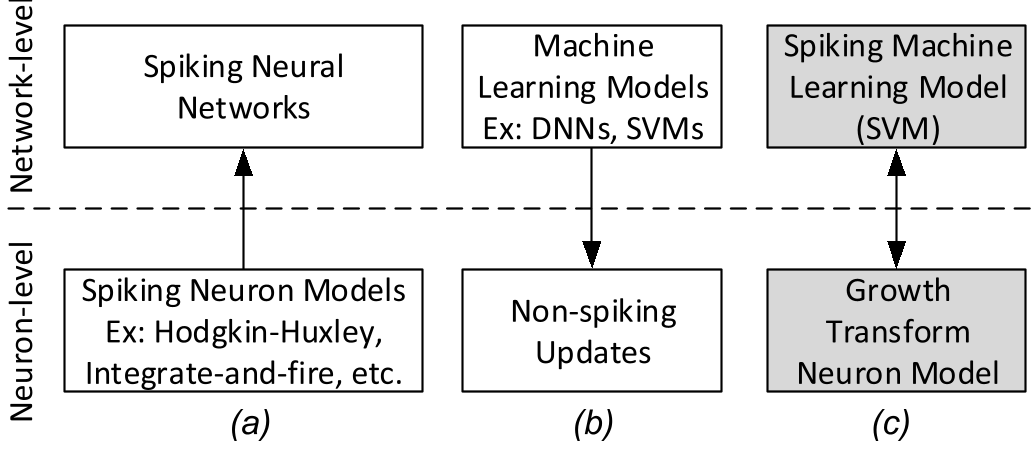 Fig 1: Contrast between (a) Bottom-up bio-mimicry, (b) Top-down ML, and (c) the proposed Growth Transform coupling.
The math follows a primal-dual mapping:
- Dual Space: Individual neurons optimize a simple potential function .
- Primal Space: The collective network minimizes a global loss function , where is the classification margin.
Emergent Biological Dynamics
1. Delta-Sigma Modulation & Noise Shaping
By using a potential function like , the neurons closest to the decision boundary (the Support Vectors) act like ΔΣ modulators. They push "quantization noise" into high-frequency bands, keeping the low-frequency "signal" (the classification margin) clean.
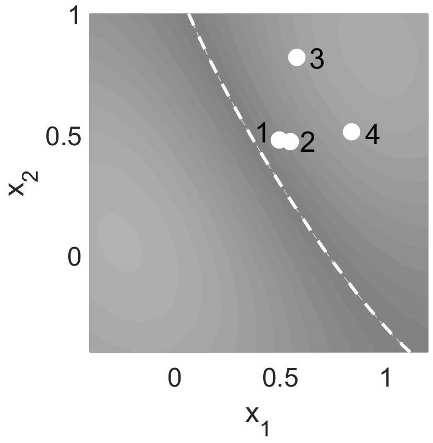 Fig 2: Emergent limit cycles in support vectors, showing the phase relationship between the internal state and the switching output.
2. Spiking and Rate Coding
If the potential function is non-convex, the neuron generates sharp "impulses" as it traverses a hysteresis loop. The paper reveals a stunning correlation: The firing rate and "time-to-first-spike" are perfectly ordered by the neuron's distance from the classification margin.
- Support Vectors (the most important neurons) spike fastest and earliest.
- Non-support Vectors remain quiet or spike slowly.
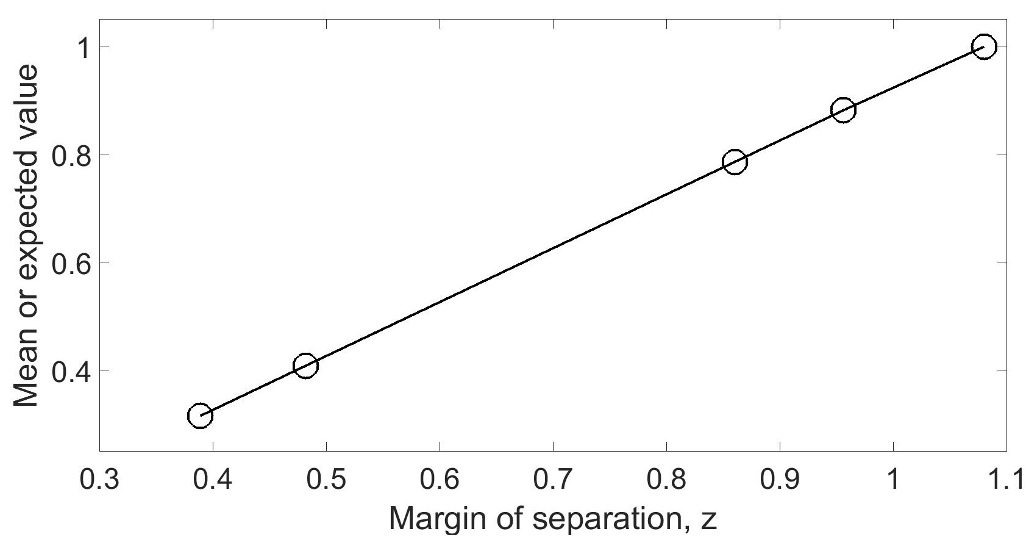 Fig 3: Mean firing rates vs. Classification margin. The network naturally discovers popular "rate coding" schemes used in neuroscience.
Experiments: Benchmarking the Biological SVM
The authors tested their Spiking and Bursting SVMs on standard datasets (UCI Adult a3a). The results confirmed that these "noisy," dynamic networks achieve classification accuracy (~83-84%) virtually identical to "perfect" mathematical SVMs like GiniSVM.
| SVM Variant | Training Error | Cross-Val Error |
|---|---|---|
| Spiking SVM | 12.1% | 16.3% |
| GiniSVM (Standard) | 3.4% | 16.8% |
Note: While training error is higher for spiking models, the generalization (Cross-val) remains competitive, suggesting a form of intrinsic regularization.
Conclusion: A New Tool for Neuromorphic Design
The "Growth Transform Neuron" provides a blueprint for the next generation of neuromorphic chips. It tells us that we don't need to force-feed spikes into a network; instead, we should define the optimization objective and let the spikes emerge as the natural "energy-efficient" language of the support vectors.
Future Outlook: This work opens doors to incorporating biophysical parameters (like ion-channel conductances) directly into machine learning objective functions, potentially leading to truly "biological" AI architectures.