
Beyond Biometrics: Catching Identity Spoofers via Social "Behavioral Signatures"
Detection of spoofed identities on smartphones via sociability metrics
This paper introduces a social behaviometric framework designed to detect identity spoofing on smartphones by analyzing sociability metrics across five major social platforms (Facebook, Twitter, LinkedIn, Skype, WhatsApp). By utilizing the DBSCAN clustering algorithm for continuous authentication, the system achieves an identification success ratio of up to 97% for genuine users.
TL;DR
Researchers have developed a framework called TrackMaison that uses your social media habits—how much data you use on WhatsApp or how long you spend on LinkedIn—to verify your identity continuously. By treating identity spoofing as an anomaly detection problem, the system can distinguish valid users from impostors with up to 97% accuracy without ever asking for a password or fingerprint.
Contextual Positioning
In the landscape of cybersecurity, we are moving from "what you know" (passwords) and "what you have" (tokens) to "how you behave." This paper shifts the focus from physical traits (physiological biometrics) to soft biometrics—specifically, social interaction patterns. It sits at the intersection of mobile computing, social network analysis, and online machine learning.
The Problem: The "Once-and-Done" Security Gap
Most security measures on smartphones are gatekeepers: once you enter your PIN or scan your face, the device assumes you are the legitimate owner until the screen locks again. If a thief grabs an unlocked phone, they have full access. Continuous authentication is the solution, but tracking hardware-heavy metrics like GPS or gait (walking style) can be battery-intensive or intrusive.
The authors' insight is simple: Our social digital footprint is unique. The way you alternate between Skype and Facebook, and the density of data you consume in those sessions, forms a "sociability signature" that is incredibly hard to spoof.
Methodology: Engineering the Social Signature
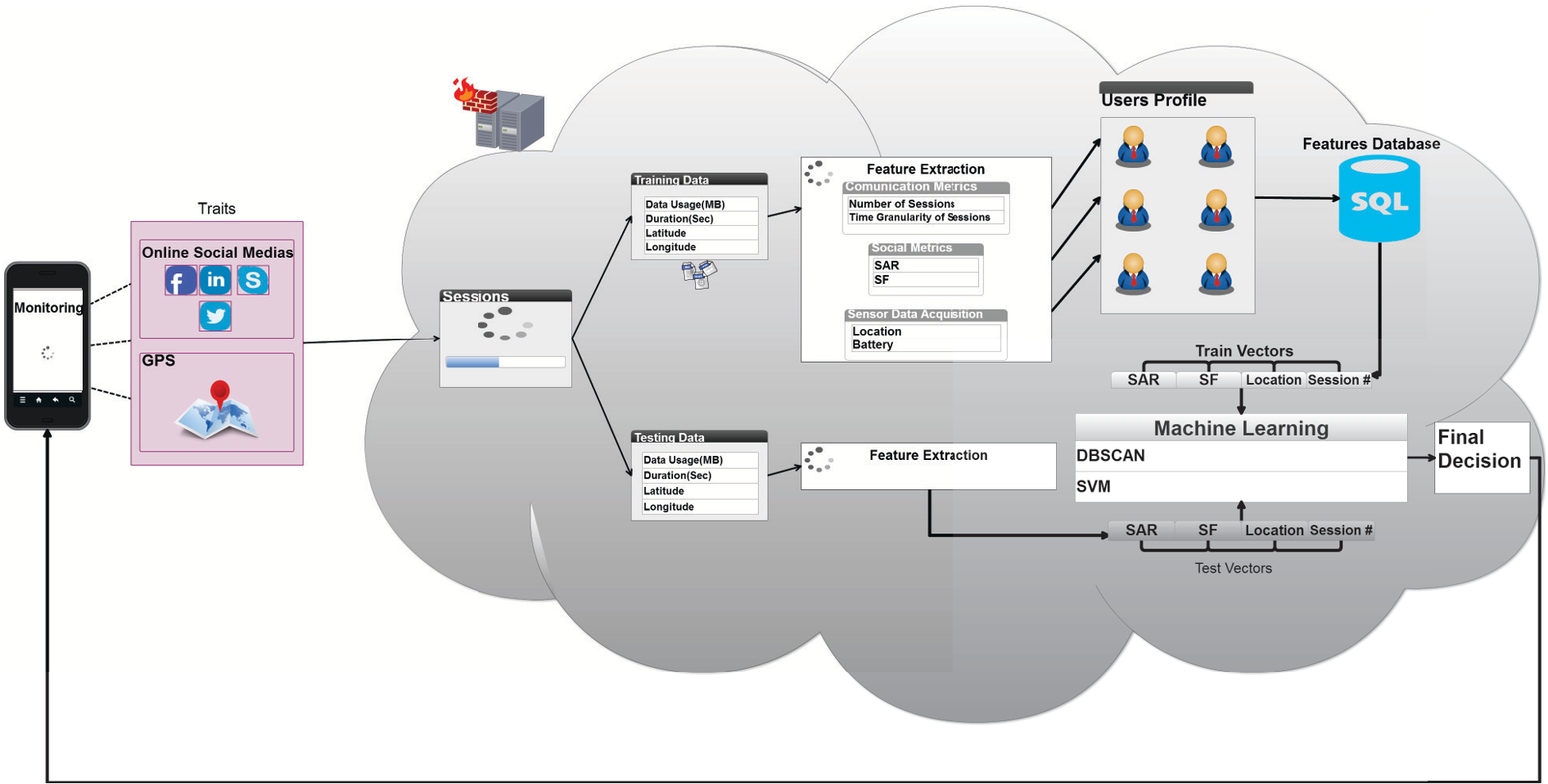
The framework operates through a front-end client collecting raw session data and a back-end cloud module performing normalization and clustering.
1. The Metrics
The researchers defined two pillars of social behavior:
- Social Activity Rate (A): The normalized volume of data consumed per session.
- Sociability Factor (SF): The duration of time spent within specific social applications.
2. The Equation of Behavior
The system uses a weighted moving average to capture both long-term habits and recent shifts in behavior. The balancing coefficients ( and ) determine how much the system "remembers" the past versus "focuses" on the present.
3. Clustering via DBSCAN
Unlike supervised learning which requires labeled "attacker" data, the system uses DBSCAN (Density-Based Spatial Clustering of Applications with Noise). It learns the "dense" regions of a user's normal social behavior. Anything falling outside these clusters—like an impostor using WhatsApp at an unusual location or LinkedIn for an atypical duration—is flagged as a spoofing attempt.
Experimental Results: Accuracy in the Face of Noise
To test the system, the researchers didn't just look at normal usage; they "injected" noise—essentially cloaking a genuine user's data with segments of another user's activity to simulate a stolen identity.
Key Findings:
- The 50/50 Rule: The highest success rates (approx. 94%) occurred when the system gave equal weight to historical behavior and recent activity. Relying too heavily on recent data (70% weight) dropped accuracy to about 74% because the system became too "jittery."
- Activity Correlation: Users who are more active on social apps (higher session frequency and duration) are easier to identify and harder to spoof.
- Spoofing Detection: Under optimal settings (), the system only failed to catch an impostor once in 30 instances, resulting in a 97% success ratio.
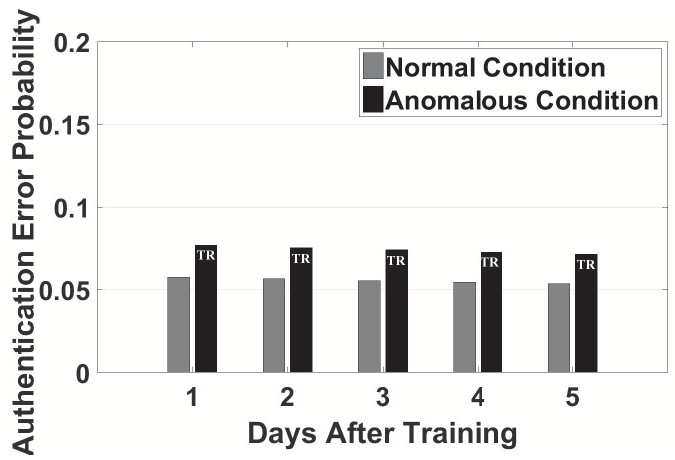 Figure: The Authentication Error Probability (AEP) increases under anomalous conditions, correctly triggering a request for secondary biometric verification.
Critical Insight & Conclusion
The true value of this work lies in its Inductive Bias. It assumes that social behavior is rhythmic and patterned. While the study used a relatively small set of representative users, the high accuracy of DBSCAN suggests that our "digital sociability" is highly granular.
Limitations: The system relies on data from five specific apps. If a user shifts to a new platform (e.g., a new viral social app), the model would require a retraining period. Furthermore, the reliance on a cloud back-end introduces a slight latency that might be a concern for real-time "kill-switch" applications.
Future Outlook: As privacy-preserving "Edge AI" matures, we can expect these sociability metrics to be calculated locally on-device. This would allow for a secure, "invisible" layer of protection that knows it's you, simply by how you talk to the world.