
SPOT 1.0: Decoding Malice—A 3D Framework for Scoring Suspicious Twitter Profiles
SPOT 1.0: Scoring Suspicious Profiles on Twitter
The paper introduces SPOT 1.0 (Scoring Suspicious Profiles On Twitter), a framework designed to identify and quantify the threat of malicious entities on microblogging platforms. It utilizes Support Vector Machines (SVM) for classification and a novel three-dimensional scoring system based on aggressiveness, visibility, and danger levels.
TL;DR
With Twitter (X) processing millions of messages daily, the platform has become a prime target for identity theft and malware distribution via condensed short-URLs. SPOT 1.0 is an automated framework that doesn't just ask "Is this a bot?" but instead quantifies how dangerous a profile is. By integrating SVM-based classification with a unique 3D scoring system measuring Aggressiveness, Visibility, and Danger, the authors provide a scalable way to filter through the noise of social media threats.
Problem & Motivation: The Evolution of Spam
For years, email was the primary vector for malicious links. However, the rise of microblogging shifted the battlefield. Twitter presents unique vulnerabilities:
- URL Shortening: Services hide the destination of a link, making manual inspection impossible for users.
- Spontaneity: The rapid-fire nature of tweets encourages clicks before critical thinking.
- Limitation of Prior Work: Most existing tools focus on binary classification (Spammer vs. Non-Spammer) but ignore the impact. A bot with zero followers is less threatening than an aggressive one leveraging high-visibility hashtags.
Methodology: The Three Dimensions of Suspicion
The core innovation of SPOT 1.0 lies in its architecture and its evaluation metric. The architecture consists of six modules, moving from raw data collection via the Twitter API to deep URL inspection (extracting the original location from HTTP headers to avoid redirection risks).
The 3D Scoring Indicator
The authors move beyond simple detection to a tri-dimensional evaluation:
- Aggressiveness (): Measures the speed of actions. If an account hits the API limits (e.g., 350 actions/hour), it is flagged as hyperactive.
- Visibility (): Analyzes how well the user exploits the "@" reference and "#" hashtag system. High visibility means the malicious content reaches beyond the account's immediate followers.
- Level of Danger (): Calculates the ratio of malicious tweets to total tweets. A tweet is "malicious" if it contains at least one verified harmful URL.
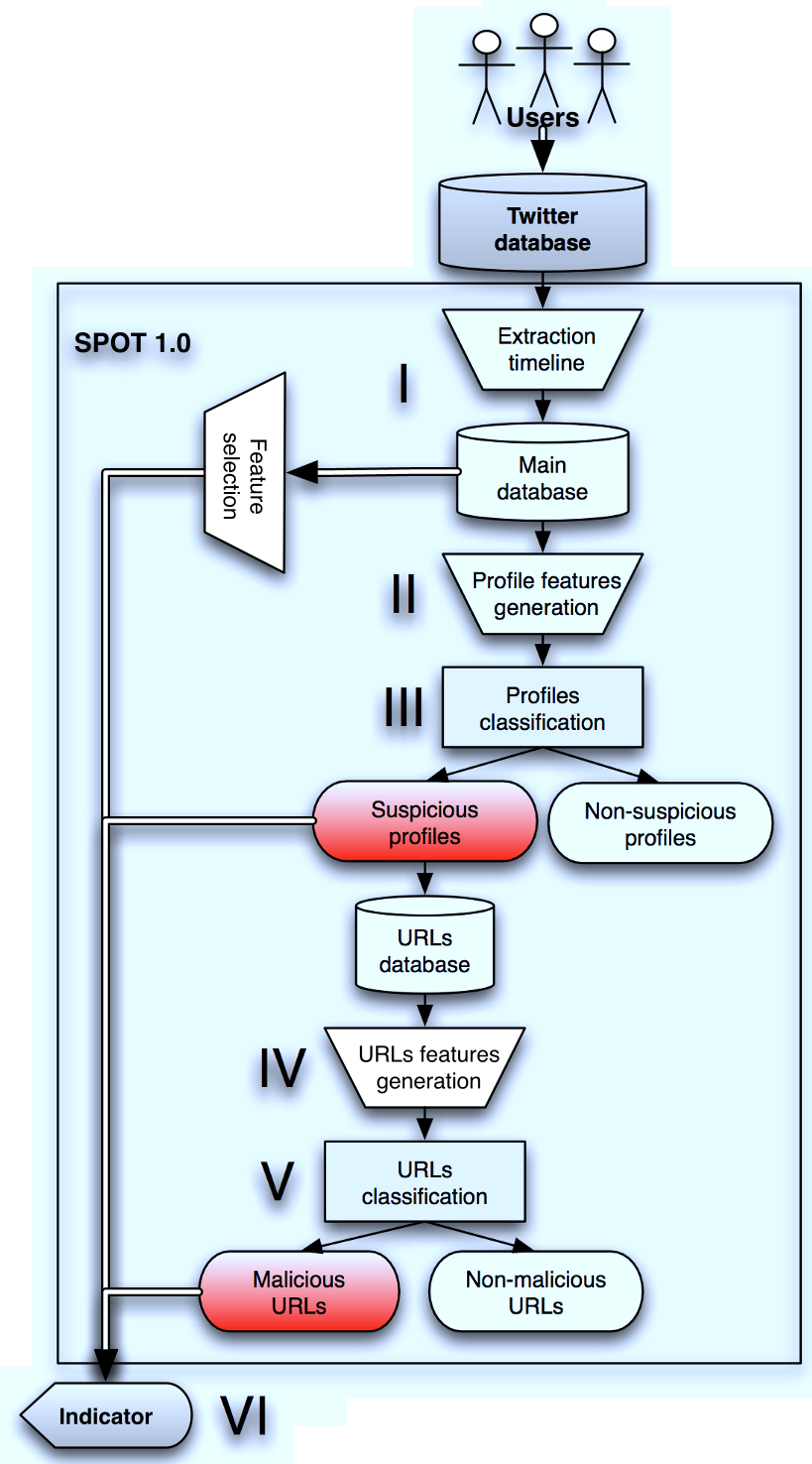 Figure 1: Overview of the SPOT 1.0 architecture, from API collection to 3D evaluation.
Experiments & Results: Identifying the "Bot Fingerprint"
The study analyzed a massive dataset of 500,000 tweets daily. By training an SVM (Support Vector Machine) using the LIBSVM library, they identified clear behavioral differences between normal and suspicious users:
| Feature | Suspicious (Avg) | Normal (Avg) |
|---|---|---|
| Profile Age (Days) | 190 | 465 |
| Tweets per Day | 131 | 35 |
| URLs per Tweet | 0.22 | 0.07 |
| Followers | 1,600 | 1,724 |
Key Insights:
- Short Life Cycle: Suspicious accounts die young (approx. 190 days), likely due to Twitter's suspension mechanisms.
- Automation Indicators: Suspicious profiles have a lower "response rate" to mentions, confirming that their actions are largely automated one-way broadcasts.
- Strategic Tagging: Malicious accounts use hashtags significantly more (0.25 vs 0.14) to force their content into popular discovery streams.
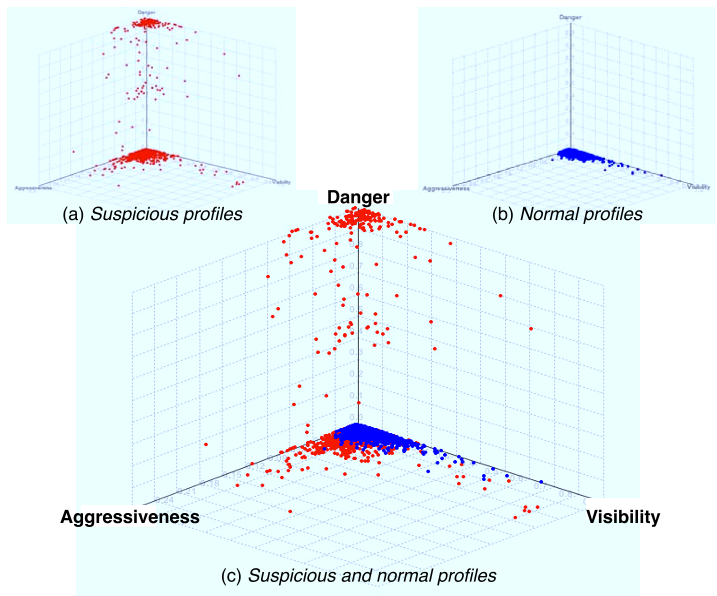 Figure 2: 3D Visualization of profiles. Red dots (suspicious) show higher distribution across danger and aggressiveness planes compared to blue dots (normal).
Critical Analysis & Conclusion
SPOT 1.0 successfully moves the needle from "detection" to "risk assessment."
Takeaway
The most dangerous profiles aren't just those sending spam; they are the ones strategically optimizing their Visibility (hashtags) and Aggressiveness to maximize the spread of harmful URLs.
Limitations & Future Work
While robust, the current version of SPOT focuses heavily on URLs. Modern threats involve "social engineering" and "misinformation" which may not contain external links. The authors suggest that future iterations will incorporate targeted keywords and topological analysis (looking at nodes and edges in the social graph) to uncover coordinated botnets.
In an era where "Verification" can be bought, frameworks like SPOT that rely on behavioral physics rather than account badges are more critical than ever.