
SpreadMax: Scaling Influence Maximization via Hierarchical Reachability
SpreadMax: A Scalable Cascading Model for Influence Maximization in Social Networks
The paper introduces SpreadMax, a cascading framework for influence maximization (IM) in social networks. It utilizes a two-tier Susceptible-Infected (SI) epidemic model and a hierarchical reachability approach to identify seed nodes, outperforming traditional greedy benchmarks in spreadability across various real-world datasets.
TL;DR
Influence Maximization (IM) is the art of finding a small set of "seed" nodes to trigger the largest possible cascade of information. While greedy algorithms provide theoretical guarantees, they are too slow for modern social webs. SpreadMax bridges this gap by combining hierarchical reachability metrics with a two-tier SI epidemic model, achieving near-total network coverage (up to 98%) while maintaining computational efficiency.
The Bottleneck: Why Greedy Isn't Enough
In the landscape of social network analysis, the most influential actors act as "hubs." Finding these hubs is typically treated as an optimization problem under the Independent Cascade (IC) or Linear Threshold (LT) models.
The classical Greedy approach (Kempe et al.) is the gold standard for accuracy but suffers from:
- NP-Hard Complexity: Repeatedly executing spread functions for every potential node is computationally ruinous.
- Diminishing Returns: Submodularity means that as you add more seeds, the marginal gain drops, often leaving vast sections of the network "unreachable."
Methodology: The Two-Tiered Strategy
SpreadMax shifts the focus from local optimization to Global Hierarchical Reachability.
Phase I: Seed Identification
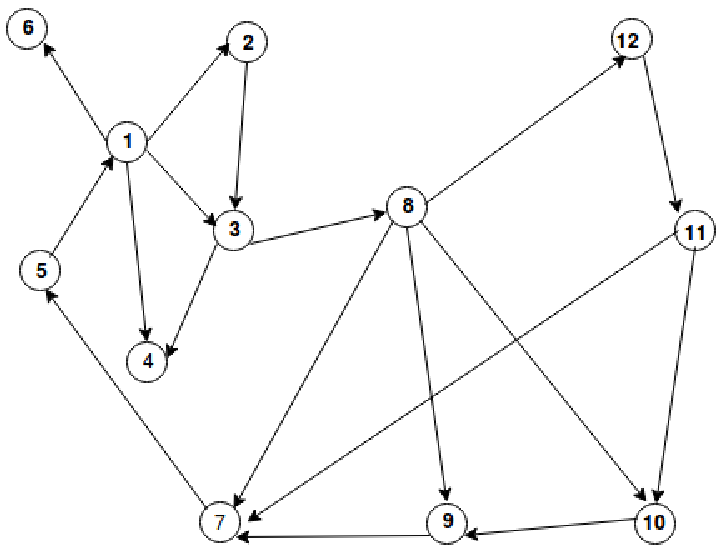
Instead of simple degree centrality, SpreadMax calculates a Closeness Index (). It looks at:
- Direct Neighbors: Who you know.
- Next-Nearest Neighbors: Who your friends know.
- Hierarchical Index: A recursive summation that identifies nodes positioned at the vital crossroads of a manifold network.
Phase II: The Spreading Engine
The authors adapt the Susceptible-Infected (SI) model. To solve the "isolated island" problem where parts of a graph are unreachable, they introduce a Ground Node. This node connects bidirectionally to every other node, effectively acting as a universal bridge that allows the random-walk algorithm to "jump" across gaps.
This formula ensures that the "influence score" of a node is not just a static number but a dynamic value that reflects its power to propagate infections over time.
Experimental Validation: Outperforming the Benchmarks
The model was tested on five diverse datasets, ranging from biological (Dolphin) to technical (Netscience and PGP).
Key Findings:
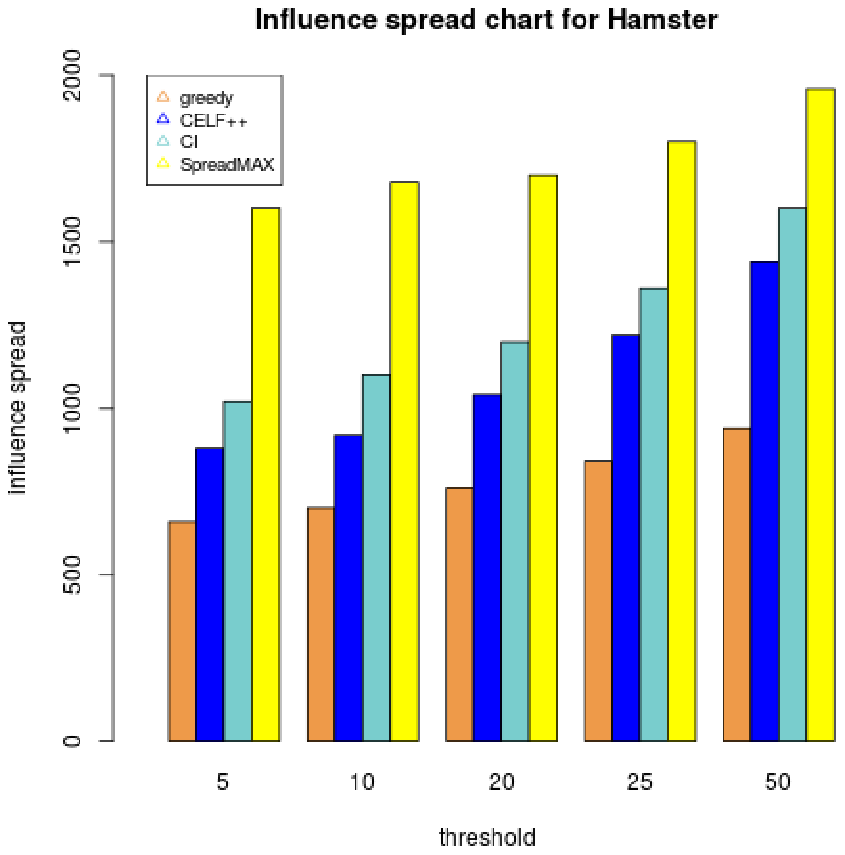
- Unmatched Spread: On the Hamster dataset, SpreadMax achieved a 98% spread rate with 50 seeds, significantly higher than the benchmarks.
- Efficiency: By bypassing the exhaustive search of the Greedy method, SpreadMax handles large networks (like CA-Hep with 8,638 nodes) with ease.
- Robustness: The inclusion of a ground node ensures that the ranking remains stable even when the network data is noisy or sparse.
Critical Insight: The Power of Reachability
SpreadMax succeeds because it recognizes that influence is a cascading physical process, not just a graph-theoretic property. By using hierarchical reachability, it selects seeds that aren't just "popular" (high degree) but are "strategically placed" (high reachability).
Limitations & Future Work
While SpreadMax is highly effective, the "Ground Node" addition—while brilliant for reachability—could potentially introduce bias in extremely sparse networks. Future iterations could explore parallel programming (OpenMP/MPI) to further reduce the complexity, making it viable for billion-node scales like Twitter or Facebook.
Conclusion
SpreadMax represents a significant step forward in making Influence Maximization practical for real-world applications. Whether it's for viral marketing, public health messaging, or controlling the spread of misinformation, the fusion of epidemic modeling and hierarchical metrics proves to be a winning combination.