
Harmonizing the Lens: A Spring-Electric Approach to Group Photography
10572_A Spring-Electric Graph Model for Socialized Group Photography.
This paper introduces a novel spring-electric graph model augmented with "color energy" to achieve visual balance in dynamic layouts. It specifically applies this model to a real-time group photography recommendation system that suggests the optimal arrangement, position, and size of people within an image frame.
TL;DR
Capturing a perfectly balanced group photo is an art form that amateur photographers often struggle with. This paper proposes a "Socialized Group Photography" system that treats people and background elements as nodes in a physical system. By applying spring-like attraction and electrical repulsion forces—weighted by the "Color Energy" of participants' clothing—the system recommends exactly where people should stand and how large they should appear to create a visually balanced masterpiece in real-time.
The Aesthetic Friction: Why Group Photos Fail
Most photography AI today focuses on "Rule of Thirds" or simple cropping. However, professional aesthetics rely heavily on Visual Balance. A person wearing a bright red coat (high color energy) exerts more "visual weight" than someone in a dull gray sweater. Existing research often ignores this color-driven weight or treats the scene as static. When a group of people moves, the entire aesthetic equilibrium of the frame shifts, making it a "dynamic layout" problem that static rules cannot solve.
Methodology: Physics Meets Fine Art
The core of the paper is the Spring-Electric Graph Model. In this virtual system:
- Nodes: Represent people (p-nodes) and background segments (s-nodes).
- Spring Forces (Attraction): Hooke’s Law keeps certain elements connected and balanced.
- Electric Forces (Repulsion): Coulomb’s Law ensures high-energy elements don't clump together, preventing visual "congestion."
The "Color Energy" Secret Sauce
The authors quantify "Color Energy" () using five parameters: Hue, Saturation, Brightness, Area, and Contrast. A person with high will trigger stronger repulsive forces in the model, naturally pushing them toward areas of the frame with lower energy (like a simple background) to avoid clashing with other high-energy elements.
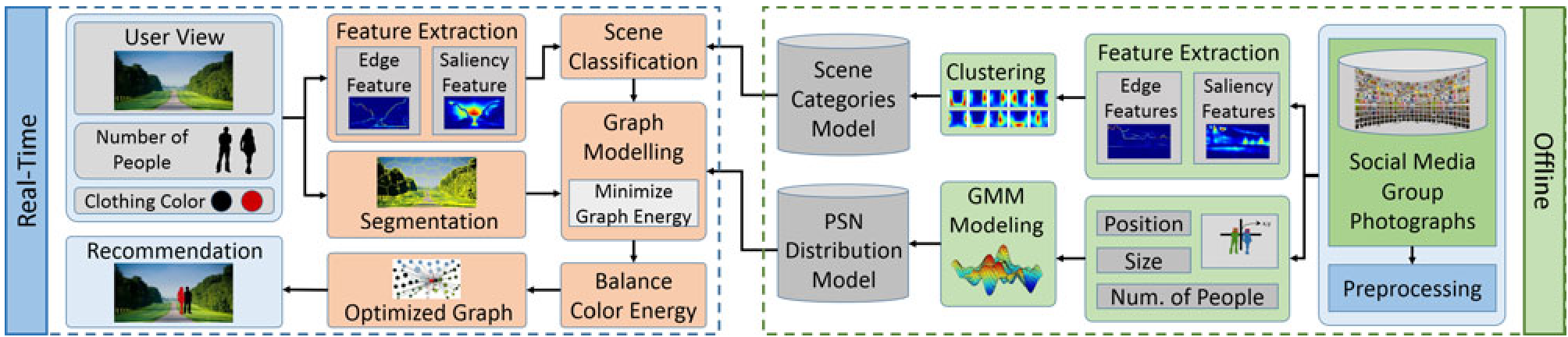 Figure 1: The pipeline from scene categorization to final position/size recommendation.
The PSN Model (Position, Size, Number)
To provide a starting point for the physics simulation, the authors trained a Gaussian Mixture Model (GMM) on nearly 6,000 high-quality social media images. This allows the system to understand "common sense" placement for different scene types (e.g., beaches vs. mountains) before the spring-electric optimization fine-tunes the result for the specific colors present in the live view.
Experimental Proof: Better than the Rules?
The authors compared their model against standard rules like the "Rule of Center" or "Rule of Thirds." In many cases, standard rules failed because they led users to block the "vanishing point" of a scene or placed people in low-contrast areas where they became invisible.
 Figure 2: Comparing the proposed method (Row 3) against prior work. Note how the proposed method ensures the subject is distinctly visible against the background.
Real-Time Performance
Running on a cloud-based mobile setup, the system achieves a processing time of ~1.5 seconds. For a graph with 60 nodes (typical for a photo), the energy minimization takes only about 500ms, making it viable for interactive feedback while the user is still framing the shot.
Critical Insight & Future Outlook
While the system is brilliant at balancing "visual weight," it occasionally prioritizes balance over Scene Semantics. For instance, it might suggest a group stand in the middle of a lake because it's "visually balanced," ignoring the fact that the people would get wet!
The true value of this work lies in its Inductive Bias: it assumes that the laws of physics (equilibrium, tension, repulsion) are a valid proxy for the human "eye for design." Future iterations incorporating semantic scene understanding (knowing what is a "pathway" vs. "water") could make this an unbeatable tool for the next generation of smart-cameras.
Conclusion
By turning "visual weight" into a literal physical force, Rawat et al. have bridged the gap between subjective art and objective math. Whether you are a professional photographer or an amateur at a family reunion, these "virtual springs" ensure that every member of the group finds their perfect spot in the sun.