
SQTime: Precision Social Search Leveraging the Temporal Dimension
SQTime: Time-Enhanced Social Search Querying
SQTime is a specialized social search framework that integrates temporal dimensions into social graph querying. It supports user-centric and system-centric queries with both explicit temporal constraints and implicit time-dependent ranking to prioritize "fresh" social connections.
TL;DR
SQTime is a system designed to solve the "static graph" problem in social search. By annotating every node and edge with time intervals, it allows users to perform user-centric (personalized) and system-centric (global/marketing) queries that understand when a connection was made. It doesn't just find results; it ranks them by "freshness" to ensure the most current social trends surface first.
Background: Why Time Matters in Social Graphs
Social networks are essentially living organisms. A friendship formed in 2010 might be dormant, while an "event attendance" edge from 2024 represents a high-intent current interest. Traditional search models often collapse these time dimensions, treating all edges as equal. SQTime argues that for search to be effective, it must respect the temporal validity of both entities and their relationships.
The SQTime Framework: Methodology
The core of SQTime is an undirected graph where and are extended with a label .
1. Dual Query Perspectives
- User-Centric: Focuses on the "egocentric" network. Example: "Find photos liked by my friends during the summer of 2023."
- System-Centric: Focuses on global analytics. Example: "Identify users who were active in specific groups over the last six months for targeted advertising."
2. Explicit vs. Implicit Time
- Explicit (Hard Constraints): Filtering the result set based on a specific window . If an entity wasn't active then, it's discarded.
- Implicit (Ranking): This is the "Freshness" factor. Even if two results satisfy the query, the one with a more recent connection timestamp () is ranked higher.
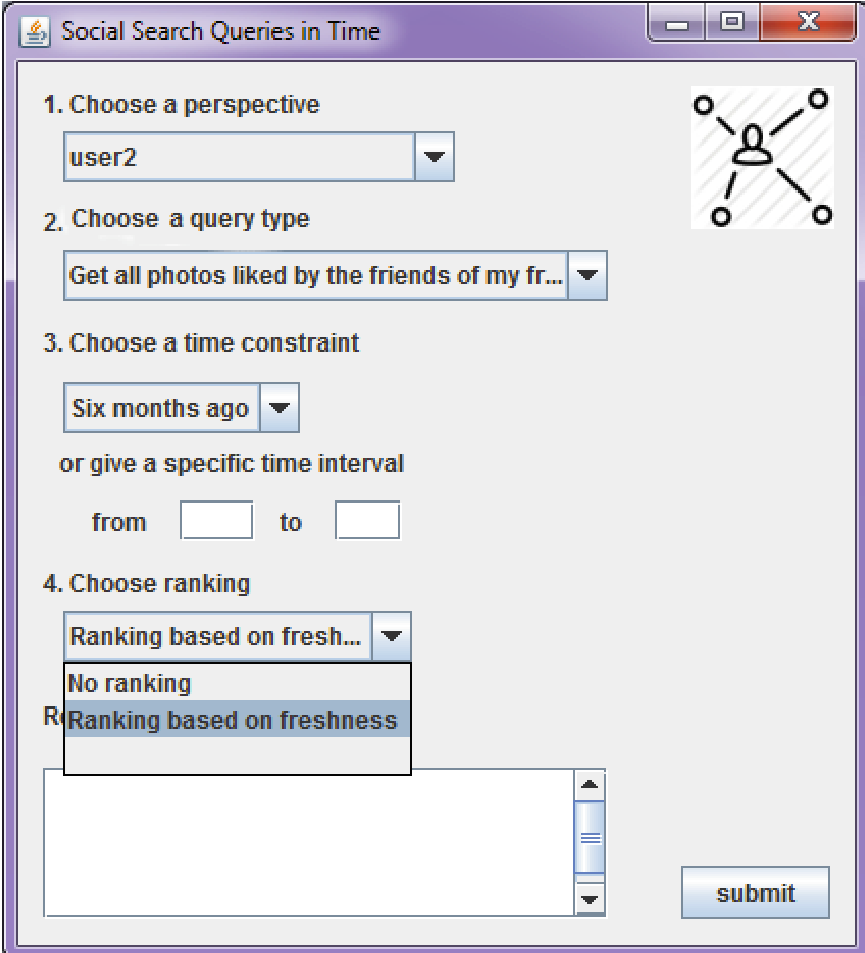 Figure 1: The SQTime interface allows users to select perspective, entity type, time constraints, and ranking preferences.
Experiments and Demonstration
The authors validated SQTime using a real-world Flickr dataset, comprising user-to-user links and "favorite" markings.
Visualizing Freshness
A unique aspect of the SQTime demo is its visualization of temporal relevance:
- For Objects (Photos): Results are displayed with varying sizes. Larger photos indicate "fresher" interactions.
- For Users (Graph Nodes): Relationship graphs use color intensity (shades of green). Bolder colors represent nodes with more recent activity.
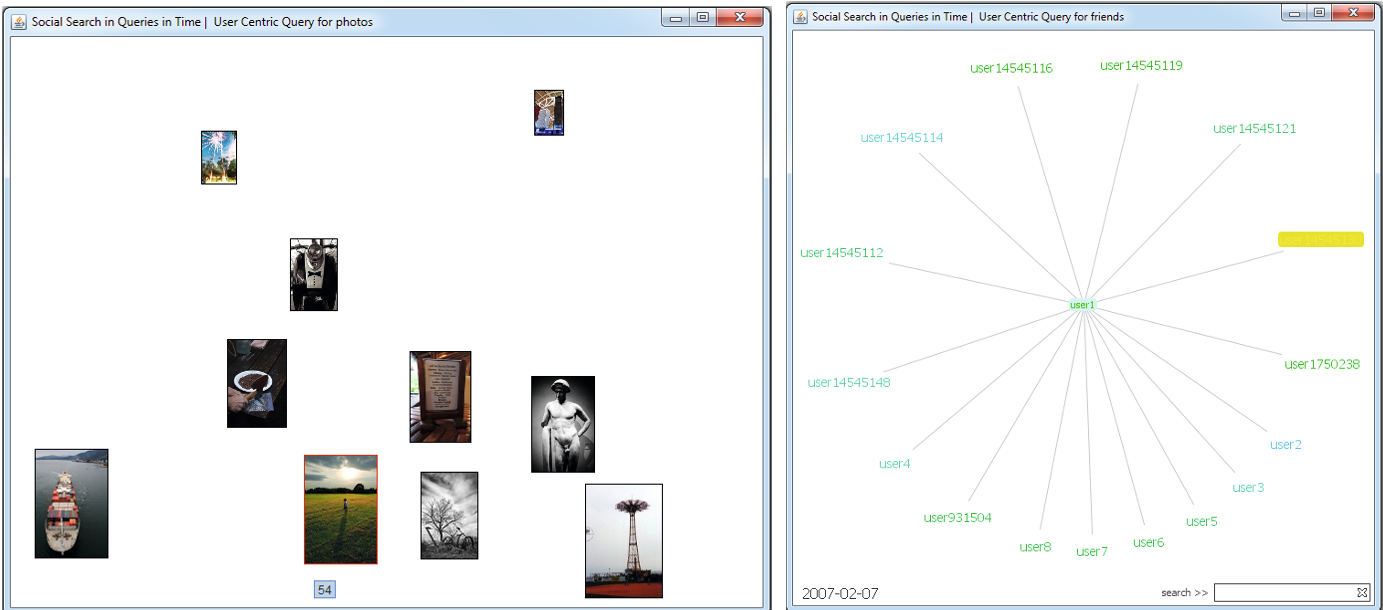 Figure 2: Visualizing freshness through size (left) and color intensity (right).
Critical Insight & Future Outlook
The primary contribution of SQTime is its ranking heuristic. By assigning a score based on of a connection, it provides a computationally efficient way to surface trending content without complex machine learning overhead.
Limitations: Currently, the model assumes undirected relationships and simple interval overlaps. Future iterations could benefit from decay functions (where old interactions don't just disappear but gradually lose weight) and handling streaming data in real-time rather than batch intervals.
Conclusion: SQTime serves as a robust blueprint for any platform where the value of information is tied to its "now-ness." It bridges the gap between pure graph theory and practical, time-aware information retrieval.