
Cloud-Based WLSN: Rethinking Bandwidth Allocation via Stackelberg Games
14210_Stackelberg Game for Bandwidth Allocation in Cloud-Based Wireless Live-Streaming Social Networks.
The paper proposes a novel Cloud-based Wireless Live-streaming Social Network (WLSN) architecture. It utilizes a two-stage Stackelberg game to manage bandwidth allocation, where desktop users (leaders) compete via a noncooperative game and mobile users (followers) adapt through an evolutionary game.
TL;DR
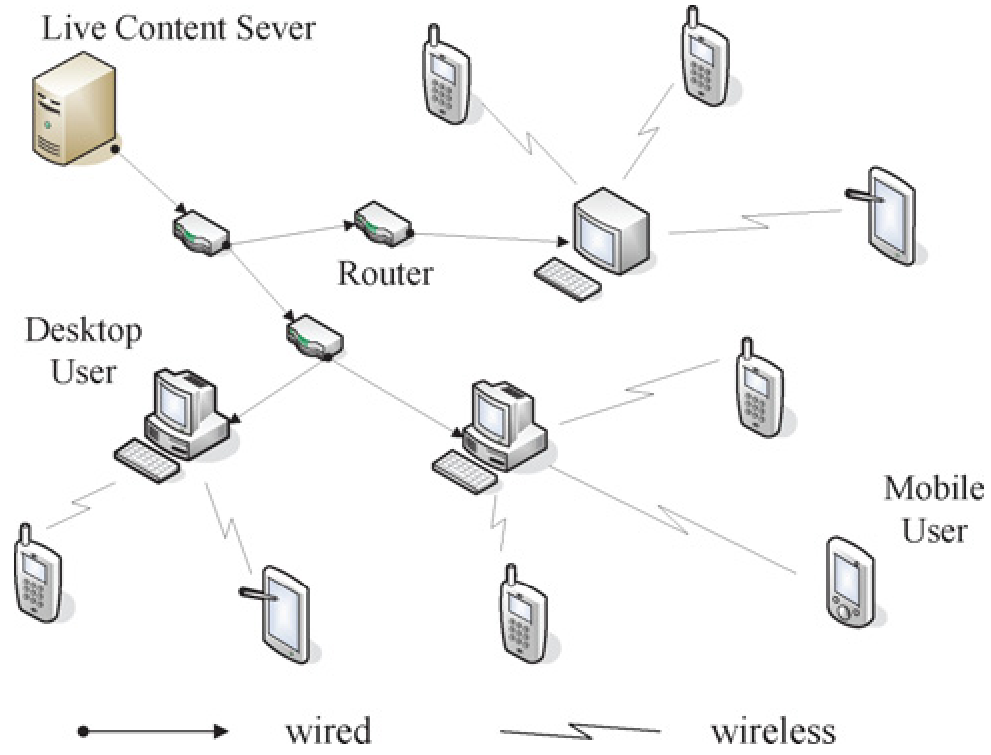
Mobile live-streaming often hits a "bandwidth wall" due to cellular costs and server congestion. This paper introduces WLSN (Wireless Live-streaming Social Networks), a framework where desktop users act as "micro-providers" by sharing their cloud-sourced stream with mobile friends. By formulating this as a two-stage Stackelberg game, the authors ensure the system reaches a stable, fair, and efficient equilibrium.
Background: The Infrastructure Gap
The demand for high-quality live streaming on smartphones (PDAs, iPads, etc.) is exploding. However, content providers face a dilemma:
- Infrastructure Costs: Delivering high-definition streams to millions of mobile devices via traditional CDNs is prohibitively expensive.
- QoS Bottlenecks: Mobile networks (3G/4G at the time of writing) are often too unstable for seamless live playback.
The author's insight is to bridge this gap using Social Relationships. If a desktop user is already watching a stream via a stable wired connection, why not "sub-let" that bandwidth to mobile friends nearby via high-speed ad hoc connections (like WiFi)?
Methodology: The Two-Stage Game
The authors treat bandwidth allocation as a virtual market.
1. The Architecture
The system integrates a Multimedia Cloud for high-capacity storage and processing with Desktop Users who serve as localized relays.
2. The Game Formulation
To manage the "selfish" nature of users, the paper employs a Stackelberg Game:
- Stage 1 (The Leaders): Desktop users engage in a noncooperative game. They compete by setting the amount of bandwidth they are willing to share () and the price () they charge (in credits or tokens).
- Stage 2 (The Followers): Mobile users participate in an evolutionary game. Since mobile users have "bounded rationality" (they don't know everything at once), they observe their peers. If a friend is getting better quality/price from another desktop user, they switch.
The behavior of mobile users is governed by Replicator Dynamics, where the share of a specific strategy (connecting to a specific desktop user) grows if its utility is higher than the population average.
Critical Analysis of Results
The researchers didn't just propose a model; they proved it works.
Unique Nash Equilibrium
For a case study of two desktop users, the authors proved the existence of a Unique Nash Equilibrium (NE) using the Lambert-W function. This is a significant mathematical achievement, as it guarantees that the market won't collapse into chaos but will settle into a predictable state.
Convergence & Stability
The simulations show how the population of mobile users shifts over time.
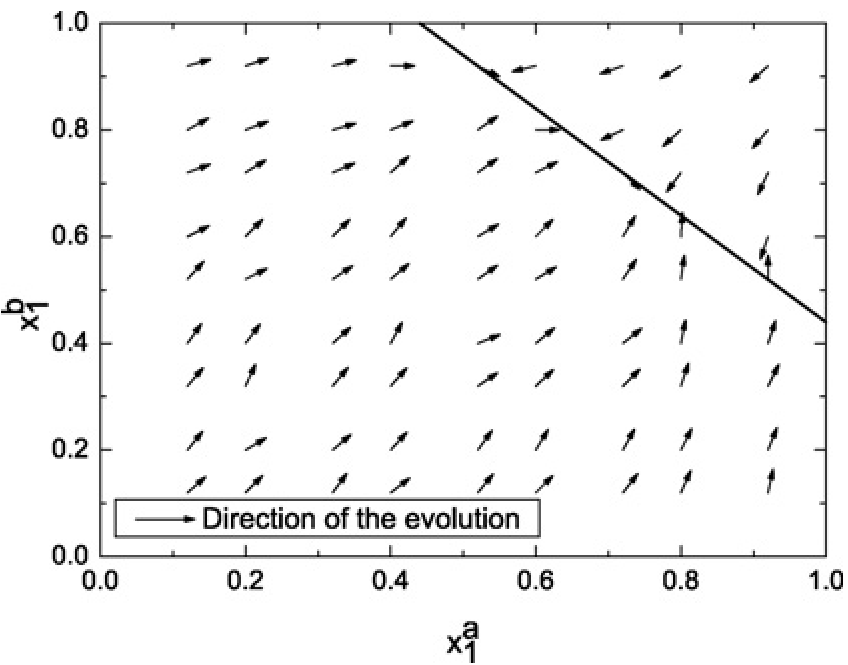
As seen in the phase plane, different starting points (initial conditions) eventually converge toward the equilibrium. This demonstrates the Robustness of the evolutionary protocol. Even if users start with random connections, the system "self-heals" into the optimal configuration.
Deep Insight & Conclusion
The real value of this paper lies in its Inductive Bias toward social structures. By moving the "bottleneck" from the central cloud server to the "social edge," the WLSN reduces total network load while rewarding desktop users for their contribution.
Takeaway for the Future: While this paper used WiFi/3G as the context, the logic is highly applicable to modern Edge Computing and D2D (Device-to-Device) communication in 5G/6G. The use of tokens as a payment mechanism also foreshadows contemporary incentive designs in Decentralized Physical Infrastructure Networks (DePIN).
Limitations:
- Mobility: The model assumes relatively stable social groupings; high-speed physical mobility might disrupt the ad hoc connections.
- Privacy: Using social relationships as a routing backbone requires careful handling of user metadata.
Overall, this work remains a cornerstone for understanding how game theory can solve real-world resource scarcity in multimedia networks.