
STAR: Rethinking MoE Routing as Structure-Aware Subspace Learning
STAR: Rethinking MoE Routing as Structure-Aware Subspace Learning
The paper introduces STAR (Structure-Aware Routing), a novel Mixture-of-Experts (MoE) routing framework that redefines gate assignment as a subspace learning problem. By integrating the Generalized Hebbian Algorithm (GHA) for online principal component estimation, STAR achieves state-of-the-art results in expert specialization and robustness across LLaMA-style pretraining, GLUE benchmarks, and ImageNet-C.
TL;DR
The "Mixture-of-Experts" (MoE) architecture is the backbone of modern LLMs (like Mixtral and DeepSeek), but its weakest link remains the router. Conventional routers are "structure-blind"—they use simple linear layers that struggle to capture the complex distribution of input data. STAR (Structure-Aware Routing) fixes this by treating routing as an online subspace learning problem. By using the Generalized Hebbian Algorithm (GHA) to track the "principal components" of data during training, STAR ensures experts specialize on actual data features, leading to better accuracy and unprecedented robustness to distribution shifts.
The "Structure-Blind" Router Problem
The core promise of MoE is specialization: Expert A handles math, Expert B handles code, and so on. However, current routers are essentially shallow linear classifiers. They decide which expert gets a token based on a weight matrix that is often unstable and purely driven by gradient signals that may favor "lazy" load balancing over true semantic understanding.
Current solutions usually slap an "auxiliary loss" on top to force even distribution (load balancing). But as the authors of STAR point out: Balance does not equal Awareness. A balanced router that doesn't understand the input structure is just a well-distributed random guess.
Methodology: Bringing Eigenvectors into the Loop
The breakthrough in STAR is the realization that the Principal Subspace (the directions of maximum variance in the data) is the most natural coordinate system for routing.
1. Online Subspace Learning with GHA
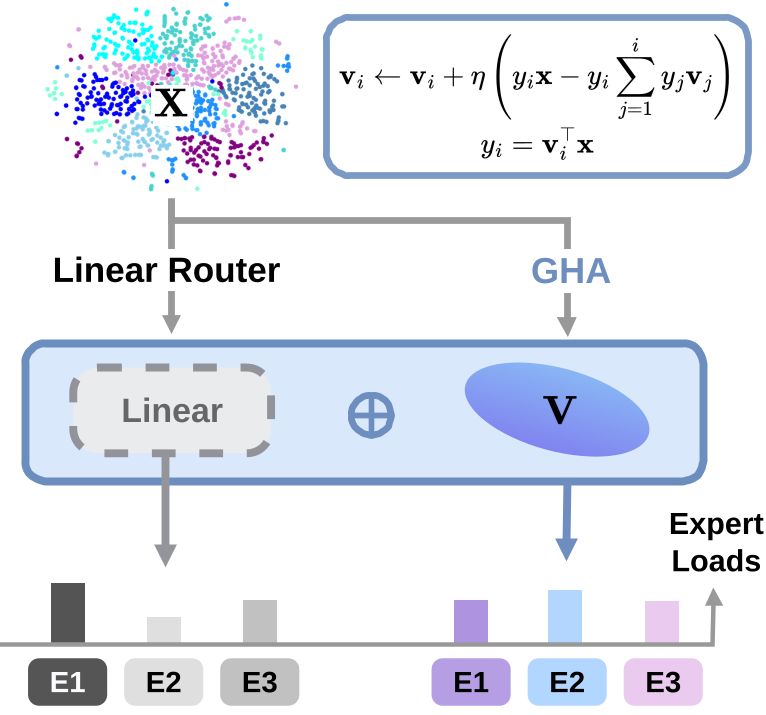
Instead of performing a heavy Singular Value Decomposition (SVD), STAR uses the Generalized Hebbian Algorithm (GHA). This allows the model to incrementally estimate the top-K principal components of the hidden representations on the fly during the forward pass.
2. The Architecture
STAR doesn't just replace the old router; it augments it. The final routing score is a fusion of:
- : The standard task-supervised gradient-driven logit.
- : The structure-aware logit derived from the principal subspace.
3. Decoupling the Hierarchy via Basis Mixing
If you route directly via principal components, the first expert would get all the data (since the 1st eigenvalue is the largest). STAR introduces a Mixing Matrix that spreads the "energy" across experts, ensuring structural awareness without causing expert collapse.
Experimental Battleground
STAR was tested across a variety of grueling benchmarks, from synthetic HMM-based tasks to large-scale LLM pretraining.
Performance Gains
In LLaMA-style pretraining (30B tokens), STAR consistently tracked a lower training loss and achieved higher zero-shot accuracy on commonsense reasoning tasks compared to Standard MoE, Expert-Choice (EC), and ReMoE.
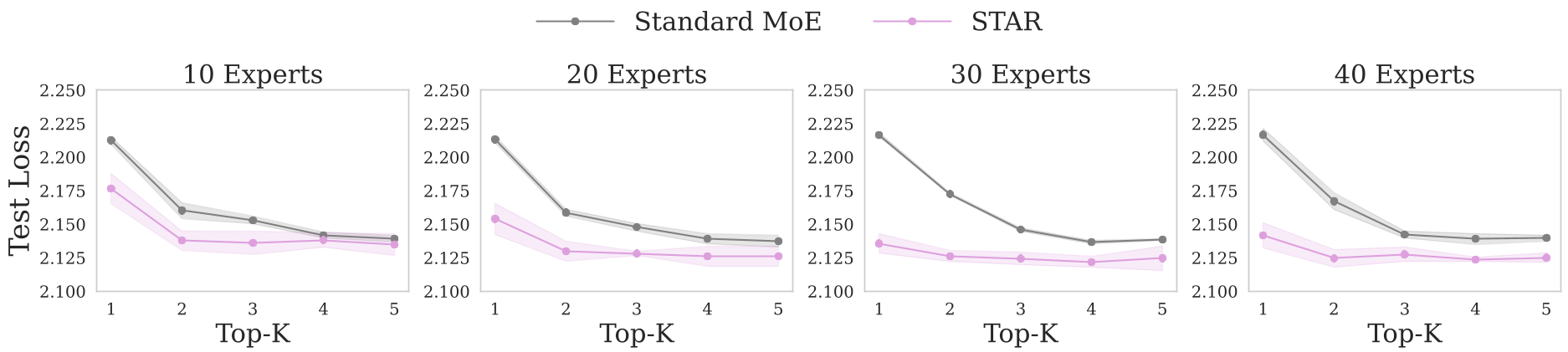 In synthetic settings, as the number of experts increases, STAR’s advantage over standard MoE grows, showing superior scalability.
Robustness & Test-Time Adaptation (TTA)
One of STAR's superpowers is TTA. At inference time, if the data distribution shifts (e.g., noisy images or a new language domain), the GHA basis can continue to update unsupervised. On ImageNet-C (corrupted images), STAR (TTA) reached the highest accuracy, proving that a structure-aware router is far more resilient than a static one.
| Scale | Standard MoE | Expert-Choice | ReMoE | STAR (Ours) |
|---|---|---|---|---|
| 182M Active | 40.65 | 40.13 | 39.94 | 41.31 |
| 469M Active | 42.69 | 42.81 | 43.29 | 43.93 |
| Zero-shot Average Accuracy across 7 tasks. |
Deep Insight: Why Does it Work?
The authors provide a mathematical proof: without the mixing matrix , routing energy is tied to the PCA spectrum, making expert collapse inevitable. By learning and the GHA basis simultaneously, STAR creates a routing space where the dimensions are orthogonal (minimizing redundancy) but the loading is balanced (maximizing utility).
Conclusion & Future Outlook
STAR demonstrates that the next leap in MoE efficiency won't come from just adding more experts or scaling parameters, but from smarter routing. By grounding routing decisions in the geometric structure of the data itself, we achieve a model that is more specialized, more stable, and more adaptable.
The negligible computational overhead (as GHA is much cheaper than the expert FFNs themselves) makes STAR a "no-brainer" candidate for integration into the next generation of massive MoE models.
Limitations
- Iteration Tuning: While or works well, finding the optimal number of GHA iterations for extremely deep models might require more tuning.
- Task Synergy: The interaction between GHA and specific loss functions like "Load Balancing" needs further exploration in ultra-large-scale (Trillion parameter) settings.