
StarFL: Safeguarding the Pulse of Smart Cities with Satellite-Quantum Hybrid FL
StarFL: Hybrid Federated Learning Architecture for Smart Urban Computing
The paper introduces StarFL, a hybrid Federated Learning (FL) architecture tailored for smart urban computing. It integrates Quantum Key Distribution (QKD) via satellite clusters and Trusted Execution Environments (TEE) to provide a theoretically secure and synchronized training framework for sensitive urban data.
Executive Summary
TL;DR: StarFL is a pioneering hybrid architecture that secures Federated Learning for smart cities by leveraging Quantum Key Distribution (QKD) via satellites and Trusted Execution Environments (TEE) on edge devices. It effectively solves the "security-synchronization-efficiency" trilemma in urban computing.
Background: Within the landscape of Privacy-Preserving Machine Learning (PPML), StarFL moves beyond purely software-based encryption. It is a "Security-by-Design" system that addresses the physical vulnerabilities of data transmission and the integrity of local execution, positioning it as a robust solution for high-stakes urban tasks like autonomous driving.
The Urban Data Paradox
Smart cities generate a torrent of sensitive data—biometrics, locations, and itineraries. While Federated Learning (FL) was designed to keep data local, it is not a silver bullet. Current SOTA FL faces three "Urban Pain Points":
- The Quantum Threat: Traditional RSA/ECC key exchanges can be intercepted or broken by future quantum computers.
- The "Black Box" Client: Servers have no way of verifying if a client actually trained the model correctly or if an attacker is reverse-engineering the model locally.
- The Temporal Chaos: Sensors (cameras, LIDAR, IoT) often provide data with jittery timestamps, making collaborative real-time learning (e.g., V2X) nearly impossible.
Methodology: The Star-Earth Synergy
StarFL introduces a three-tiered architecture: Satellite Cluster, Federated Server, and TEE-enabled Clients.
1. Hardened Key Distribution (QKD)
Instead of relying on mathematical complexity (which can be brute-forced), StarFL uses the Beidou Satellite System to distribute keys via quantum states. Based on the No-Cloning Theorem, any eavesdropping attempt physically alters the signal, instantly alerting the system to a breach.
2. TEE & Model Partitioning
To prevent local leakage, StarFL uses Trusted Execution Environments (like ARM TrustZone). However, training an entire Deep Neural Network (DNN) inside a TEE is slow. The Insight: StarFL implements Model Partitioning.
- REE (Rich Environment): Handles low-level feature extraction (computationally heavy, less sensitive).
- TEE (Secure Enclave): Processes high-level decision layers and Softmax (computationally light, high privacy risk).
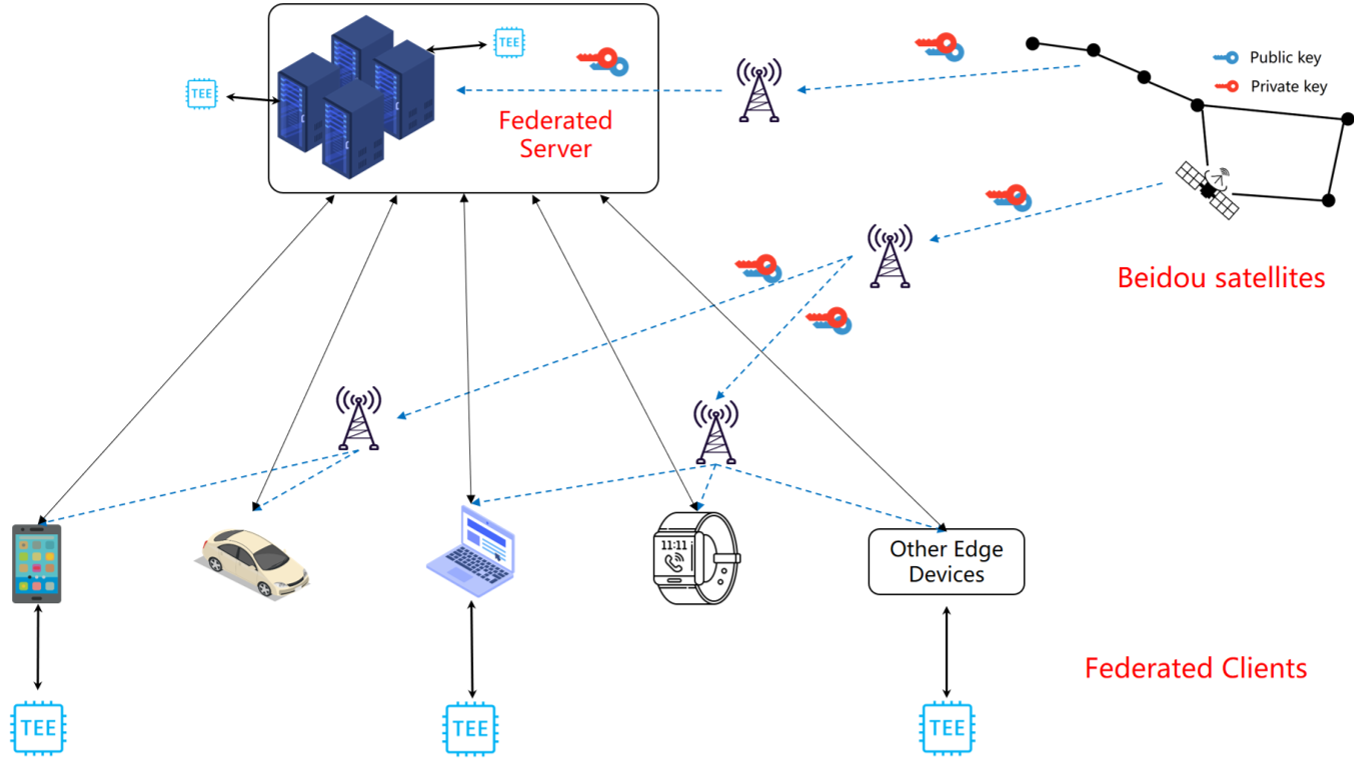 Figure 1: The holistic StarFL workflow integrating Satellites, Servers, and TEE Clients.
3. Precision Synchronization
By utilizing Beidou’s atomic clock services, StarFL ensures that every client—be it a roadside sensor or an autonomous vehicle—labels its training window with identical nanosecond precision.
Experimental Validation
The authors tested the architecture using AlexNet and VGG-7 on the Hikey 960 board (simulating an edge device).
- Efficiency: Even when moving intensive layers into the TEE, the CPU overhead was remarkably low (under 5%).
- Memory: The memory footprint remained stable, proving that hardware-level security does not necessitate massive hardware upgrades for edge nodes.
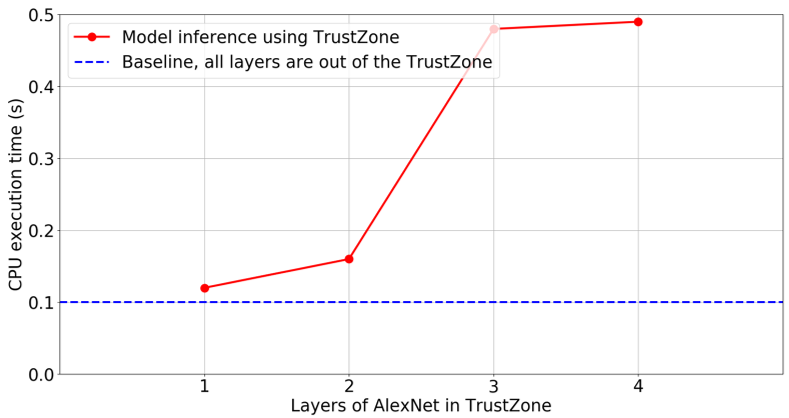 Figure 2: CPU execution time comparison showing minimal overhead even with high TEE layer partitioning.
Deep Insights: Why This Matters for the Future
The most profound impact of StarFL isn't just the "Quantum" buzzword; it's the verification mechanism. In standard FL, a "Malicious Client" can send fake updates to poison the global model. Because StarFL uses Remote Attestation via TEE, the server can cryptographically prove that the local training was executed exactly as specified on the legitimate local data.
Use Case: Autonomous Driving (VICS)
In Vehicle-Infrastructure Cooperative Systems, StarFL allows a vehicle to learn from a roadside camera's data without either party "seeing" the raw pixels. The satellite ensures that the vehicle’s LIDAR data and the camera’s video are synced to the exact same millisecond before the gradient update is calculated.
Conclusion & Limitations
StarFL provides a blueprint for "Unconditionally Secure" urban computing. However, challenges remain:
- Hardware Cost: Requiring QKD receivers and TEE-capable chips increases the barrier to entry.
- Signal Loss: Satellite-to-ground QKD is still sensitive to weather and atmospheric interference.
Despite these, StarFL marks a shift from algorithmic-only privacy to Hybrid Privacy, where physics and hardware join forces with machine learning to protect the digital citizens of tomorrow.