
Community-Driven SE Ontology: Transforming Static Knowledge into Active Coordination
State of the Art of Community-Driven Software Engineering Ontology Evolution
The paper proposes a community-driven framework for the evolution of a Software Engineering (SE) Ontology specifically tailored for multi-site software development. It integrates Semantic Web technologies with social networking agents and recommender systems to manage knowledge shifts and improve remote team coordination.
TL;DR
In the complex landscape of multi-site software development, "semantic drift"—where teams lose track of common terms, expertise, and project history—causes massive delays. This paper proposes a Community-based Software Engineering (SE) Ontology Evolution framework. By marrying Social Networks with Semantic Web agents, it allows the project's "knowledge map" to evolve dynamically based on developer interactions and expert consensus, turning a passive documentation tool into an active recommendation system.
The Problem: The "Passive Structure" Trap
Most ontologies are static. In a distributed environment (e.g., teams in Perth, Shanghai, and Bangalore), this passivity leads to:
- Redundancy: The same bug reported multiple times because members aren't aware of related issues.
- Expertise Blindness: Issues assigned to developers without the specific domain knowledge, leading to "invalid fixes."
- Knowledge Silos: Critical terms (like "ADS" in the paper's case study) being unfamiliar to new members, with no active system to explain them.
Traditional ontology evolution focuses on Schema Evolution (database-centric) or Versioning (log-centric), but it misses the Human-centric element of how knowledge actually grows during a project.
Methodology: The Social-Semantic Architecture
The authors propose a multi-layered agent system to bridge the gap between informal social chatter and formal semantic definitions.
1. The Multi-Agent Layer
- User Agents: Monitor member actions and build profiles.
- Recommender Agents: Propose solutions based on the current SE Ontology.
- Ontology Agents: The "gatekeepers" who maintain consistency and manage different versions of the SE Ontology tailored for specific domains (ERP, CRM, etc.).
2. Dual Social Networks
The framework distinguishes between the Software Engineer Social Network (SESN)—where everyday "lightweight" discussion happens—and the Domain Expert Social Network (DESN).
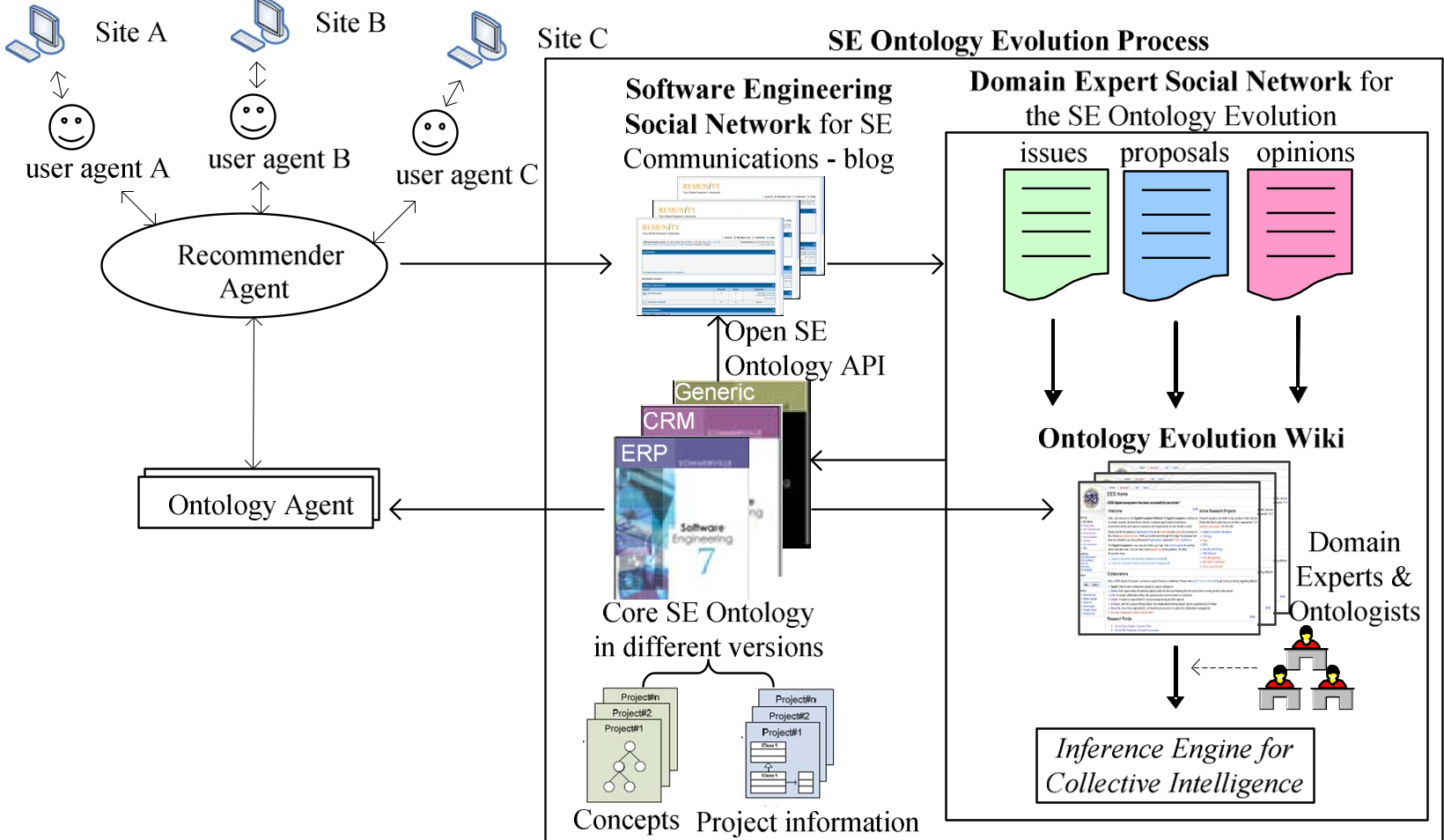
3. The Evolution Wiki (OEW)
When "Different Opinions" (requests that don't match the current ontology) accumulate, they are moved to an Ontology Evolution Wiki. Here, experts use text mining and quality assessment tools to decide if a new concept (like "SaaS" or "Cloud Engineering") should be merged into the core SE Ontology.
Engineering Intuition: Why it Works
The secret sauce is the Recommendation System backed by a Markov Model for Reputation.
Instead of treating every developer's input equally, the system weights votes based on "Reputation Values." If a developer has a history of resolving bugs in the "SilverLink" library, their input on evolving concepts related to that library carries more weight. The Markov Model accounts for the fact that expertise is dynamic—it can grow, stagnate, or trend upward over time.
Evaluation and Impact
The paper illustrates a scenario where a bug fix took 26 days due to miscommunication. Through the proposed system:
- Ontology Agents would have automatically flagged duplicate bug reports (#873, #880, #904).
- Recommender Agents would have instantly matched the bug symptoms to the expert (Michael) instead of letting it cycle through non-experts.
- Collaborative Tagging would have provided the necessary "ADS" definitions to Larry on-demand, preventing technical debt.
Critical Analysis & Future Outlook
Strengths: The paper brilliantly identifies that ontology evolution isn't just a technical update; it's a consensus-building process. Integrating social signals (likes, tags, wiki edits) into formal knowledge structures is a precursor to modern "Knowledge Graphs."
Limitations: The "extraction and mining" process from Wiki articles was in its infancy when this was written. Today, this would likely be replaced by LLM-based RAG (Retrieval-Augmented Generation) systems. Furthermore, the manual burden on "Domain Experts" to manage the Wiki could be a bottleneck in fast-paced Agile environments.
Takeaway: For future software engineering tools, the lesson is clear: Knowledge management must be "active." If the ontology doesn't learn from the developers as they code and chat, it is destined to become an obsolete artifact.