
Decoding GitHub's DNA: A Hypernetwork Analysis of Social Coding Evolution
Statistical Analysis of Social Coding in GitHub Hypernetwork
This paper presents a comprehensive statistical analysis of social coding dynamics on GitHub using a hypernetwork model. By analyzing five years of GHTorrent data (2008-2012), the authors investigate the evolution of developer collaboration and demonstrate that these networks exhibit high levels of self-organization and scale-free properties across multiple dimensions.
TL;DR
GitHub is more than just a code repository; it is a complex, self-organizing ecosystem. This paper utilizes hypernetwork theory to map five years of GitHub's growth, revealing that while the community is largely self-similar and scale-free, a sudden behavioral shift occurred in 2012 where expert developers began "reaching down" to collaborate with novices. The study also highlights that "similarity" (programming language) is the strongest predictor of collaboration, with over 70% of overlapping project ties staying within the same language family.
The Limitation of Traditional Graphs
In classic network analysis, we often use lines (edges) to connect two points (nodes). However, software development is rarely a series of one-on-one interactions. A single GitHub project can involve hundreds of developers. Representing this as a standard graph loses the "hyper-context" of the project itself. By using Hypernetworks, where one "hyperedge" can encompass many nodes, researchers can finally see the full picture of collective intelligence without oversimplifying the data.
Methodology: Popularity vs. Similarity
The researchers focused on two driving forces of social evolution:
- Popularity (The Rich-Get-Richer): Measured via Hyperdegree, which counts how many projects a developer joins.
- Similarity (Birds of a Feather): Measured via programming language communities and the inclination to collaborate within the same technical stack.
The Model Architecture
The team constructed 20 snapshots (quarterly) from 2008 to 2012, treating each developer as a vertex and each project as a hyperedge .
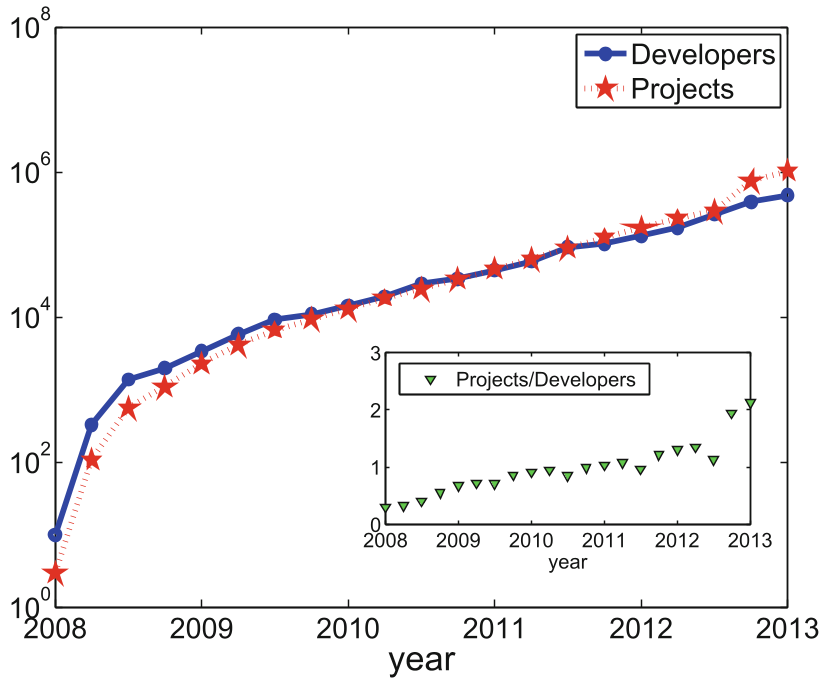 Fig 1: The exponential growth of projects vs. developers highlights the increasing complexity of the social coding landscape.
Key Findings: The 2012 Anomaly
One of the most striking insights is the analysis of Assortativity (). Ordinarily, social networks are "assortative"—popular people hang out with other popular people.
- The Shift: From 2008 to early 2012, GitHub followed this trend. However, in late 2012, the Pearson coefficient plummeted to -6.37.
- The Interpretation: This indicates Disassortative Mixing. High-degree "star" developers began collaborating with low-degree "freshmen." This potentially marks GitHub's transition from a niche club of experts to a mainstream educational and collaborative platform.
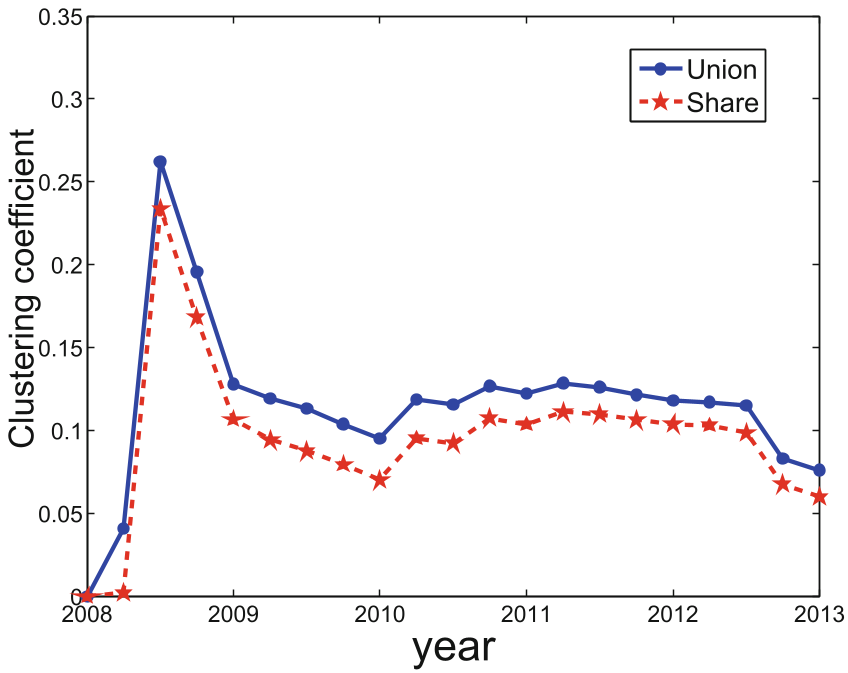 Fig 2: The sharp decline in clustering coefficients in 2012 supports the theory that developers began branching out beyond their established circles.
Language Communities: The Java Exception
The study dived into specific silos: JavaScript, Ruby, Java, PHP, and Python. While most followed the global trend, Java stood out. It showed a pathologically strong disassortativity compared to the others.
| Dataset | γH (Power Law) | Pearson r |
|---|---|---|
| JavaScript | -3.17 | 0.794 |
| Python | -2.696 | 0.798 |
| Java | -3.246 | -3.81 |
This suggests that the Java community's structure on GitHub was fundamentally different—perhaps due to the nature of large enterprise frameworks or the way Java projects are forked and maintained compared to more "agile" scripts like Ruby or JS.
Critical Insight & Conclusion
The paper proves that the "Social" in Social Coding is governed by Self-Organization. The scale-free nature of hyperdegrees () proves that GitHub isn't managed top-down; it evolves organically.
The Takeaway: If you are building tools for developers or managing an OS community, realize that "Language Similarity" is the glue. However, as an ecosystem matures (as GitHub did in 2012), the "stars" naturally begin to support the "newcomers," shifting the network from a closed elite circle to an open mentoring structure.
Limitations: The study ends in 2012. Given the explosion of AI-driven coding and the move toward monorepos since then, the hypernetwork dynamics today likely show even higher hyperedge lengths and different clustering behaviors.